


5 Axis CNC Machine for Mold Making
Discover the precision, flexibility, and efficiency of a 5 axis CNC machine for mold making — engineered to handle complex geometries, tight tolerances, and high-surface-finish requirements with unmatched accuracy. At Shandong VEDON Intelligent Equipment Co., Ltd., our advanced 5 axis CNC machines combine robust construction, intelligent control systems, and industry-tailored solutions — empowering mold makers worldwide to accelerate time-to-market and elevate part quality. Whether for automotive dies, medical molds, or aerospace tooling, our R&D-driven, quality-certified machines deliver reliability you can trust.
Why Mold Makers Are Switching to 5-Axis CNC Technology
Traditional 3-axis machining struggles with undercuts, deep cavities, and compound curvature — all common in injection molds, die-casting tools, and composite layup fixtures. A 5 axis CNC machine for mold making eliminates multiple setups, reduces manual repositioning errors, and cuts total cycle time by up to 40% compared to sequential 3+2-axis approaches. This directly translates into faster prototyping (often within 7–10 working days), tighter geometric tolerance control (±0.008 mm typical), and superior surface finish (< Ra 0.4 µm without polishing).
Beyond geometry, thermal stability and dynamic rigidity are critical for mold longevity. Machines built with cast-iron beds, preloaded linear guides, and integrated coolant management maintain dimensional consistency across 8–12 hour continuous runs — essential when producing molds rated for 500,000+ production cycles. The shift isn’t just about capability; it’s about repeatability, scalability, and risk mitigation in high-stakes tooling projects.
Shandong VEDON’s engineering philosophy centers on balancing performance with operational pragmatism. Our machines integrate real-time vibration monitoring, adaptive feed control, and ISO 230-2 compliant calibration protocols — not as optional upgrades, but as standard features supporting long-term process validation required by Tier-1 automotive and medical device OEMs.
Key Technical Parameters That Matter in Mold-Specific 5-Axis Systems
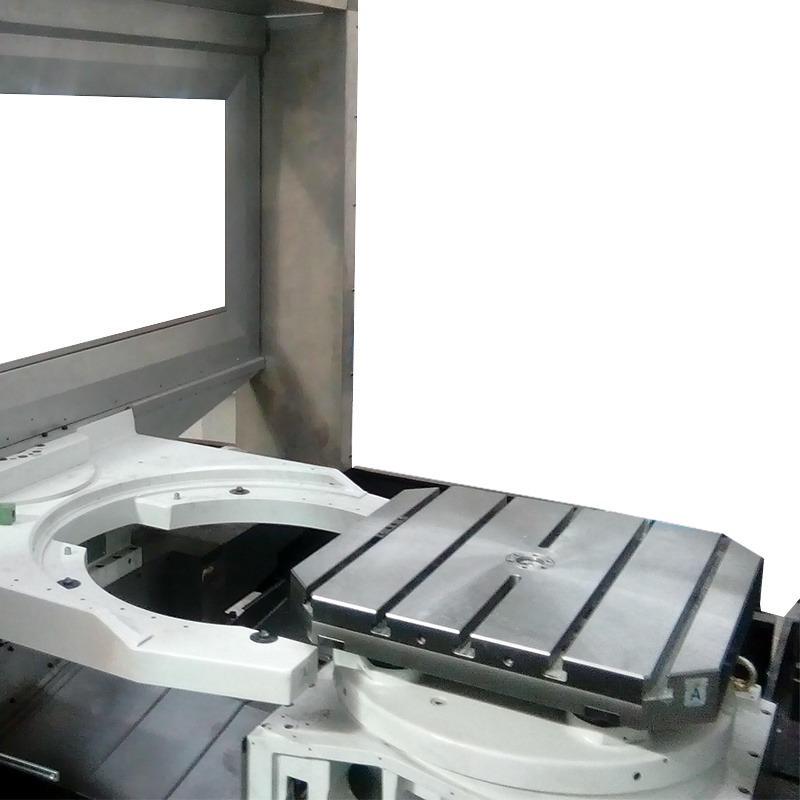
Not all 5-axis configurations suit mold making equally. Swivel-rotary tables (A/C-axis) offer better workpiece accessibility and lower inertia than spindle-tilt designs — especially important when machining large steel or aluminum mold bases weighing 800–3,000 kg. Rigidity metrics like static stiffness (≥ 45 N/µm at tool tip) and thermal drift compensation (< 5 µm over 8-hour operation) must be verified against actual test reports — not just brochure claims.
Spindle power, torque curve, and tool-change speed also impact throughput. For hardened tool steels (HRC 58–62), minimum spindle torque of 120 N·m at 3,000 rpm ensures stable roughing without chatter. Automatic tool changers with ≤ 2.8-second chip-to-chip time reduce non-cutting intervals — crucial when running multi-operation programs spanning 20+ tools.
This table reflects real-world specifications validated during factory acceptance testing (FAT). Unlike generic “maximum capacity” figures, these values represent guaranteed performance under load — measured with calibrated ballbar and laser interferometer systems per ISO 230 standards. The GH4228 series supports mold base sizes up to 500×500 mm with hydraulic clamping force ≥ 12,000 N, ensuring zero slippage during aggressive high-feed milling of P20 or H13 steel.
How to Evaluate Mold-Specific 5-Axis CNC Suppliers
Procurement teams often prioritize price or brand recognition — but mold-making ROI hinges on four measurable criteria: (1) documented thermal stability data across 8-hour shifts, (2) availability of mold-specific CAM post-processors (e.g., for Siemens NX or Mastercam Mold Tooling packages), (3) local service response time (< 24 hours for critical downtime), and (4) proven integration with metrology workflows (e.g., touch-probe inspection routines embedded in G-code).
Avoid vendors offering “5-axis capable” machines without specifying whether the B/C axes are direct-drive or belt-coupled — backlash in belt-driven systems degrades contour accuracy on freeform surfaces. Also verify if the controller supports simultaneous 5-axis interpolation (not just indexed positioning), which is mandatory for turbine blade or optical lens mold applications.
- Request FAT reports showing volumetric accuracy across full travel — not just single-point checks
- Confirm software licensing includes mold-specific modules (e.g., electrode erosion simulation, draft analysis)
- Validate that coolant pressure (≥ 12 bar) and flow rate (≥ 45 L/min) meet EDM-preparation requirements
- Assess whether the machine’s vibration damping system complies with ISO 10816-3 for industrial machinery
Why Choose Shandong VEDON for Your Next Mold-Making Investment
Shandong VEDON Intelligent Equipment Co., Ltd. is a modern high-tech enterprise integrating R&D, manufacturing, sales, and service. We specialize in providing high-quality CNC machine tools, intelligent manufacturing solutions, and precision cutting tools. Since its founding, we have adhered to the core principles of "innovation, quality, and reliability," striving to create outstanding industrial value for global customers.
Our GH4228 platform exemplifies this commitment: designed specifically for mold shops handling medium-to-large steel and aluminum tooling, it delivers precise, efficient metal cutting via hydraulic clamping, multiple blade speeds (27/45/69 m/min), and a rigid 1860×1000×1400 mm footprint. With models ranging from 280×280 mm to 500×500 mm work envelopes, the GH-series scales to your current needs while supporting future automation integration — including pallet changers and robotic loading compatible with MTConnect protocol.
We don’t stop at delivery. Every machine ships with a 3-phase commissioning plan: (1) on-site mechanical verification (72-hour run-in), (2) CAM post-processor configuration and operator training (2-day workshop), and (3) 12-month predictive maintenance scheduling based on spindle load logs and coolant analysis. This structured support reduces ramp-up time by an average of 3.2 weeks versus industry benchmarks.
Get Started Today
Contact us to discuss your specific mold-making requirements — whether you need parameter confirmation for GH4228 integration, custom work-holding solutions for asymmetric cavities, lead-time estimates for GH4250 delivery (standard: 12–14 weeks), or technical validation for ISO 13485-compliant medical mold production. Our application engineers respond within 4 business hours with actionable recommendations — not generic brochures.

Vedon
Typically replies within minutes
Any questions related to Home?

William / CEO / Brand Founder

Elaine / Sales Manager

Jaye / Sales Director