


Annular Cutters vs. Twist Drills for Magnetic Drill Holemaking
For repeated through-holes in steel plate or structural sections, an annular cutter is often the better choice for a magnetic drill, particularly as hole diameter increases. It removes a ring of metal and leaves a central slug, reducing the volume of material cut compared with a twist drill. That can shorten drilling time and reduce the thrust needed, provided the cutter, speed, lubrication, and setup suit the job.
A twist drill remains useful for smaller holes and for blind holes when the machine supports conventional drilling and provides suitable depth control. The choice starts with the hole specification, then the machine’s actual tooling capacity. A magnetic drill rated for a particular annular cutter diameter should never be assumed to accept a twist drill of the same diameter.
Start with the hole you need to leave behind
On a fabrication job involving multiple bolt-clearance holes through plate, annular cutting has a practical advantage: there is little reason to turn the entire hole volume into chips. The advantage becomes more useful as diameter increases, although the crossover depends on material, cutter geometry, machine capability, and the number of holes.
For a few small holes, a compatible twist drill may be the more convenient option. Its lower purchase cost can outweigh an annular cutter’s potential time savings, especially if the machine already has an approved chuck or spindle adapter. There is no universal diameter at which every operator should switch tools.
Blind holes change the decision. A conventional annular cutter leaves a core attached to the workpiece until breakthrough, so it is generally unsuitable when the job requires a cleared blind hole. A twist drill can produce a blind hole within the machine’s limits, but its point leaves a conical bottom. If the drawing calls for a flat bottom, a controlled bottom profile, or a close-tolerance finished bore, additional tooling or another machining process may be necessary.
Existing holes also require care. An annular cutter’s pilot pin normally helps locate the tool before its teeth engage. When enlarging an opening, that locating support may be absent. Use a cutter and guiding arrangement intended for the operation. A twist drill can also grab or chatter when enlarging a hole, particularly where little material remains for its cutting edges to engage.
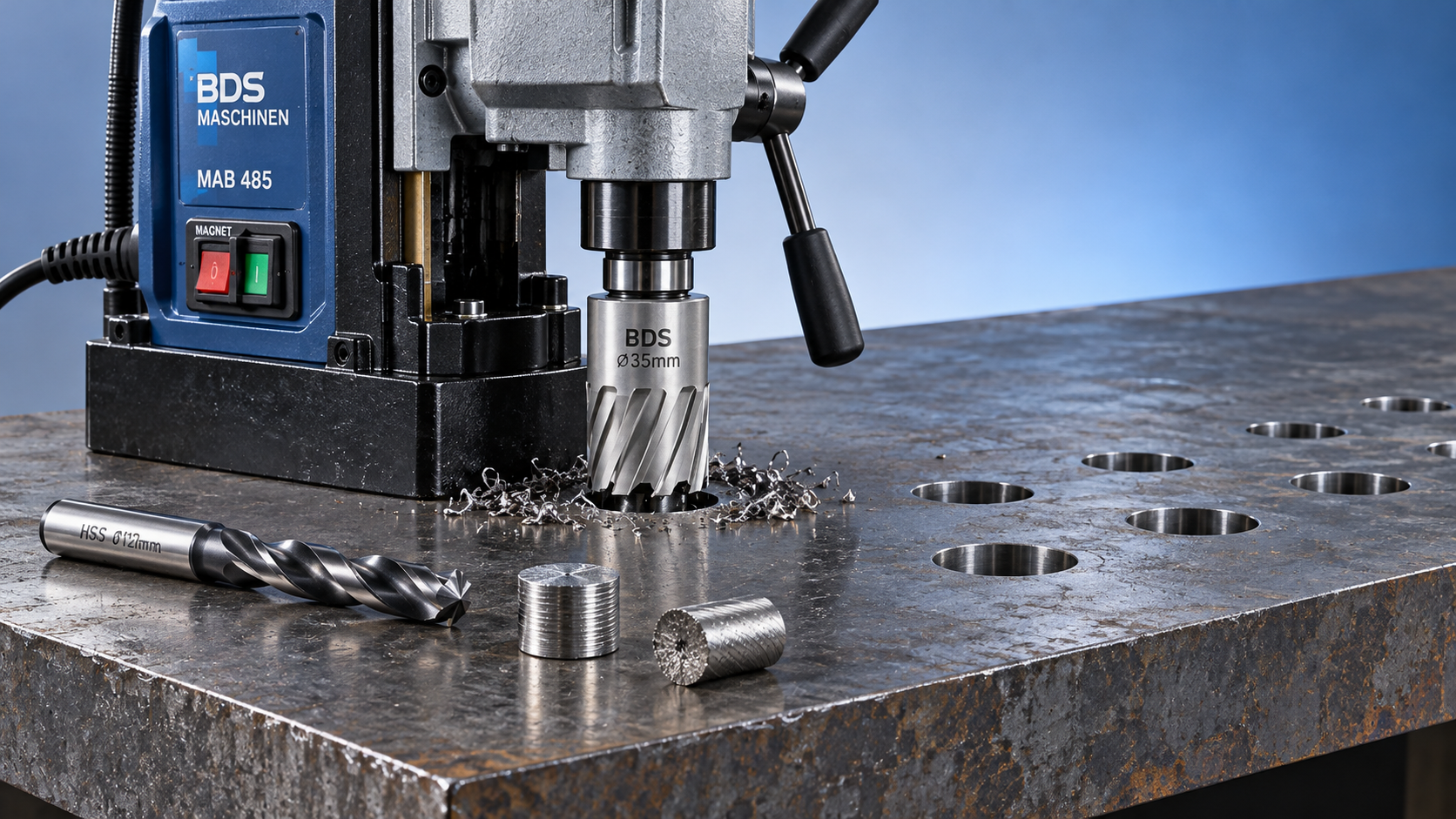
Neither tool automatically delivers a finished precision bore. Runout, tool wear, feed, and movement at the magnetic base all affect hole size and finish. For clearance holes, a clean drilled result may satisfy the drawing; for a locating or bearing fit, allow for the specified finishing operation.
Check the spindle, speed, and working space before choosing tooling
The most consequential compatibility check is whether the machine is approved for the selected tool type and diameter. Annular cutters commonly use a dedicated arbor, often with a pilot pin and a coolant path. Twist drills may require a chuck, an adapter, or a suitable taper spindle. An adapter that physically fits does not establish the machine’s drilling capacity.
Product listings can make this distinction easy to miss. For example, the VDW35 lists a 35 mm core-drilling diameter. That figure is relevant to annular cutter selection; it does not establish a 35 mm twist-drilling capacity. An operator considering conventional drilling should check the permitted spindle arrangement, twist-drill capacity, and operating instructions separately.
Speed deserves the same attention. Larger cutting diameters generally require lower spindle speeds for a given cutting speed, while material and tool grade alter the appropriate setting. Stainless steel, for instance, needs a tool and cutting conditions suited to its tendency to work-harden. A machine’s no-load speed alone does not show whether it can maintain suitable cutting conditions under load. Use the toolmaker’s recommendations within the drill’s operating limits.
Available working space can rule out an otherwise suitable tool. Check these dimensions together:
- Cutting depth: The annular cutter’s rated depth must accommodate the section being drilled.
- Feed travel: The spindle needs enough movement to position the tool, complete the cut, and withdraw it.
- Installed tool length: A chuck and twist drill can consume substantial clearance beneath the spindle.
- Exit clearance: Breakthrough requires space for the tool and, with annular cutting, the released slug.
Stroke and cutter depth are separate specifications. A machine may have sufficient feed travel yet lack the installed clearance for a particular tool assembly, especially inside a frame or beneath an obstruction.
Setup stability can outweigh the cutter’s speed advantage
Both tools depend on a stable magnetic base. Paint, scale, debris, surface curvature, and insufficient steel thickness can reduce effective holding. A published magnetic holding-force figure applies under specified conditions; it should not be treated as the available resistance on every beam, plate, or assembly.
Thin plate creates two problems: it may provide inadequate magnetic holding, and it may flex under drilling load. A backing arrangement can help only when it provides a suitable magnetic path and mechanical support. Follow the machine manufacturer’s minimum workpiece requirements and approved setup methods. Nonmagnetic materials require an appropriate approved fixture or clamping arrangement.
A twist drill’s chisel edge contributes to axial thrust, making excessive feed particularly troublesome on a marginal setup. Annular cutters can reduce thrust for larger through-holes, but their teeth still need steady engagement. Base movement, spindle play, or workpiece vibration can produce chatter and chipped cutting edges.
Stacked plates deserve a separate decision. Gaps between layers create interrupted engagement, and a retained slug can interfere with the next layer. Use annular tooling specifically suitable for stack drilling and follow its slug-removal procedure. A standard cutter intended for single-layer work should not be selected simply because its cutting depth covers the combined thickness.
During cutting, deliver the recommended lubricant to the cutting edges and maintain a controlled feed. Too little feed can cause rubbing; excessive feed can overload the tool or disturb the base. Ease the feed as breakthrough approaches. Stop the spindle before clearing chips or a retained slug, and use the specified safety restraint for the drill, particularly in vertical or overhead work. Keep people clear of the slug’s exit path.
Compare cost per acceptable hole
A twist drill’s purchase price can make it attractive for occasional work. Annular cutters become easier to justify when the job involves repeated larger through-holes and the setup allows their cutting advantage to translate into shorter cycles. The useful comparison includes positioning, drilling, chip handling, slug removal, tool changes, and rework.
Cutter life also depends on how the job is run. A more expensive tool can become costly quickly if it repeatedly encounters an unstable base, unsuitable speed, or interrupted cuts it was not designed to handle. High-speed steel and carbide-tipped annular cutters offer different combinations of toughness, cutting capability, and maintenance requirements. Select the grade for the material and operating conditions rather than treating the higher-priced option as an automatic upgrade.
For a batch of through-holes in structural steel, begin by checking whether an annular cutter covers the diameter and depth, then verify arbor fit, available speed, magnetic support, and slug clearance. For small holes or blind holes, check the machine’s approved twist-drilling arrangement and the required bottom geometry. Where either setup is uncertain, resolve that limitation before buying tooling.
Before committing a full batch, inspect the first hole for diameter, burrs, finish, and position, and watch the drill for movement or chatter during the cut. A tool that meets the drawing with stable cutting and manageable handling gives the operator a sound basis for continuing the job.

Vedon
Typically replies within minutes
Any questions related to Home?

William / CEO / Brand Founder

Elaine / Sales Manager

Jaye / Sales Director