


For a milling machine, R8 usually suits manual tool changes, while BT40 supports automated production. ISO 40 requires closer identification before compatibility can be confirmed.
The critical distinction is that matching taper size does not guarantee interchangeable tooling. Retention hardware, flange geometry, and tool changer interfaces must also match.
Technical evaluators should therefore compare the complete spindle system against cutting loads, tool change frequency, accuracy requirements, and the cost of maintaining suitable tooling.
This comparison examines geometry, retention, compatibility, and speed considerations to help buyers distinguish useful specifications from assumptions that can cause purchasing mistakes or machining problems.
For equipment discussions with Shandong VEDON Intelligent Equipment Co., Ltd., these checks provide a practical basis for specifying CNC machine tools and precision cutting tools.
What Actually Differs Between R8, ISO 40, and BT40?
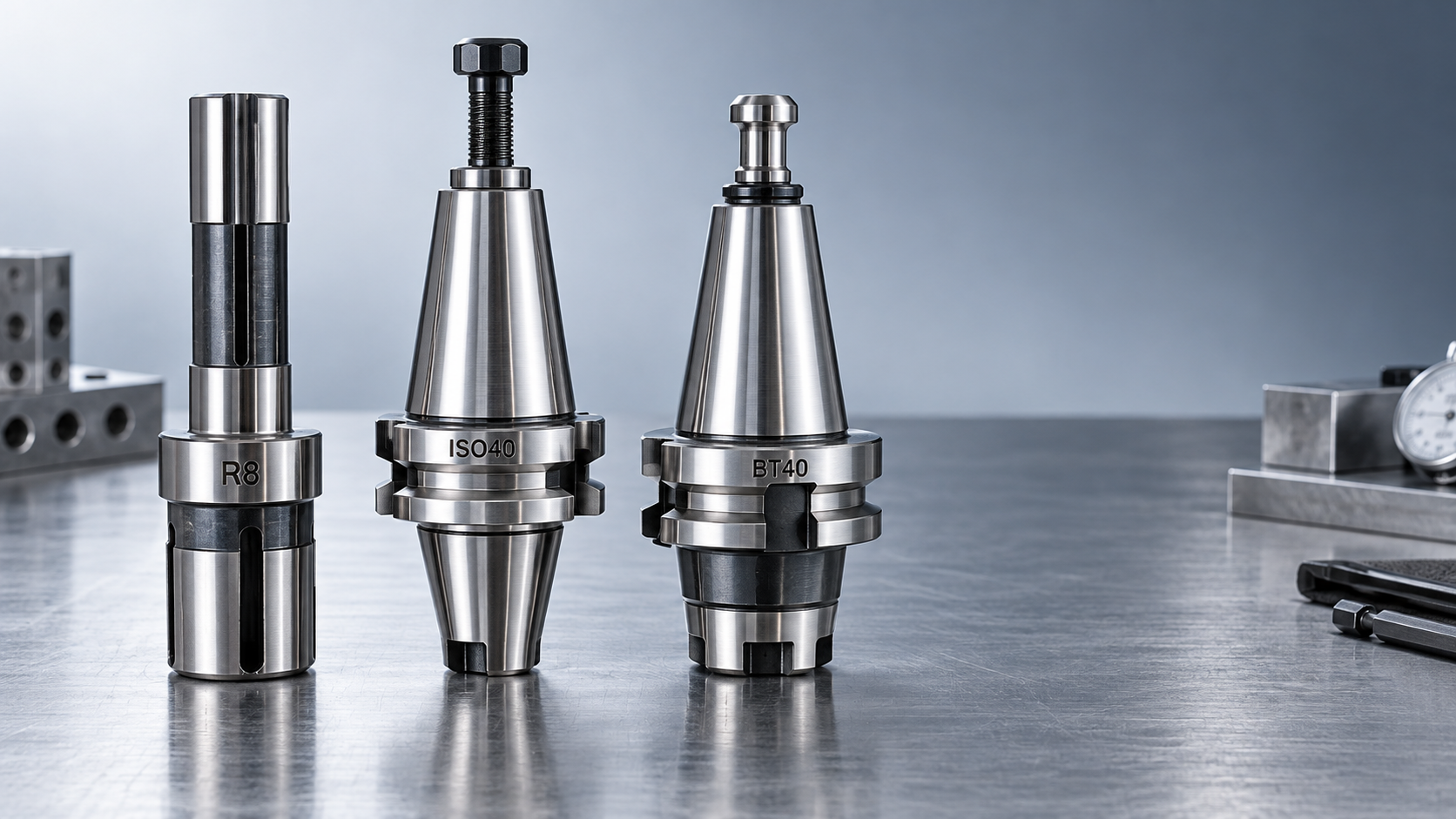
R8 uses a tapered seating section and a straight shank, with an internal thread accepting a drawbar. It is common on conventional vertical milling machines.
ISO 40 and BT40 belong to the size 40, 7:24 steep taper family. Their shared taper geometry does not establish complete holder interchangeability by itself.
The term ISO 40 can describe different tooling arrangements in commercial specifications. Ask which standard, flange design, and retention method the machine actually requires.
BT40 commonly follows the MAS 403/JIS B 6339 interface family. A purchase specification should identify the applicable standard and machine requirements rather than shorthand alone.
Can Existing Toolholders Transfer to the New Milling Machine?
Do not approve a machine purchase based only on whether an existing holder enters the spindle. Seating, retention, and automatic handling require separate confirmation.
A holder can share the correct taper while having an incompatible flange or pull stud. Such mismatches can prevent secure clamping or reliable tool changes.
For example, DIN 2080 size 40 tooling commonly uses a threaded drawbar arrangement. DIN 69871 and BT tooling use different flange and retention configurations.
CAT40 also shares the size 40 steep taper, but its flange and retention details differ from BT40. Treat conversion claims as requiring documented verification.
Request a spindle interface drawing and an approved pull stud drawing. Compare threads, stud head geometry, flange dimensions, and changer engagement features before ordering.
For R8, confirm the drawbar thread, available drawbar engagement, and holder condition. Regional tooling variations make thread assumptions particularly risky when purchasing imported equipment.
Inventory existing holders by exact designation and usable condition. Include replacement pull studs, presetting equipment, storage, and inspection costs when estimating tooling migration expenses.
Which Interface Provides Better Rigidity and Accuracy?
For demanding milling, a size 40 system generally offers greater tooling stiffness potential than R8. Actual performance still depends on the complete machine construction.
Spindle bearings, spindle projection, holder design, cutter diameter, and tool overhang influence deflection. A larger taper cannot compensate for excessive reach or weak workholding.
R8 remains practical for moderate cuts, repair work, and varied toolroom operations. Its suitability should be established against actual materials and expected metal removal rates.
Standard BT40 and other conventional steep taper systems primarily locate through taper contact. Do not assume the holder flange also contacts the spindle face.
Dual contact configurations require compatible spindle and holder designs. Their potential benefits should be evaluated using the specific manufacturer's specifications and a representative cutting trial.
Accuracy should be measured at the cutting tool, with the intended holder and overhang. Spindle runout alone does not describe the complete assembled system.
Request measurements after repeated tool changes and after thermal stabilization. This reveals whether seating consistency and operating temperature support the required dimensional tolerances in production.
Does BT40 Automatically Mean Higher Spindle Speed?
No universal maximum speed follows from the BT40 designation. The permitted speed depends on the spindle assembly and the entire rotating tool and holder combination.
Evaluate holder balance, cutter ratings, pull stud requirements, bearing specifications, and tool overhang. The lowest applicable limit governs the safe operating range for that setup.
Ask suppliers to state balancing conditions, including assembly configuration and intended speed. A balance grade without those details provides limited guidance for application approval.
For heavy roughing, available torque at the cutting speed may matter more than maximum revolutions. Review the spindle power and torque curves alongside interface selection.
For sustained high speed finishing, assess thermal behavior and vibration through trial cuts. Compare surface finish and dimensional drift over a realistic production cycle.
How Much Do Tool Changes Affect Production Economics?
R8 can be economical where operators change tools infrequently and work varies substantially. Lower tooling expenditure may outweigh slower changeovers in repair and prototype environments.
BT40 becomes attractive when repeated cycles use multiple tools and automatic changes reduce operator involvement. The benefit depends on actual cycle structure and machine reliability.
Estimate annual savings by multiplying time saved per tool change by changes per part and annual volume. Convert recovered time using a realistic machine hourly rate.
Then compare those savings with additional holders, maintenance, pull studs, and inspection costs. Include setup time and rejected parts where reliable production data exists.
For unattended operation, verify tool magazine capacity, maximum tool weight, adjacent pocket restrictions, and supported tool dimensions. These limits can constrain an otherwise suitable spindle.
When Should a Separate Drilling Solution Be Considered?
Some industrial metalwork requires drilling directly on large steel structures. Moving those components onto a milling machine may add handling time without improving the operation.
The VD23RE magnetic drill offers a listed 23 mm maximum drilling diameter, 1500 W rated power, and an adjustable no-load speed of 0–450 r/min.
Its listed magnetic holding force is 13,500 N. Actual holding depends on suitable ferromagnetic material, plate thickness, surface condition, and compliance with the operating instructions.
Evaluate this equipment as a separate drilling option; the supplied specifications do not establish R8, ISO 40, or BT40 spindle compatibility for this product.
What Should Technical Evaluators Specify Before Ordering?
Build the acceptance specification around representative operations: material, cutter diameter, engagement, overhang, tolerance, surface finish, and expected cycle time. Then identify the required spindle interface.
Require documented holder compatibility, pull stud details, clamping requirements, speed limits, and changer restrictions. Request cutting demonstrations that reproduce the intended production conditions closely.
Choose R8 for suitable manual work, and evaluate BT40 for automated production. Treat ISO 40 as incomplete information until its exact interface is confirmed.
The best milling machine purchase combines verified tooling compatibility with sufficient stiffness, useful torque, repeatable accuracy, and tool change economics that match the workload.