When a Vertical Machining Center Delivers ROI in Batch Metal Production
A vertical machining center delivers a credible return on investment in batch metal production when it removes a recurring constraint: unstable cycle times, excessive changeover work, outsourced machining, avoidable scrap, or limited capacity during peak order periods. The purchase is harder to justify when parts are low-volume, highly varied, simple enough for conventional equipment, or poorly standardized before reaching the shop floor.
The key question is not whether a Vertical machining center is faster than an existing machine. It is whether its higher spindle utilization, repeatability, automation potential, and process consolidation can create a durable reduction in cost per acceptable part. For a capital-intensive asset, ROI comes from production economics over its usable life, not from an impressive maximum travel, spindle speed, or catalogue cycle-time claim.
Batch size alone does not determine the investment case
Batch production is often treated as a straightforward reason to buy CNC capacity. That is incomplete. A batch of 200 parts can be unsuitable for a machining center if it requires extensive manual handling, inconsistent raw material, frequent engineering changes, or special fixtures that take longer to prepare than the machining time saved. Conversely, recurring batches of 20 to 50 complex parts can support the investment if the components share a similar setup logic and the machine can be kept productively loaded across several part families.
The strongest cases generally have a combination of repeatability and variation. Parts may change in dimensions, hole patterns, or machining features, but they use a stable material range, similar workholding approach, and a known sequence of milling, drilling, tapping, boring, or contouring operations. A vertical machining center can then reduce the number of separate setups and transfer operations without becoming dedicated to only one SKU.
Decision-makers should distinguish between “batch demand” and “machine-ready batch demand.” Machine-ready demand means released drawings are stable, tooling is available, material specifications are controlled, and the production route is sufficiently repeatable to program and fixture with confidence. Without these conditions, a new machine may simply expose existing planning and engineering weaknesses more clearly.
Where the financial return actually comes from
Labor savings are visible, but they are rarely the only or even the largest source of return. The more meaningful gains often arise from process compression. A part previously moved among a drill press, manual mill, tapping station, and inspection bench may be completed in fewer handling stages on one machine. Each eliminated handoff reduces queue time, positioning error, paperwork, and the risk of damage between operations.
Cycle consistency matters as much as average cycle speed. Manual processes can produce a reasonable average output while still creating wide variation between operators, shifts, and batches. That variation makes delivery commitments unreliable and forces management to carry extra time in schedules. A well-programmed machining center does not eliminate all variance—tool wear, material behavior, fixture condition, and programming quality still matter—but it can make the process substantially more predictable.
Quality-related savings must also be calculated realistically. Tighter tolerances are valuable only if the customer’s specification and the part’s function require them. The financial benefit comes when repeatable positioning prevents rework, reduces inspection burden, or avoids rejection of high-value parts. Buying a high-specification machine to achieve accuracy beyond the actual tolerance requirement can lengthen payback rather than improve it.
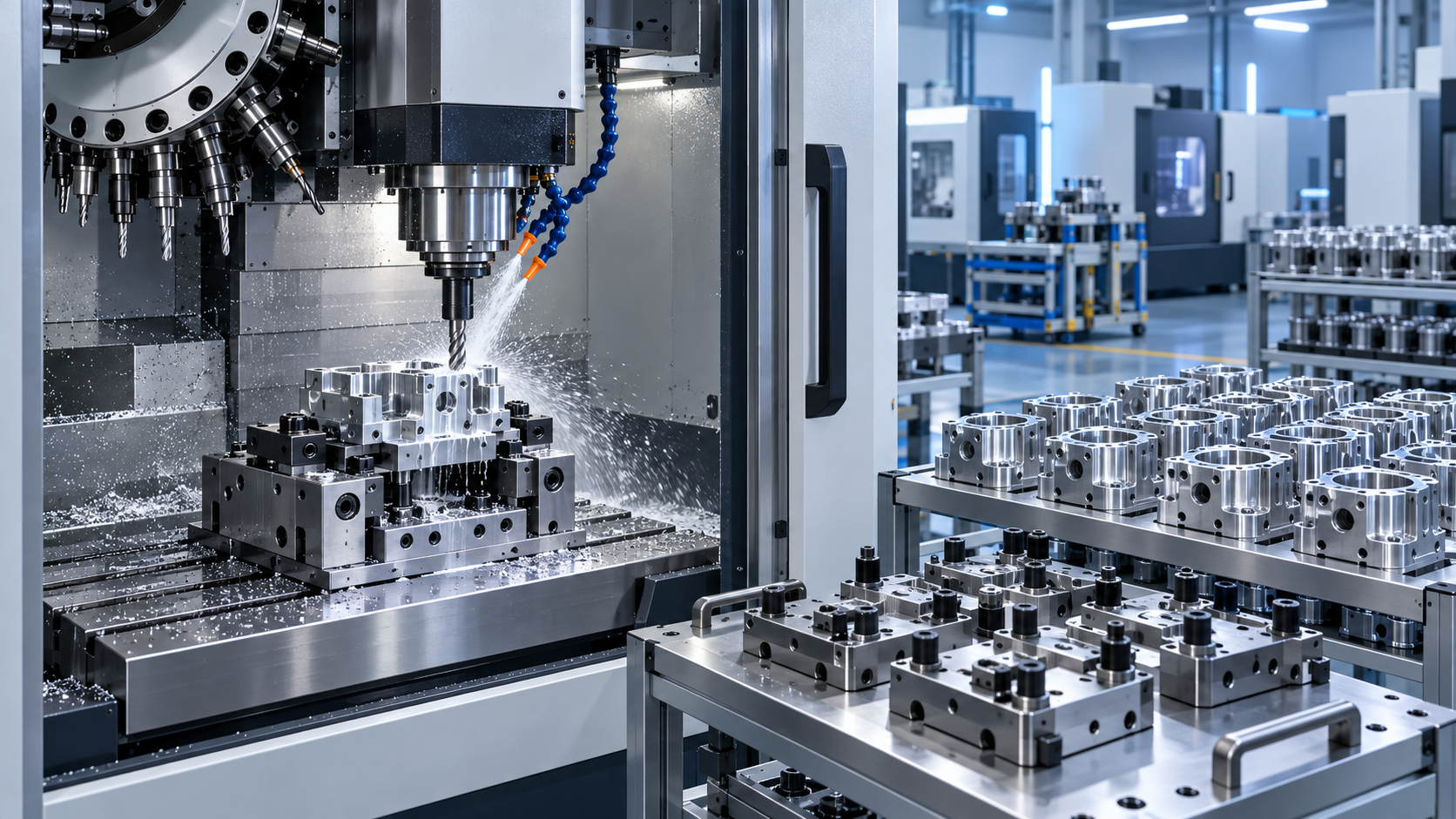
A practical ROI model should include more than the machine purchase price. Capital cost is only one component. The investment case should account for:
- machine, control options, tooling, workholding, probing, chip management, and installation;
- operator and programmer training, plus the time required to stabilize initial production;
- electrical supply, compressed air, foundation or floor-load requirements, and material flow changes;
- preventive maintenance, consumables, coolant, tooling replacement, and expected service response;
- the cost of downtime during commissioning and the cost of lost production if the machine becomes a bottleneck;
- reduced outsourcing, lower setup labor, improved throughput, less scrap, and any incremental contribution margin from additional capacity.
The calculation should use contribution margin rather than booked sales value when estimating revenue-related gains. Extra machine capacity has economic value only when the business can convert it into profitable orders or protect existing profitable work that would otherwise be delayed or subcontracted.
Utilization is the decisive variable, but it is often misunderstood
A machining center does not need to run without interruption to earn its cost back. It does, however, need a believable workload after allowing for setups, tool changes, programming, maintenance, inspection, material waiting time, and operator availability. A plan based solely on nominal spindle hours can be misleading because the spindle is only productive after the entire production system is ready.
Low utilization is especially expensive when the machine was selected for a narrow part type. If demand softens for that component, the asset may have few alternative jobs. A more flexible configuration can be preferable even if its initial price is higher, provided it can machine several recurring families of prismatic parts. Travel dimensions, table load, spindle torque, tool magazine capacity, coolant delivery, and controller capability should be selected from the likely work mix, not from one unusually large drawing.
There is also a difference between utilization and productive utilization. Running the machine on poorly optimized programs, excessive air cuts, unstable fixtures, or frequent manual intervention can create the appearance of full capacity while leaving cost per part high. Before approving a purchase, it is useful to review a representative routing: actual cutting time, loading time, probing or inspection time, tool-change count, deburring needs, and the number of interventions required per cycle.
Setup reduction is often more valuable than peak cutting performance
For recurring batches, setup time can consume a large share of available capacity. A machine that completes a part quickly but needs lengthy re-indication, manual alignment, and tool preparation for every job change may not improve overall economics. The better investment is often the one supported by practical fixturing, stored offsets, standardized tools, repeatable locating surfaces, and programs that can be reused with limited revision.
This is why workholding should be included in the capital decision rather than treated as an afterthought. Fixtures determine whether repeatability survives beyond the first approved batch. If a component requires multiple orientations, the business should assess whether a simple vise arrangement is sufficient, whether dedicated fixtures are justified, or whether the expected volume supports additional-axis capability. The answer can materially change both the acquisition cost and the payback period.
Tooling strategy has similar importance. A vertical machining center may combine drilling, thread milling, tapping, roughing, and finishing operations, but each process requires a controlled tool-life plan. Tool breakage, uncontrolled wear, and inconsistent presetting can erase the expected cycle-time advantage. The procurement decision should therefore include tool availability, local technical support, replacement lead times, and the ability to source compatible holders and cutting tools without dependency on a single channel.
Do not use a machining center to solve the wrong production problem
A VMC is not automatically the best answer for every hole-making or secondary-machining requirement. Large fabricated structures, site work, and parts that cannot be economically moved to a machine table may require portable or magnetic drilling equipment instead. For example, a VDD40 magnetic drill is intended for industrial drilling tasks where mobility and magnetic holding are relevant. It is not a substitute for the controlled multi-axis positioning, enclosed machining environment, and repeatable milling capability expected from a vertical machining center.
The distinction matters because misallocated capital is a common source of disappointing ROI. If the real constraint is material cutting, welding distortion, poor drawing release discipline, slow inspection approval, or a shortage of skilled programmers, adding CNC capacity alone will not resolve it. The machine may increase upstream demand for properly prepared blanks and downstream demand for inspection and deburring, shifting rather than removing the bottleneck.
Supplier evaluation should focus on operating risk, not only machine specification
Comparable headline specifications do not guarantee comparable lifetime value. Service access, commissioning competence, spare-parts availability, control-system familiarity, documentation quality, and application support can have a larger effect on uptime than a small difference in quoted spindle speed. Buyers should clarify who performs installation, what training is included, how warranty claims are handled, which critical spares can be supplied quickly, and whether remote diagnostics are available for the chosen control.
Acceptance criteria should be agreed before shipment. These may include geometric accuracy verification, test cutting on a representative material, repeatability expectations, documented machine configuration, safety provisions, and confirmation that the selected tooling and fixtures are compatible with the delivered machine. A vague acceptance process creates avoidable disputes after installation, when production pressure is already high.
The most defensible investment case is built around a constrained set of recurring parts, a documented production route, and conservative assumptions about usable capacity. When a vertical machining center can replace several unstable operations, shorten changeovers, protect quality, and remain flexible enough to serve future part families, it becomes a production asset rather than a fixed overhead. When those conditions are absent, improving routing, tooling, fixtures, or planning discipline may produce a better return before committing to the machine itself.

Vedon
Typically replies within minutes
Any questions related to Home?

William / CEO / Brand Founder

Vinson / Sales Director

Elaine / Sales Manager

Jessica / Sales Manager