5 Vertical Machining Center Specifications Buyers Should Verify First
A vertical machining center can meet the same headline dimensions as another machine and still produce very different results in cycle time, surface finish, tool life, and maintenance cost. For procurement teams, the first comparison should therefore be based on the specifications that define how the machine will behave under the intended cutting load, not on list price or spindle speed alone.
The right machine is the one that can machine the actual part family with sufficient margin: enough travel for fixtures and tool access, enough table capacity for the workpiece and workholding, enough spindle torque for the material, and enough structural stability to hold tolerance throughout a shift. The following five checks usually reveal whether a quoted machine is genuinely suitable.
1. Verify usable travel, not just nominal X, Y, and Z stroke
Travel figures are often the first numbers buyers compare. They matter, but the published X, Y, and Z values do not automatically describe the usable machining envelope.
A part may fit within the table dimensions yet still be difficult or impossible to machine if the fixture consumes too much Z-axis clearance, if a long tool holder reduces reach, or if access to a side feature requires repositioning. Buyers should review the complete stack-up: table surface to spindle nose, maximum workpiece height, fixture height, tool projection, and the clearance required for safe rapid movement.
This is particularly important for castings, plates with multiple setups, and parts requiring fourth-axis fixtures. A machine with slightly smaller nominal travel but better spindle-nose clearance may be more practical than a larger model with a restrictive vertical envelope.
- Request a layout drawing showing the workpiece, fixture, vise or pallet, and longest expected tool.
- Check whether all critical features can be reached in one or two setups.
- Allow room for clamp access, probe movement, chip evacuation, and tool-change clearance.
- Review table-to-column clearance at the extreme axis positions, not only at center travel.
Reducing setups can often justify a higher machine cost because it removes handling time and reduces the chance of positional error between operations.
2. Match spindle performance to the material and cutting strategy
Spindle speed is easy to quote, but torque and power delivery across the operating range are often more useful purchasing criteria. High maximum rpm supports small-diameter tools and finish work. It does not by itself show whether the machine can maintain productive metal removal with larger end mills, drills, or face mills.
For aluminum parts with small tools, a high-speed spindle may be appropriate. For steel, stainless steel, forged material, or interrupted cuts, buyers should examine the torque curve at the rpm range used by their common tools. A spindle that performs well at the top of its speed range may offer limited cutting force at lower rpm, where heavier drilling and milling operations take place.
Ask suppliers to clarify the spindle’s continuous and short-duration power ratings, torque characteristics, transmission type, tool interface, and cooling arrangement. The machine should also be assessed with the intended toolholder system. Toolholder quality, pull-stud design, balancing, and clamping force all influence repeatability and finish quality.
Some drilling work does not require a machining center at all. For localized holes in fabricated steel where positional tolerance and secondary milling are limited, a portable magnetic drill such as VDG35 (Vitality Orange) may be more economical than tying up CNC capacity. Its stated 50 mm drilling capacity and compact format suit a different operating model. The comparison is useful because it forces procurement teams to separate simple drilling demand from parts that genuinely need multi-axis CNC control, programmed positioning, and finish machining.
For a vertical machining center, spindle selection should be based on a representative operation sheet: material grade, tool diameter, depth of cut, width of cut, target cycle time, and expected daily utilization. That discussion is more revealing than comparing maximum spindle rpm alone.
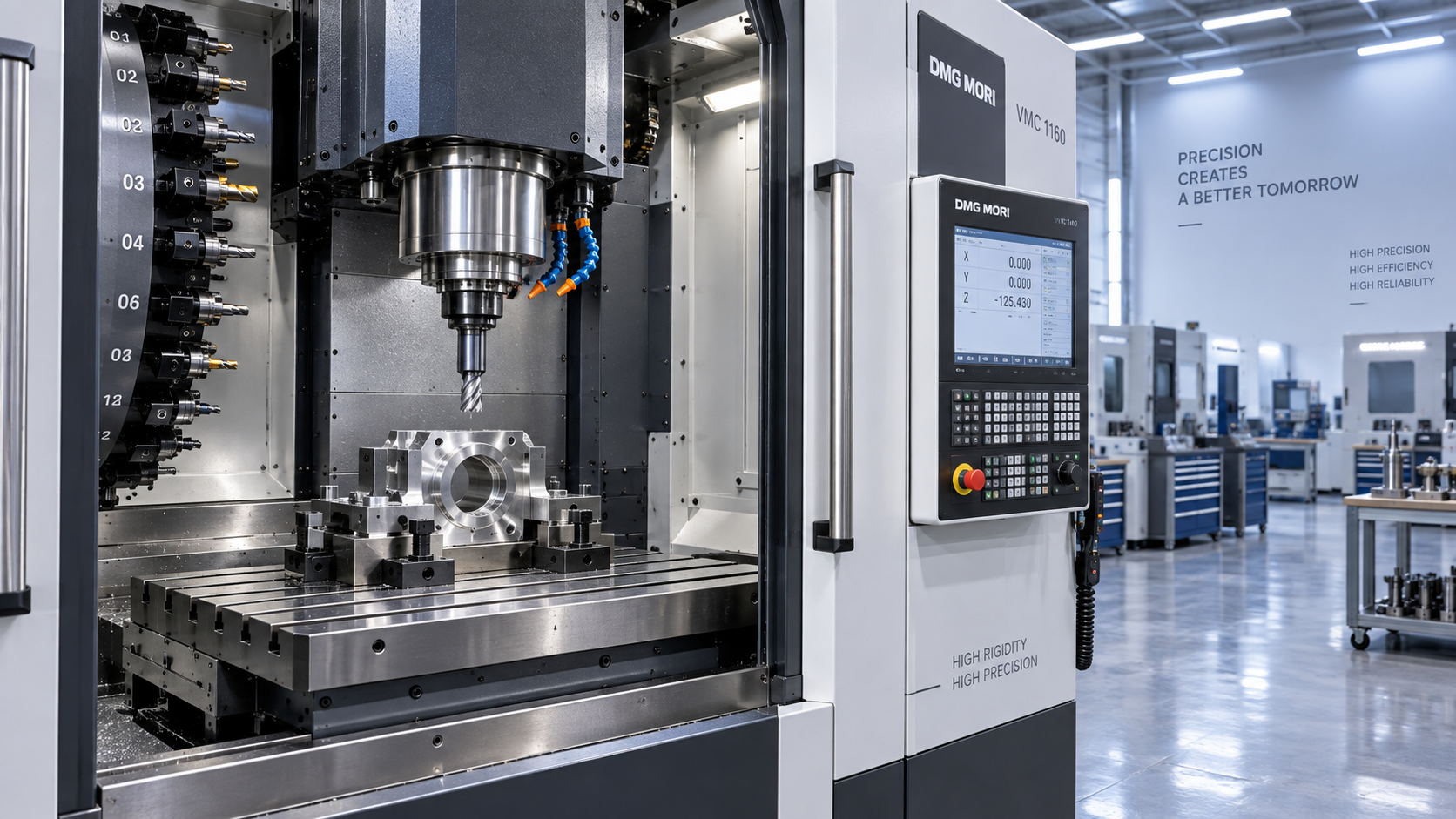
3. Treat table load and workholding as a combined specification
Table load is frequently misunderstood as the maximum part weight. In practice, the machine must carry the workpiece, fixture, vise, locating blocks, clamps, rotary device if used, and sometimes a tombstone or hydraulic system. The load position matters as well. A centrally located compact part creates a different demand from a long fixture extending toward the table edge.
Buyers should ask how the rated table load is defined and whether it applies under static conditions, during axis movement, or during machining. A machine may support a given static load while still losing dynamic performance when rapid moves, acceleration, and cutting forces act on an offset fixture.
Table dimensions and T-slot arrangement should be checked against the actual workholding plan. A large table is of limited value if the slot spacing complicates fixture mounting or if the clamping pattern prevents access to the areas that need machining. For repeat work, consider whether a standardized fixture plate or zero-point clamping system will improve changeover time.
4. Look beyond positioning accuracy to rigidity and thermal behavior
Catalog accuracy values are important, but they should not be read as a guarantee of finished-part accuracy. The final result also depends on column stiffness, spindle bearing condition, ballscrew support, guideway design, servo tuning, foundation quality, ambient temperature, coolant temperature, and the part’s own stability.
Rigidity becomes visible when the machine is asked to remove material consistently. Insufficient structural stiffness can show up as chatter marks, shortened tool life, dimensional drift, poor bore quality, or the need to reduce feeds and depths of cut. Those symptoms raise cost even when the machine remains technically capable of completing the part.
Rather than relying only on a single positioning figure, procurement teams should request test conditions for accuracy claims and ask what compensation functions are included in the control. Ballbar reports, sample cutting results, and machine geometry documentation can be useful where tolerances are demanding. The goal is not to demand laboratory-level perfection for every application; it is to establish whether the quoted performance is relevant to the parts being purchased for.
Thermal stability deserves equal attention for long unattended cycles or production work. A machine that shifts dimensionally after warm-up may still be acceptable for general fabrication, while precision housings, valve bodies, and close-tolerance mold components may require stronger thermal management and a defined warm-up procedure.
5. Check tool-changing capacity in relation to the real process plan
Tool magazine size affects more than convenience. If the machine cannot hold the tools needed for a part family, operators may spend time loading tools between jobs, altering programs, or accepting extra setups. That reduces the practical advantage of automation.
Start with the complete tool list, including drills, spot drills, taps, end mills, reamers, boring tools, chamfer tools, probes, and duplicate tools used to protect unattended production. Then allow space for tools that may be required as part designs change. A 24-tool magazine can be sufficient for straightforward prismatic parts; it can become restrictive when multiple hole sizes, tight bores, and finishing operations are involved.
Tool-change time should be considered alongside magazine capacity, but cycle time savings must be viewed realistically. On long roughing cycles, a small difference in tool-change seconds may have little effect. On high-volume parts with many short operations, it can matter. Also confirm the maximum tool diameter, tool length, and tool weight permitted in adjacent magazine pockets. Large boring heads or long drills may reduce usable magazine capacity even when the nominal tool count appears adequate.
Turn the quotation into an application check
Before selecting a machine, ask each supplier to respond to the same part-based requirement: drawings or representative dimensions, material, annual volume, tolerance-critical features, preferred workholding, cycle-time objective, and planned shifts. The most useful quotation will identify any assumptions around tooling, fixture weight, spindle duty, coolant, electrical supply, installation, and acceptance testing.
A lower purchase price can become expensive when it forces additional setups, limits cutting parameters, or leaves insufficient tool capacity for the intended work. Conversely, paying for excessive travel, spindle speed, or automation can be difficult to justify when the part mix does not use it. The five specifications above give buyers a practical way to separate necessary capability from impressive but unused capacity.

Vedon
Typically replies within minutes
Any questions related to Home?

William / CEO / Brand Founder

Vinson / Sales Director

Elaine / Sales Manager

Jessica / Sales Manager