Assessing VMC650 ROI Before Expanding an In-House Machining Department
Before expanding an in-house machining department, decision-makers need more than a machine quotation. They need a credible view of capacity, labor, quality risk, outsourced-part costs, and the point at which a new VMC650 begins to pay for itself. The question is not simply whether a vertical machining center can produce a part. It is whether bringing that work inside will create a more controllable, profitable production system.
For many manufacturers, outsourcing works well during early growth. It avoids capital expenditure and gives access to specialist capability. The pressure usually appears later: suppliers extend lead times, design revisions become expensive, quality issues take longer to resolve, and urgent orders disrupt the production schedule. A VMC650 can be a practical bridge between outsourced machining and a larger automated machining cell—but only when its workload, technical fit, and operating model are evaluated honestly.
Start the VMC650 ROI Review with the Parts, Not the Machine
The strongest investment case begins with a 12-month review of parts currently purchased from outside machine shops. Separate them into recurring production parts, low-volume repeat parts, prototypes, repair components, and one-off jobs. A VMC650 generally creates its clearest return on parts with repeatable demand, manageable setups, and dimensions suited to its working envelope.
For a typical VMC650 configuration, the X/Y/Z travel may be around 600 × 500 × 500 mm, with an approximately 800 × 500 mm worktable and a 400 kg loading capacity. Those figures are useful starting points, but they should not be treated as the final decision criterion. The real question is whether the largest workpiece, fixture, cutter projection, and required tool approach can fit safely without compromising access or rigidity.
Build a part-family list and record the following for every candidate:
- Annual quantity and forecast stability;
- Current outsourced unit cost, freight, inspection, and rework cost;
- Material type, stock form, and expected metal-removal rate;
- Number of setups, required tooling, and estimated cycle time;
- Tolerance, surface-finish, and inspection requirements;
- Revenue or operational impact when the part is delayed.
This exercise often changes the conversation. A low-cost outsourced part may still be a poor first in-house candidate if it requires frequent setups and limited quantities. Conversely, a modest component used every week may carry hidden value because it reduces purchasing administration, waiting time, and production interruptions.
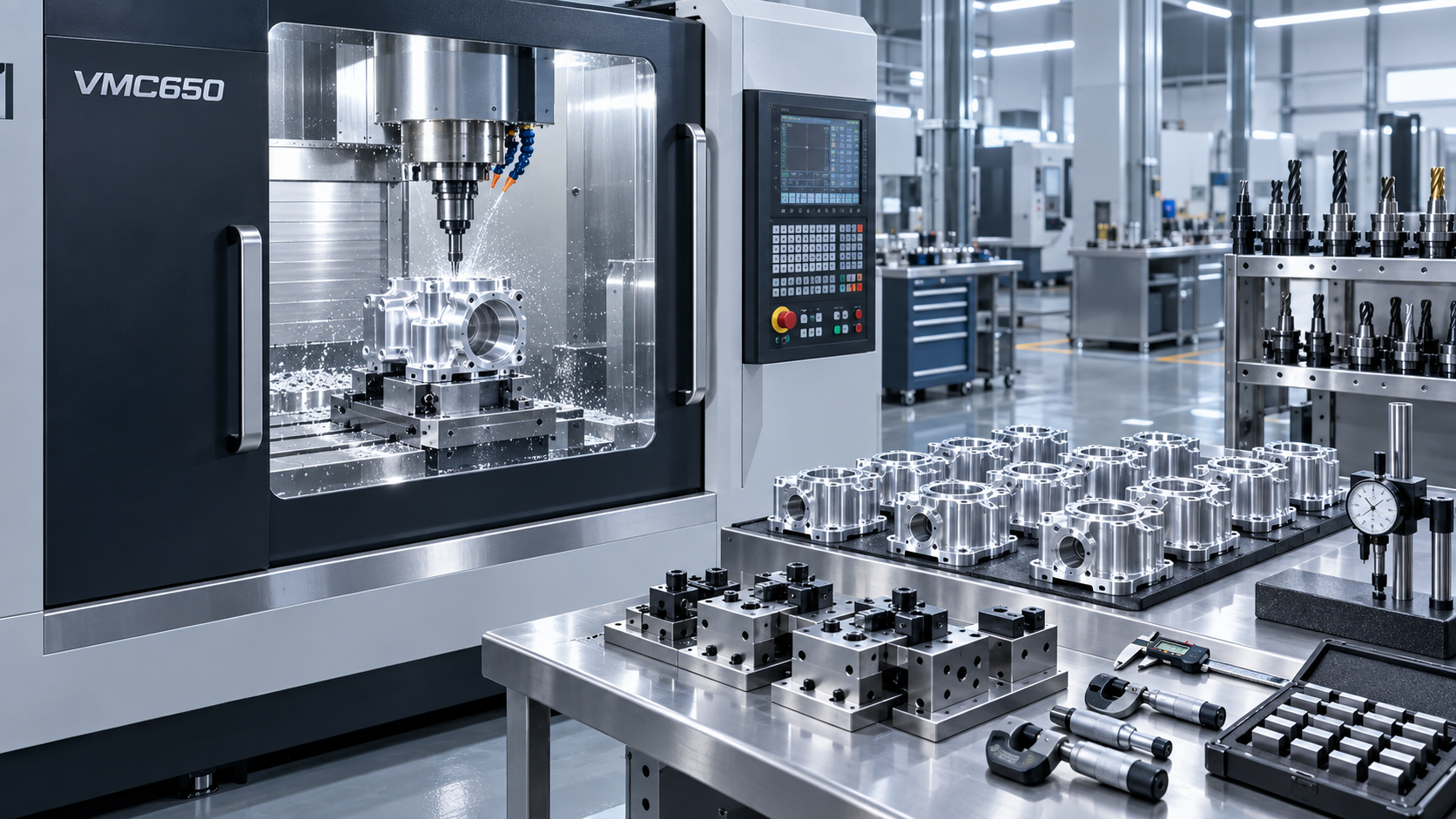
Calculate the Fully Loaded Cost of In-House Machining
A common ROI mistake is comparing a supplier’s invoice price with only the machine’s purchase price. In-house machining has a wider cost base. Capital cost is important, but it is only one part of the calculation.
Your annual ownership and operating estimate should include the machine investment, freight and installation, electrical and air preparation, foundations where required, workholding, cutting tools, CAM software or programming resources, operator training, preventive maintenance, utilities, and inspection capacity. Include the expected cost of downtime as well. A machine with no trained operator or no prepared tooling is not productive capacity.
A practical calculation can be expressed as:
Annual net benefit = avoided outsourcing cost + savings from shorter lead times and lower rework − annual in-house operating cost
Then:
Simple payback period = total initial investment ÷ annual net benefit
Use conservative assumptions. For example, do not assume every available shift will be billable machining time. Account for setup, prove-out, tool changes, inspections, material handling, preventive maintenance, and periods when the machine is waiting for programs or material. For early-stage in-house operations, planned utilization is often more realistic than optimistic utilization.
Decision-makers should also test three scenarios: a cautious case with lower demand and longer setup times, a base case aligned with current orders, and a growth case that includes new work won through faster response. If the VMC650 only makes sense under the most aggressive scenario, the investment may need a phased approach rather than an immediate purchase.
Precision Is an Economic Variable, Not Just a Specification
Machining accuracy matters because variation has a cost. It may lead to scrap, secondary fitting, additional inspection, rejected assemblies, or difficult conversations with customers. For parts that need consistent hole locations, profiles, pockets, or mating surfaces, repeatability can be as commercially important as top-end positioning accuracy.
When reviewing a machine, examine the mechanical foundation behind the published figures: bed construction, guideway design, ball screws, servo system, spindle behavior, and thermal stability in the intended environment. A one-piece cast bed, high-precision ball screws, and servo drives can support stable processing of complex curved surfaces and thin-walled parts, provided that tooling, fixtures, programming, and operator practice are equally disciplined.
VEDON’s VMC platform is designed around this broader production need. A configuration with positioning accuracy stated at ±0.003 mm and repeatability at ±0.004 mm may be relevant for manufacturers seeking more predictable dimensional control. However, buyers should validate accuracy under realistic cutting conditions and with their own representative parts, rather than relying on specification sheets alone.
Capacity Planning: Avoid Buying for Today’s Bottleneck Only
A VMC650 should relieve a constraint, not create a new one. If the current bottleneck is external machining lead time, bringing selected parts in-house may immediately improve responsiveness. But if programming, inspection, deburring, or material preparation is already constrained, the machine may simply move the queue downstream.
Map the full route of a typical part: material receipt, cutting, fixturing, machining, deburring, measurement, cleaning, and assembly release. This reveals whether the proposed machining center will operate as a stand-alone asset or as part of a capable internal process.
The 10,000 rpm belt-driven spindle and BT40 tooling commonly associated with this machine class can suit a wide range of general mechanical components in steel, aluminum, cast iron, and engineering plastics. A tool magazine with 16 or 24 positions may also reduce manual intervention on parts requiring multiple operations. Yet a faster spindle or rapid traverse does not automatically create more output if setups remain slow. For mixed, low-volume work, investment in modular fixtures and offline programming can produce as much value as a small reduction in cycle time.
When a VMC650 Is the Right Scale—and When It Is Not
The VMC650 is often a sensible choice for companies machining medium-sized components, fixtures, plates, housings, brackets, and repeat mechanical parts. It can offer a manageable entry point for an internal CNC department without committing floor space and capital to a much larger platform.
It may be the wrong choice if the business regularly machines oversized workpieces, requires heavy-duty cutting torque, needs five-axis access, or anticipates rapid growth into large structural components. In those cases, evaluating a larger travel model early may prevent a costly second purchase. For example, companies comparing future capacity requirements can review the broader VMC1580 platform alongside smaller models, especially where longer X-axis travel or larger worktables are becoming part of the product roadmap.
That does not mean “bigger” is always better. Oversizing can increase capital exposure, floor-space demands, power requirements, and idle capacity. The best machine is the one that covers the profitable part mix with enough margin for fixtures, tool access, and reasonable growth.
A Purchase Decision Should Include a Readiness Check
Before issuing a purchase order, ask whether the organization is ready to operate the VMC650 as a production asset. Who will program new parts? Who owns tool-life monitoring? Is there a calibrated inspection process? What happens when an urgent job interrupts the planned schedule? Who will maintain the machine and manage spare consumables?
Also request a meaningful technical discussion with the supplier. Share part drawings under appropriate confidentiality controls, clarify material grades and tolerances, confirm machine options, and ask what is included in commissioning and after-sales support. Shandong VEDON Intelligent Equipment Co., Ltd. combines CNC machine tools with intelligent manufacturing and precision cutting tool capabilities, which can be useful when buyers need to consider the machine, tooling, and process requirements together rather than as disconnected purchases.
Ultimately, VMC650 ROI is not measured only by monthly spindle hours. It is reflected in shorter and more reliable lead times, fewer quality escapes, stronger control over engineering changes, and the ability to respond when a customer needs an answer quickly. When those gains are supported by a realistic cost model and a qualified part pipeline, expanding in-house machining can become a disciplined business decision rather than a hopeful capital purchase.

Vedon
Typically replies within minutes
Any questions related to Home?

William / CEO / Brand Founder

Jaye / Sales Director