Choosing a Vertical Milling Machine for Steel, Aluminum, and Mold Work
Choosing a Vertical Milling Machine for Steel, Aluminum, and Mold Work
Choosing a Vertical Milling Machine is rarely a matter of selecting the largest table, the highest spindle speed, or the lowest quoted price. For procurement teams, the more useful question is whether the machine will hold accuracy, maintain a stable cycle time, and remain serviceable across the actual mix of parts the shop expects to run.
That question becomes more demanding when one machine must cover steel components, aluminum parts, and mold work. These materials place different demands on the spindle, structure, coolant system, tooling, and CNC control. A machine that performs well in high-speed aluminum machining may not be the right choice for deep steel cuts. Likewise, a robust general-purpose machining center may still fall short on surface finish and contour control for precision mold cavities.
The right decision starts with the workpiece, not the brochure. Before comparing machine models, buyers should gather representative part drawings, material grades, maximum blank size, annual quantities, critical tolerances, and the intended cutting tools. This creates a realistic machining profile and prevents expensive over-specification in some areas and under-specification in others.
Start with rigidity and cutting behavior
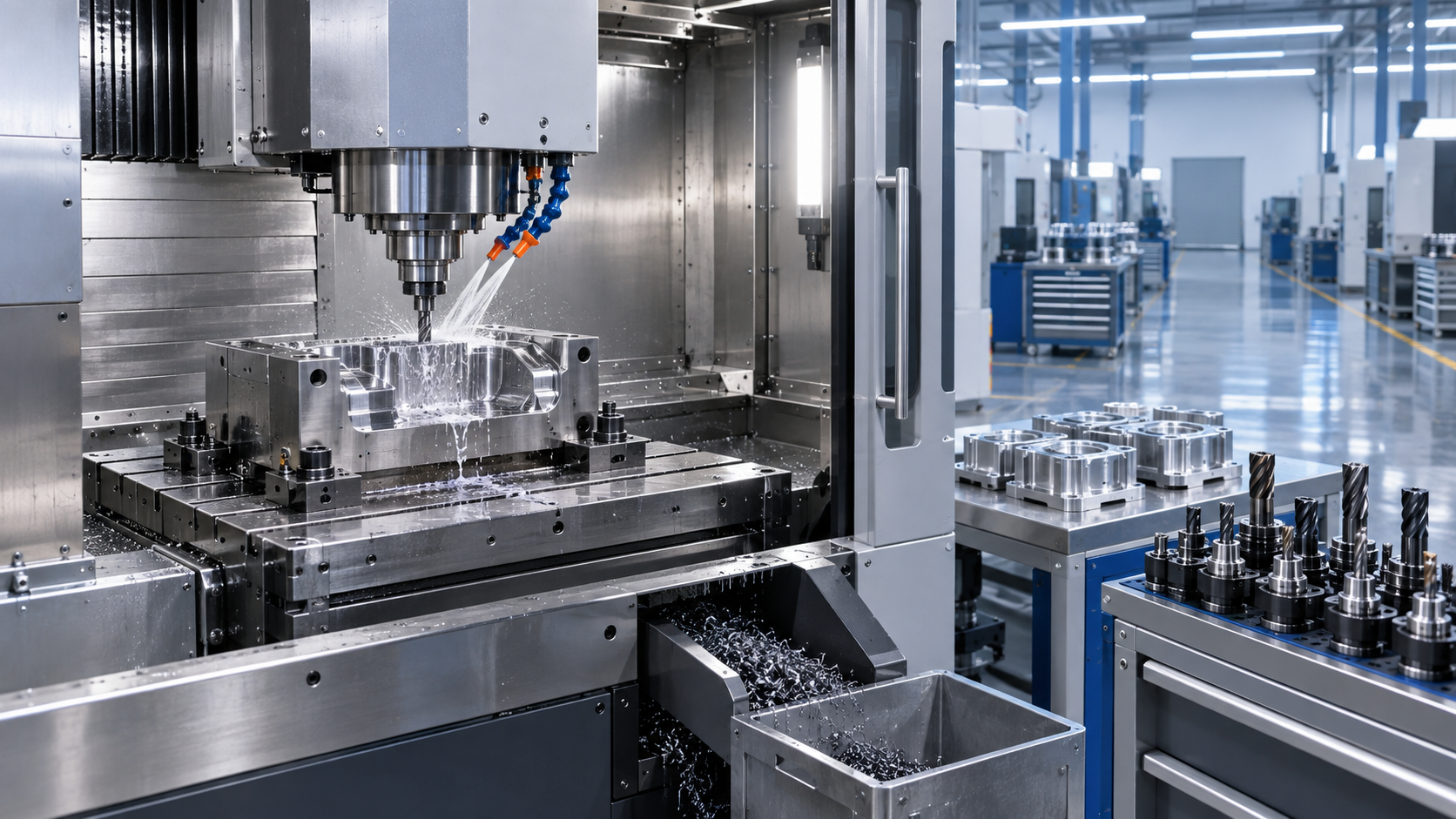
For steel machining, rigidity is often the first practical filter. A Vertical Milling Machine needs a stable machine base, properly sized linear guides or box ways, and a spindle-head structure that can resist deflection under load. If the structure moves excessively during roughing, the result is not only poor surface quality. Tool wear rises, cutting conditions become inconsistent, and operators may reduce feed rates simply to avoid chatter.
Buyers should look beyond the machine’s overall weight. Weight can support stability, but it does not explain how the casting, column, saddle, table, and spindle head behave as a system. Ask the supplier how the machine is intended to handle typical steel roughing, especially where long tool overhang, deep pockets, or interrupted cuts are involved. It is also worth checking whether the stated table load reflects the full fixture-and-workpiece combination rather than the part weight alone.
For aluminum, rigidity still matters, but thermal behavior and chip evacuation often become more visible. Aluminum can be machined at much higher cutting speeds, creating a large volume of chips in a short time. An enclosure, coolant arrangement, and chip-management design that work acceptably for occasional steel machining may become a bottleneck during continuous aluminum production.
Match spindle performance to the material mix
Spindle selection should be based on torque, speed range, power delivery, and duty cycle together. It is easy to focus only on maximum rpm, particularly when aluminum and mold finishing are on the production plan. High speed is useful for small-diameter tools, fine finishing, and efficient aluminum cutting, but it does not replace low-speed torque for steel roughing or large-diameter cutters.
A balanced spindle specification is usually more valuable for mixed work than an extreme specification in one direction. For example, a mold shop may need smooth high-speed contouring for finishing, while still requiring enough torque to machine pre-hardened material or prepare a cavity with larger tools. The supplier should be able to explain the spindle’s usable torque curve and recommended application range, not merely provide peak figures.
Cooling also deserves attention. Spindle temperature changes can affect dimensional consistency during long cycles, especially in mold work where fine tolerances and repeatable surface quality matter. The required cooling configuration depends on the machine design, operating environment, production schedule, and accuracy target. It should be reviewed as part of the complete process, rather than treated as an optional detail after the purchase order is issued.
Accuracy is more than a positioning number
Published positioning and repeatability figures are important, but they are only a starting point. Procurement decisions should distinguish between a machine’s stated geometric capability and the accuracy achieved on real parts after thermal change, fixture variation, tool wear, and operator setup are considered.
Mold applications make this distinction especially clear. A cavity may require smooth transitions between toolpaths, stable corner behavior, and consistent interpolation on three-dimensional surfaces. In such work, CNC response, servo tuning, look-ahead capability, and machine dynamics can influence the final result as much as nominal axis accuracy. Requesting sample machining discussions based on representative geometry is often more informative than comparing one catalogue value against another.
For steel and aluminum production parts, repeatability may be the more commercially important measure. If a component is machined in batches, the machine must return reliably to the same condition through repeated loading, probing, tool changes, and shifts. A practical acceptance plan should therefore identify the critical features, measurement method, fixture concept, and expected production sequence before delivery.
Tool capacity and automation should follow the production plan
Tool magazine capacity is frequently underestimated. A small toolchanger may be sufficient for simple drilling and pocketing, but mixed-material work often requires separate roughing, finishing, drilling, chamfering, probing, and backup tools. Mold machining can consume additional stations for long-reach tools, ball-end mills, and dedicated finishing cutters. Too little capacity creates manual intervention, increases setup risk, and weakens the value of unattended operation.
Automation should be evaluated with the same discipline. A pallet system, robot interface, barcoded tool management, or in-process probing system can be appropriate where repeat volumes justify it. But automation does not correct unstable fixturing, poor chip control, or unreliable tooling. The sounder approach is to first stabilize the machining process, then identify where automation reduces handling time or protects quality.
There may also be separate drilling tasks around the milling cell: preparing structural steel, fixtures, plates, or workholding components before they reach the CNC machine. In those situations, a portable magnetic drilling solution such as the VDW50 can complement fixed machining equipment rather than replace it. Its stated 50 mm maximum drilling diameter, 1500 W rated power, 0–600 r/min no-load speed, and 12000 N magnetic holding force are relevant to industrial metal drilling, subject to confirming the workpiece condition and safe operating requirements.
Look at the machine as a serviceable production asset
The purchase price is only one part of the cost of ownership. Buyers should assess installation requirements, electrical compatibility, consumables, spare-part availability, preventive maintenance access, training, and response arrangements for technical support. A highly capable machine becomes difficult to justify if routine servicing requires long downtime or if common wear items are hard to obtain.
This is also where supplier capability matters. Shandong VEDON Intelligent Equipment Co., Ltd. combines R&D, manufacturing, sales, and service across CNC machine tools, intelligent manufacturing solutions, and precision cutting tools. For a purchaser, the useful value of that integrated approach is the ability to discuss the milling machine, tooling, production workflow, and service expectations as connected parts of one machining plan.
Questions worth resolving before release
- What are the largest and heaviest workpieces, including fixtures and clamping hardware?
- Which material grades will dominate production: mild steel, alloy steel, aluminum, pre-hardened mold steel, or a changing combination?
- Which features define part acceptance: hole position, profile tolerance, surface finish, cavity geometry, or cycle time?
- Will the machine run mostly one-off mold components, repeated production parts, or both?
- What tooling, probing, chip handling, coolant filtration, and operator training must be included from day one?
A well-chosen Vertical Milling Machine is not simply one that meets today’s largest part envelope. It is one whose structure, spindle, controls, tooling capacity, and support plan fit the work that will actually consume machine hours. Reviewing representative parts with the supplier, including the difficult steel cuts and the precision mold features, gives procurement teams a far stronger basis for selection than a specification comparison alone.

Vedon
Typically replies within minutes
Any questions related to Home?

William / CEO / Brand Founder

Elaine / Sales Manager

Jessica / Sales Manager