Evaluating the Lifetime Cost of a Universal Milling Machine for a Workshop
Evaluating the Lifetime Cost of a Universal Milling Machine for a Workshop
For a workshop, the quoted price of a Universal milling machine is only the first visible part of the investment. The more consequential costs appear after delivery: preparing the site, commissioning the machine, purchasing and managing tooling, training operators, maintaining accuracy, and absorbing the impact of unexpected stoppages. A lower initial price can be sensible in some situations, but only if it does not create a larger operating burden over the machine’s working life.
This matters especially for businesses that handle varied repair work, fixtures, prototype parts, small-batch components, and secondary machining operations. In these environments, a versatile manual or conventional milling platform may be used across many jobs rather than dedicated to a single part family. Its real cost is therefore closely tied to how smoothly it fits the workshop’s people, processes, available tooling, and service resources.
Start with the Cost of Putting the Machine to Work
The purchase order should be reviewed as the beginning of the project, not its conclusion. Before comparing suppliers, decision-makers should identify what is included in the delivered scope and what remains the workshop’s responsibility. Freight, unloading equipment, insurance, foundation preparation, positioning, electrical connection, initial lubrication, and acceptance checks can all affect the actual installed cost.
A universal mill also needs a practical working envelope around it. Operators require access for changing cutters, setting workpieces, moving the table, inspecting parts, and cleaning chips. If a machine is squeezed into an unsuitable location, minor tasks take longer and safety risks increase. The layout should also account for coolant management, chip collection, lifting access for heavy fixtures, and storage for frequently used collets, vises, arbors, and measuring tools.
Electrical compatibility deserves early attention. Voltage, frequency, motor configuration, grounding arrangements, and local installation requirements must be checked against the workshop supply. Correcting a mismatch after arrival can delay production and introduce unplanned expense. Importing a machine without confirming this basic point is a common avoidable risk.
Capacity Is Not the Same as Useful Productivity
Machine dimensions and travel figures are important, but they do not alone show whether a Universal milling machine will be productive in daily use. The right evaluation begins with the parts a workshop actually expects to machine. Consider the largest workpiece footprint, typical material grades, required cutter diameters, fixture height, tolerance expectations, and whether vertical, horizontal, or angled machining is regularly needed.
For example, a table may appear large enough for a workpiece, yet the setup may leave too little clearance for a vise, dividing head, rotary attachment, or overarm support. Likewise, spindle speed range must suit the intended cutters and materials rather than simply look impressive on a specification sheet. A machine that forces repeated compromises in setup will consume operator time every day, even if its initial price was attractive.
Rigidity is another lifetime-cost issue. The machine body, guideways, spindle arrangement, feed system, and clamping method influence how confidently an operator can remove material and hold dimensions. A workshop should not assume that a higher spindle motor rating automatically means better cutting performance. Stability comes from the complete mechanical system, the condition of the machine, the workholding strategy, and the selected cutting parameters.
Tooling and Workholding Often Decide the Real Budget
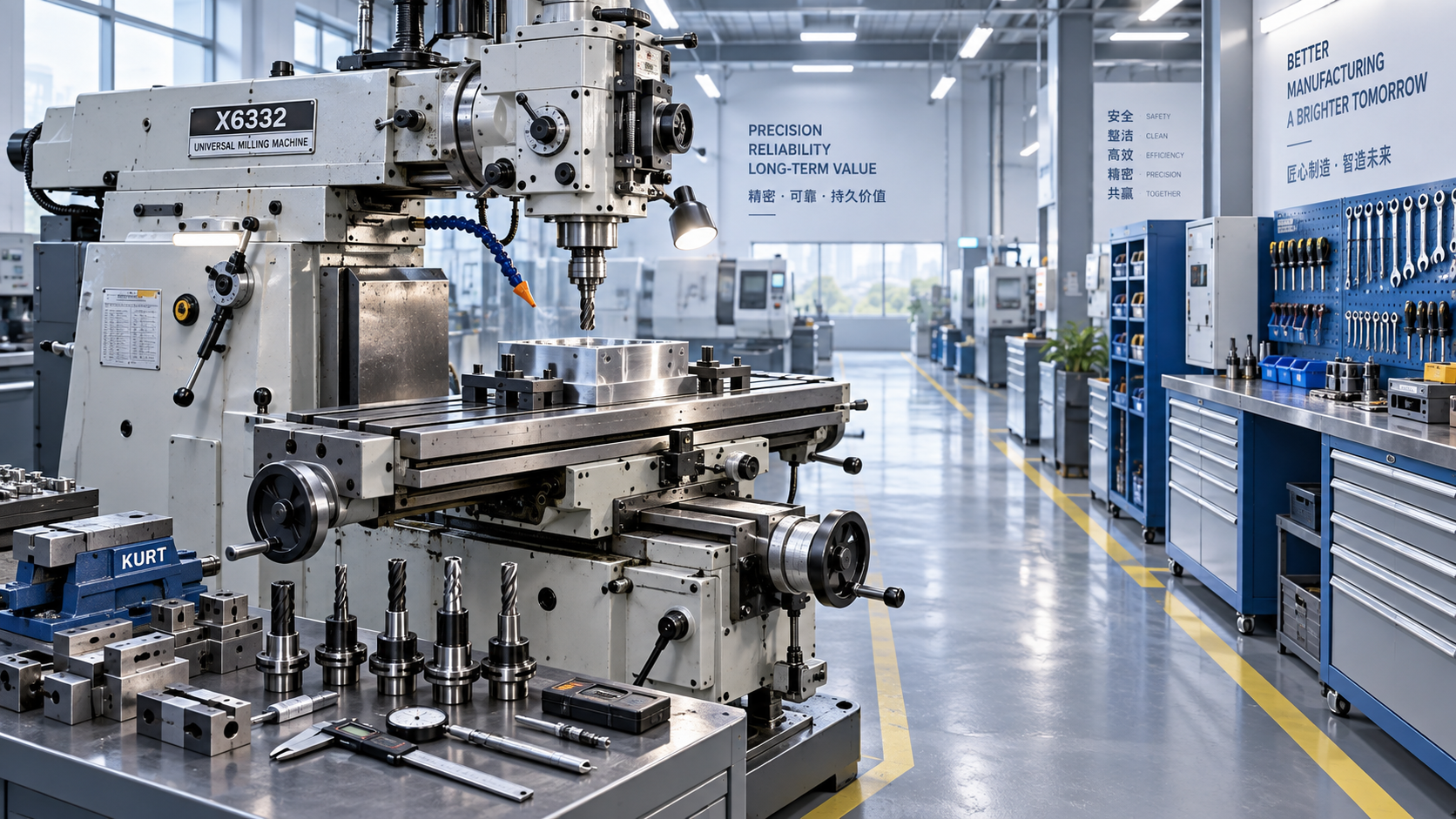
Many procurement estimates understate the cost of making a milling machine genuinely useful. The machine may need a vise, clamping kit, collets, arbor assemblies, cutter holders, end mills, face mills, drill chucks, angle plates, measuring instruments, and possibly indexing or rotary equipment. These items are not optional accessories when the workshop’s workload requires them; they are part of the operating system.
The key question is not whether every accessory should be purchased at once. It is whether the machine accepts the tooling standards and attachments the workshop already owns or intends to standardize. Reusing compatible, well-maintained tooling can lower the first-year cost. Conversely, an unusual interface may tie the workshop to slower procurement, higher replacement cost, or a narrower choice of suppliers.
A structured tooling plan also prevents a hidden form of downtime: operators waiting for the correct holder, fixture, or cutter. In a mixed-job workshop, accessible and repeatable workholding can be worth more than adding theoretical machine capacity that will rarely be used.
Energy Matters, but Downtime Usually Matters More
Electricity consumption should be considered, particularly where machines run multiple shifts or local energy prices are high. However, it should be assessed in context. A conventional milling machine does not consume its rated motor power continuously. Actual use depends on cutting load, idle time, auxiliary equipment, and operator practice. A meaningful estimate requires expected operating hours and representative machining conditions, not just a nameplate comparison.
In many workshops, unplanned downtime is the more expensive concern. A stopped mill can interrupt repair work, postpone a tooling change, create a queue at another machine, or leave skilled operators waiting. The cost is not limited to a replacement part. It includes diagnosis time, delivery lead time, labor disruption, scrapped material where applicable, and delayed commitments elsewhere in the production schedule.
That is why maintainability should be reviewed before purchase. Ask how routine lubrication is handled, whether wear items can be identified and sourced, what service documentation is available, and who can support troubleshooting. A design that permits straightforward inspection and adjustment is often easier to keep productive than one that is difficult to service, even if both appear comparable at delivery.
Precision Has a Cost Curve
Precision performance should be evaluated over time, not judged only by an initial test cut. Backlash, guideway wear, spindle condition, alignment, lubrication discipline, thermal behavior, and workholding all influence the machine’s ability to produce consistent work. A workshop making general repair components may accept a different level of variation than one producing tooling, inspection fixtures, or close-tolerance mating parts. The machine should be matched to the tighter end of the real job mix, not the average job.
It is useful to establish an acceptance and maintenance baseline at installation. Record relevant geometric checks, operating observations, and test-piece results appropriate to the workshop’s own requirements. Periodic comparison helps maintenance teams spot deterioration before it becomes a quality problem. This is more practical than discovering loss of accuracy only after rejects begin to accumulate.
Operator skill is part of this equation. A capable machinist can compensate for some limitations, but relying on constant manual correction is expensive and difficult to scale. Clear setup practices, sensible inspection routines, and accessible controls reduce variation between shifts and make the machine less dependent on one individual’s experience.
Compare Suppliers Beyond the Quotation
A sound comparison separates the equipment price from the lifecycle support proposition. Request clarity on the machine configuration, standard and optional accessories, packing method, documentation, commissioning scope, spare-parts availability, warranty terms, and technical response process. Vague inclusions are not necessarily a problem, but they should be resolved before the order is placed.
For workshops evaluating models such as the VD3120R, the productive next step is to compare the machine’s actual configuration against the planned work rather than against a generic checklist. Shandong VEDON Intelligent Equipment Co., Ltd. combines R&D, manufacturing, sales, and service across CNC machine tools, intelligent manufacturing solutions, and precision cutting tools. That broader equipment perspective can be useful when a buyer needs to consider milling capacity alongside tooling compatibility, process needs, and long-term support arrangements.
The supplier conversation should include the questions that tend to surface later: Which consumables and replacement components are likely to be needed? What technical information accompanies the machine? Can the supplier clarify installation conditions before shipment? How will the workshop confirm that delivered performance matches the agreed configuration? Straight answers to these points reduce uncertainty more effectively than a small discount on the machine price.
A Practical Way to Make the Decision
Before approving the investment, build a simple lifetime-cost worksheet for each shortlisted option. Include acquisition and installation costs, essential initial tooling, expected preventive maintenance, probable spare-part exposure, operator training time, energy assumptions, and a realistic allowance for lost production during service events. The purpose is not to predict every expense precisely. It is to reveal which assumptions drive the decision and which costs have been omitted from the quotation comparison.
The best choice is rarely the least expensive machine in isolation. It is the machine that can complete the required work safely and repeatably, with tooling and service arrangements the workshop can sustain. Confirm the part envelope, setup requirements, power supply, required accuracy, accessory list, delivery responsibilities, and support path before treating the purchase price as a final number.

Vedon
Typically replies within minutes
Any questions related to Home?

William / CEO / Brand Founder

Elaine / Sales Manager

Jessica / Sales Manager