What Spindle Speed Range Does a Vertical Milling Machine Really Need?
A Vertical Milling Machine does not need the highest available spindle speed. It needs a usable speed range that matches the cutting tools, materials, cutter diameters, and removal rates required by the planned work. A machine rated to 10,000 rpm may be well suited to general prismatic parts, mould components, and smaller carbide cutters, yet it can be a poor fit if the workload is dominated by large-face milling in alloy steel at low rpm. Conversely, an 8,000 rpm spindle can cover substantial production work but may restrict finishing performance when small tools and high surface speeds are essential.
The specification should therefore begin with the lowest and highest speeds required by real operations, rather than a single maximum-rpm figure. The upper limit governs small-diameter tooling and high-speed finishing. The lower end, together with torque and motor power, determines whether the spindle can remove material steadily with larger cutters.
Start with cutting speed, not spindle rpm
Spindle speed is calculated from cutting speed and cutter diameter:
n = (1,000 × Vc) / (π × D)
Where n is spindle speed in rpm, Vc is cutting speed in metres per minute, and D is cutter diameter in millimetres. Tool manufacturers publish cutting-speed guidance by workpiece material, coating, coolant method, and machining strategy. That recommendation is the correct starting point; machine rpm is the result.
A 10 mm end mill requires far more rpm than a 63 mm face mill at the same cutting speed. This is why a stated maximum speed alone can be misleading. A shop machining aluminum housings with 6 mm to 12 mm carbide end mills will reach a different conclusion from one roughing ductile iron castings with 50 mm to 80 mm indexable cutters.
For example, a 63 mm face mill cutting a steel component may work at a speed that falls comfortably below 2,000 rpm. A 6 mm carbide end mill finishing a contour in aluminum may require several times that speed. A single machine serving both duties needs a range that covers both calculations, while retaining torque at the low end and acceptable thermal behavior at the high end.
The practical meaning of 8,000 rpm and 10,000 rpm
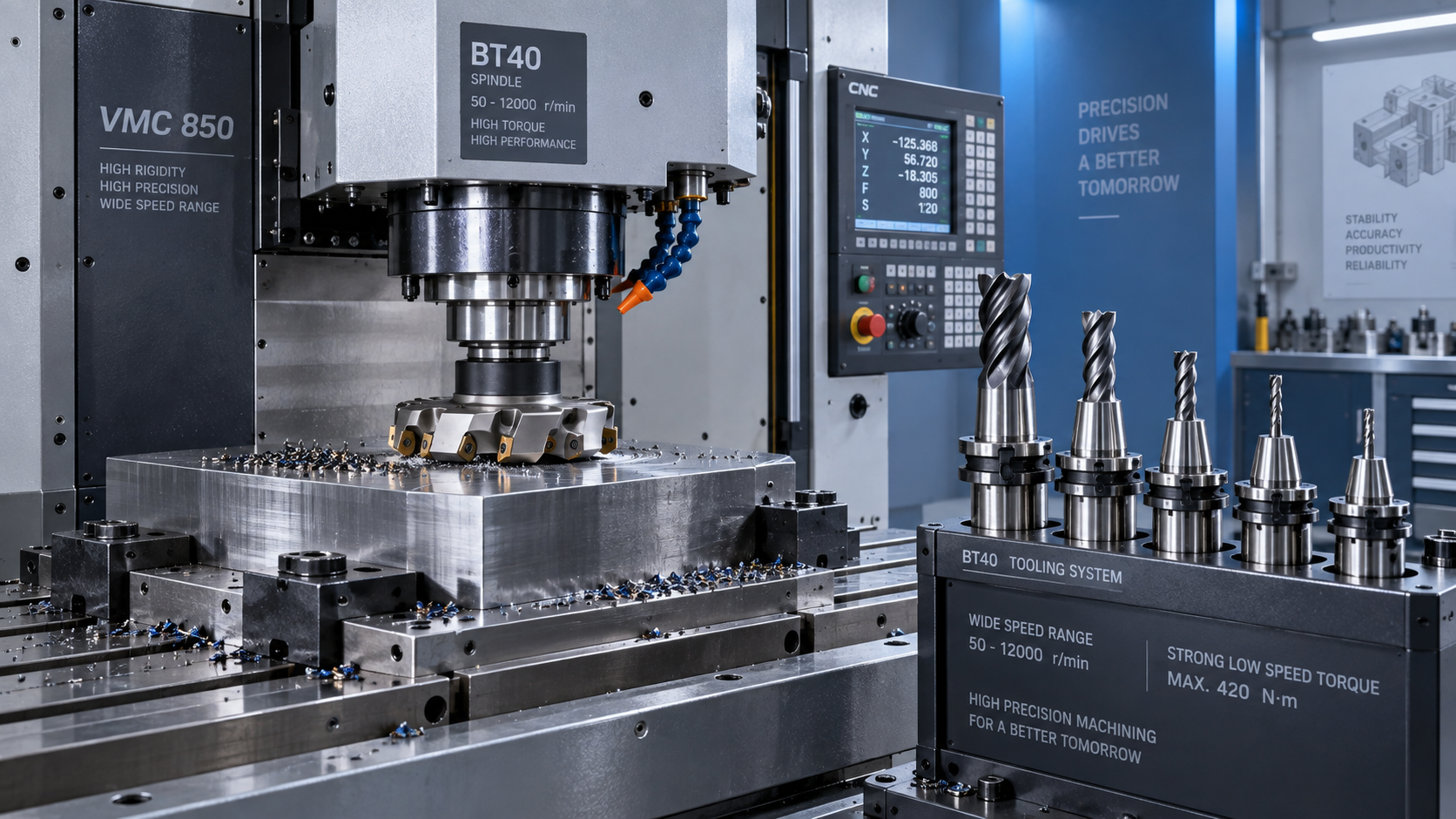
An 8,000 rpm spindle is often sufficient for general-purpose vertical milling where the work mix includes steel, cast iron, stainless steel, and moderate-size aluminum parts. It supports common BT40 tooling, face mills, drilling, tapping, and end milling with cutter diameters that do not demand extreme speed. The advantage is not merely the rpm rating: the spindle must sustain cutting load without excessive speed loss, vibration, or heat.
A 10,000 rpm spindle adds useful capacity for smaller carbide end mills, higher-speed aluminum machining, finishing passes, and complex curved surfaces where cutter diameter decreases in tight radii. It also provides a margin when programmed cutting speed would otherwise force the process near an 8,000 rpm ceiling. Running continuously at the maximum rated speed leaves little room to compensate for tool wear, changes in stock condition, or a revised finishing tool.
Neither rating automatically establishes better machining accuracy. A high-rpm spindle with poor holder balance, excessive tool overhang, weak workholding, or inadequate machine stiffness can leave chatter marks and dimensional variation. A lower-rated spindle on a rigid machine can produce better results in demanding roughing operations because the cutting system remains stable.
Low-speed torque changes the answer
Torque deserves equal attention whenever larger cutters, deep cuts, difficult materials, or high metal-removal rates are involved. Spindle power expresses the capacity to perform work over time, while torque is the turning force available at a particular speed. A spindle may carry a high maximum rpm but deliver limited torque at the speed required for a large face mill. The result can be reduced feed, shallow axial engagement, overload alarms, or unstable cutting.
This distinction becomes clear during roughing. If a process plan calls for broad shoulder cuts in pre-hardened steel or heavy machining of cast material, the relevant question is not “Can the machine reach 10,000 rpm?” It is “What torque is available at the calculated operating rpm, and can the machine maintain it through the planned engagement?” The spindle torque curve, rather than the catalog headline, answers that question.
Belt-driven spindle configurations can be appropriate for broad general machining, but the available torque and power characteristics must be read with the selected belt ratio and speed range in mind. A published maximum speed does not show whether output is continuous or short-duration, nor whether it applies across the full usable band.
Tooling and setup often limit speed before the spindle does
At higher rpm, the complete rotating assembly matters. Toolholders, pull studs, collets, end mills, face mills, and balancing quality must be suitable for the intended speed. A toolholder that is acceptable for ordinary milling may generate measurable runout or imbalance at higher rotational speed. Runout causes unequal tooth loading; one cutting edge then wears faster, raising cutting force and degrading surface finish.
Tool projection is equally important. A long, slender end mill may chatter at a speed that a short tool handles cleanly. Raising rpm to solve a poor finish can make chatter worse when the speed moves closer to a natural vibration frequency. Reducing radial engagement, shortening the assembly, changing the toolpath, or selecting a different flute geometry may be more effective than changing the rpm command.
Workholding creates a similar limitation. Thin plates, tall clamped parts, and parts supported unevenly can deflect under changing cutting loads. The spindle may be capable of the programmed speed, but the component is not. Finishing tolerances should be verified with the actual fixture and tool reach, especially where wall thickness changes along the toolpath.
Use the workload envelope during machine specification
A reliable requirement can be built from a small set of representative operations: the largest face mill, the largest drill, the most demanding roughing end mill, the smallest finishing tool, and the longest-reach tool. Calculate their target rpm from approved cutting data, then identify the expected feed rate, axial depth, radial engagement, and material condition. This produces a workload envelope rather than an arbitrary rpm target.
- A maximum speed is adequate when the small-tool operation runs below the limit with reasonable margin and the required feed rate remains within axis capability.
- The minimum practical speed must accommodate large-diameter cutters without forcing them below an efficient cutting-speed zone.
- Torque and power should be evaluated at the actual roughing speed, not at the spindle’s peak-power value alone.
- Where finishing is sensitive, include holder type, tool overhang, cutter balance, coolant delivery, and fixture stiffness in the acceptance condition.
For a machine such as the VMC1580, an 8,000 rpm or 10,000 rpm belt-spindle option should be assessed against this envelope. The BT40 taper, stated spindle motor options, and available torque figures indicate the need to compare the selected configuration with both the roughing and finishing portions of the planned work. Positioning accuracy and repeatability are meaningful only when the spindle, tooling, and structure remain stable under the cutting load.
Common speed-selection errors
Choosing the highest rpm because it appears more versatile is a frequent specification error. Higher speed is valuable only when the tool diameters and cutting conditions use it. Otherwise, budget and maintenance attention may be directed toward a capability that does not improve the planned process.
The opposite error is selecting a low-speed spindle from the largest cutter alone. If finishing includes small-radius corners, small drilled features, or fine surface requirements, an inadequate upper range forces reduced cutting speed. Reduced speed can lower productivity, but it can also cause rubbing and poor chip formation when a small carbide tool is run too slowly.
Another source of rework is treating material names as complete machining data. “Stainless steel” or “aluminum” is not enough. Material grade, hardness, casting skin, stock shape, coolant access, and interrupted cuts alter the stable cutting window. The intended tool supplier’s data and the actual component geometry should be available before finalizing the spindle requirement.
A well-chosen Vertical Milling Machine spindle range is therefore a balance: enough high-rpm capacity for the smallest productive tools, sufficient low-speed torque for the largest loaded cutters, and a stable mechanical system between those extremes. When those conditions are defined from representative operations, the resulting specification is easier to validate during process trials and less likely to constrain later production work.

Vedon
Typically replies within minutes
Any questions related to Home?

William / CEO / Brand Founder

Elaine / Sales Manager

Jessica / Sales Manager