


On a milling machine with leadscrew backlash, conventional milling is generally the safer starting choice because climb milling can pull the table unexpectedly into the cutter.
That movement can suddenly increase tool engagement, damage the cutting edge, shift the workpiece, or create an injury hazard before the operator can respond effectively.
For operators using manual mills or worn feed systems, the decision depends on mechanical clearance, feed control, workholding, and the machine manufacturer’s operating instructions.
This guide explains how backlash changes cutting behavior, how to check your setup, and which conditions must be verified before climb milling becomes a reasonable option.
Why Can Climb Milling Pull a Loose Table Into the Cutter?
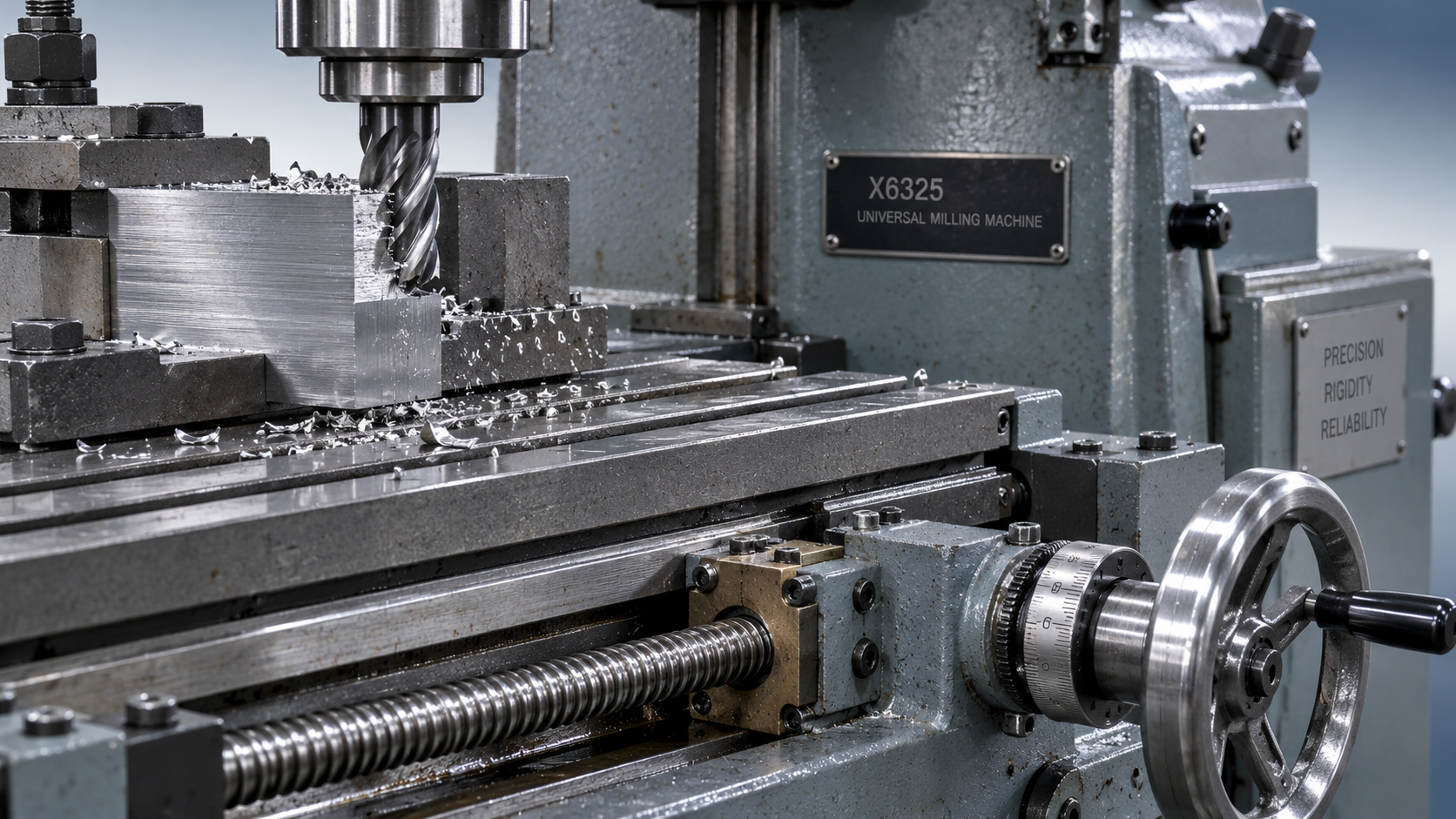
Backlash is clearance between mating feed components. When the leadscrew changes direction, it may rotate through that clearance before the table begins moving again.
During conventional peripheral milling, cutter rotation at the contact point opposes the workpiece feed direction. Chip thickness starts near zero and increases through engagement.
During climb peripheral milling, cutter rotation at the contact point follows the workpiece feed direction. Chip thickness starts relatively thick and decreases toward exit.
This distinction matters because climb milling produces a feed direction force component that can drive a loose table ahead of the screw’s controlled movement.
When the table crosses the available clearance, the cutter can take a larger bite than intended. The resulting load can cause grabbing, chatter, or breakage.
Conventional milling generally keeps the feed mechanism loaded against the cutting resistance. This reduces the tendency toward uncontrolled advance, although it cannot compensate for defective machinery.
How Do You Identify the Correct Feed Direction?
Determine the cutting method from cutter motion at the actual contact point. A clockwise spindle alone does not tell you whether the operation is climb milling.
For peripheral cutting, compare the tooth’s tangential motion where it touches the workpiece with the direction the workpiece moves relative to the cutter axis.
If those directions match, that engagement is climb milling. If they oppose each other, it is conventional milling. Recheck whenever you change the cutting side.
Be careful with drawings that show tool travel instead of table travel. On a stationary spindle arrangement, these descriptions use opposite directions for equivalent relative motion.
Full width slotting engages both sides of an end mill, combining climb and conventional cutting regions. It does not behave like a simple peripheral pass.
Likewise, face milling requires attention to cutter offset and engagement geometry. Use the tooling supplier’s guidance when a basic side milling diagram does not apply.
Check Backlash Before Choosing Your Cutting Strategy
Follow the machine’s inspection procedure with the spindle stopped and the machine secured against unexpected movement. Remove the cutter when practical for safer access.
A dial indicator referenced to a fixed machine surface can reveal actual table movement. Compare that movement with handwheel rotation as you reverse the feed direction.
Rotate the handwheel slowly until the indicator shows movement, then reverse slowly. The intervening handwheel movement indicates lost motion at that location under those conditions.
A digital readout can help show table position, but it does not eliminate mechanical clearance. The table may still move unexpectedly under changing cutting forces.
Check several positions along the axis because screw and nut wear may vary with travel. A single measurement cannot establish the condition of the entire axis.
Also inspect gib adjustment, lubrication, screw supports, nut condition, and workholding. Backlash measurements alone do not reveal every source of movement or poor rigidity.
There is no universal backlash value that makes climb milling safe. Suitability depends on the complete feed system, cutting load, machine design, and manufacturer limits.
How Should You Set Up Conventional Milling on a Manual Mill?
Begin with secure workholding and short, rigid tool projection. Confirm that the vise or fixture is properly secured and the workpiece has adequate support.
Select the feed direction from the engagement geometry, then take up feed clearance before entering the material. Approach the starting position consistently from the intended direction.
Use axis locks only as the machine manual permits. Secure unused axes where appropriate, while keeping the feed axis free to move as designed.
Choose speed, feed, axial depth, and radial engagement from recommendations for the tool and material. Reduce engagement when machine rigidity or available power requires it.
Use a restrained first pass to assess the setup. Watch for uneven feeding, vibration, workpiece movement, and unexpected load changes while maintaining a safe operating position.
If the table grabs, the handwheel kicks, or cutting becomes unstable, stop using the approved procedure. Investigate the cause before attempting another cut or adjustment.
Never try to restrain a grabbing table by hand. Keep hands clear of rotating tools and chips, and stop the spindle before measuring or clearing obstructions.
Does a Light Climb Finishing Pass Make It Safe?
A lighter finishing pass reduces cutting forces, but it does not remove backlash. Even shallow engagement can pull a freely moving table into the tool.
Do not treat added gib friction, handwheel resistance, or a power feed as proof of control. These measures do not necessarily prevent movement through clearance.
Software backlash compensation also has limits. Correcting commanded reversal position does not physically remove clearance or guarantee that cutting forces cannot move the table unexpectedly.
Consider climb milling only when the manufacturer permits it and the feed system can control cutter forces throughout the intended operation, including entry and exit.
Verify mechanical condition, applicable backlash limits, drive behavior, workholding, and tooling recommendations. Any uncertainty about table control should be resolved before attempting the cut.
What Changes When You Move to a CNC Milling Machine?
Many CNC machining centers use preloaded ball screws and servo drives, making climb milling a routine option when the machine remains within its specified condition.
However, a CNC label does not prove that backlash is controlled. Worn supports, damaged components, or incorrect adjustment can still compromise positioning and cutting stability.
For operators evaluating equipment, Shandong VEDON Intelligent Equipment Co., Ltd.’s VMC1370 combines a one-piece cast bed with a ball screw and servo drive system.
Its listed axis travels are 1,300 × 700 × 700 mm, with a 1,400 × 700 mm worktable supporting larger fixture and component setups.
These specifications help assess capacity, but cutting suitability still requires verification. Confirm backlash, maintenance condition, applicable accuracy specifications, and manufacturer guidance for your intended operation.
Choose the Method Your Machine Can Reliably Control
For a backlash-prone manual milling machine, conventional milling is generally the practical starting choice. It reduces the tendency for the cutter to advance the table.
Climb milling can offer useful cutting and finish benefits when the feed system reliably controls engagement. Those benefits depend on verified machine condition and suitable setup.
Base the decision on measured condition and manufacturer instructions. Correct excessive clearance and unstable feeding before pursuing surface finish improvements through a different cutting direction.