


Manual vs. CNC Milling Machines for Small-Batch Job Shop Work
A small-batch job shop may need to skim a repair plate, machine a bracket, and produce several matching housings within the same delivery window. Choosing the wrong milling machine can tie up skilled labor, extend setup time, or leave expensive capacity underused. Manual milling usually suits straightforward, nonrepeating work; CNC milling becomes more attractive when geometry, repeatability, or recurring orders justify programming and setup.
Batch size alone does not settle the decision. A single contoured component may justify CNC machining, while several simple plates may remain economical on a manual mill. Compare the complete route from drawing review to accepted parts—not just purchase price or cutting speed.
Start with the jobs that consume your shop hours
Review representative completed jobs and separate time spent on workholding, tool preparation, programming, cutting, inspection, and correction. Include interrupted jobs and urgent modifications. These reveal whether the real constraint is spindle capacity, engineering preparation, or access to a skilled machinist.
For a rectangular plate requiring one faced surface and a simple slot, a manual mill with a digital readout can provide a direct route to completion. The operator establishes datums, positions the work, and machines the features without creating a CNC program. That advantage shrinks when the drawing adds multiple pockets, interpolated holes, or coordinated contours.
Repeat potential also matters. A first order may carry programming and fixture-development costs that later releases can reuse. However, repeat orders only retain that advantage when programs, offsets, tooling records, and inspection requirements are controlled. An undocumented setup is not a reusable production process.
Where manual and CNC milling differ in practice
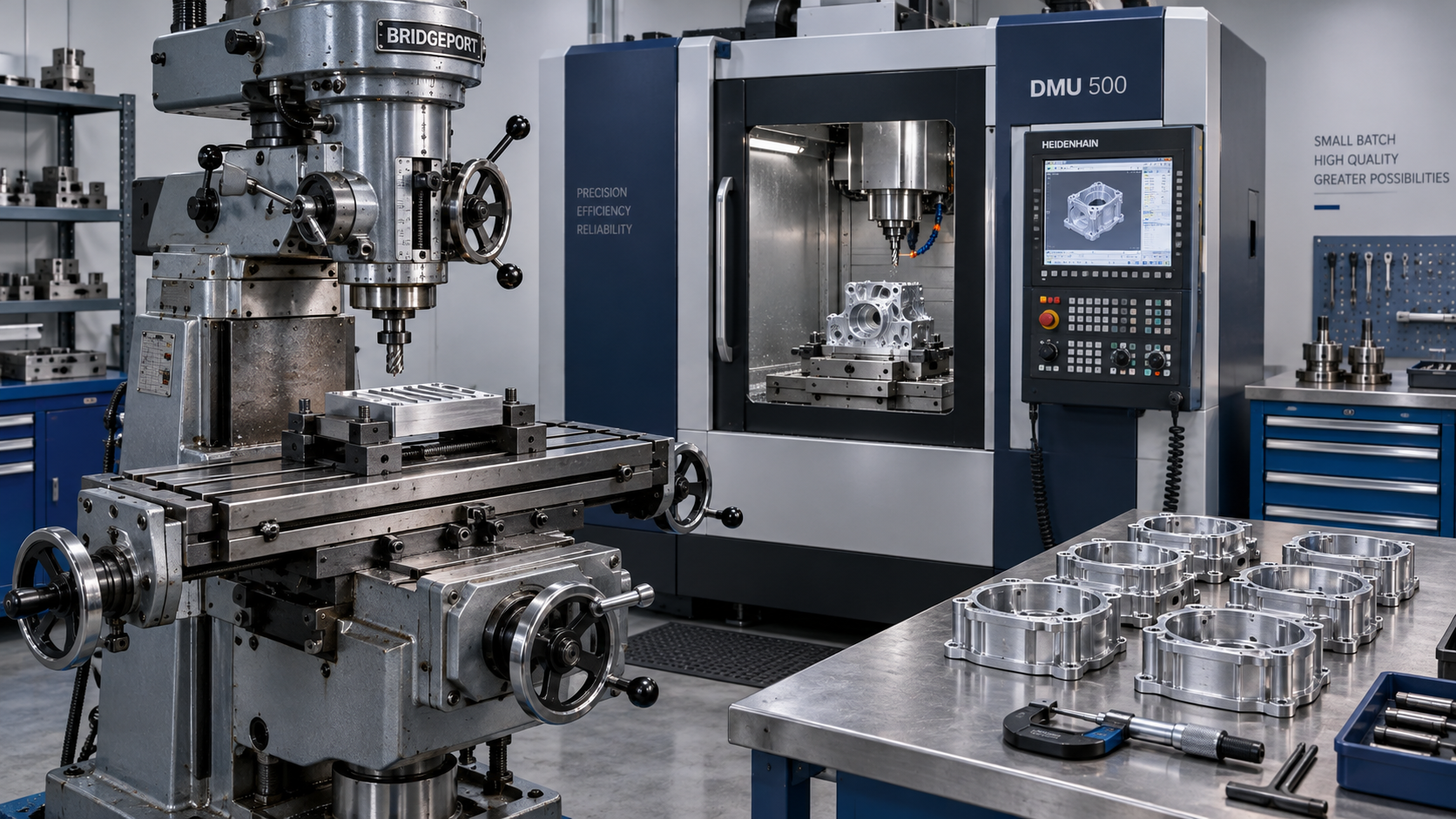
Neither column establishes a universal winner. A CNC machine waiting for programs can contribute less useful capacity than a well-supported manual mill. Conversely, assigning intricate features to manual equipment can consume scarce skilled hours even when the machine itself costs less.
Compare cost per accepted part, not hourly rate alone
A low machine rate can hide high labor content. A higher CNC rate can also hide poor utilization if the workload does not support it. Use the same cost boundaries when comparing routes:
Batch cost = preparation and setup + machining resources + tooling and fixtures + inspection + expected rework or scrap.
Divide that total by the number of accepted parts. Include programming whether it is done internally or purchased externally, and avoid counting operator labor twice if it is already included in the machine rate. Evaluate repeat batches separately from the first batch.
For a recurring part, the break-even quantity depends on the additional CNC preparation cost divided by its per-part savings. That comparison is useful only when both routes can meet the drawing and delivery requirement. It also assumes the tooling, fixture, and revision remain sufficiently stable for the planned production run.
Account for the bottleneck. Saving manual machining hours has greater value when the relevant machinist is already overloaded. Reducing cutting time brings less immediate benefit when inspection or material availability controls shipment. Separate cash savings from released capacity; they are not automatically the same financial result.
Tolerance requirements need more than a control-system comparison
CNC control improves repeatable motion, but it does not guarantee that every finished feature meets tolerance. Machine condition, spindle runout, backlash, thermal behavior, tool deflection, workholding, and measurement methods still determine the result. A capable manual machine can produce precise work, although maintaining consistency may require more operator intervention.
Read the drawing by feature rather than treating the tightest tolerance as a specification for every operation. A close-tolerance bore may require boring or another finishing process regardless of how surrounding surfaces are milled. Thin walls and deep pockets introduce deflection risks that automation alone cannot remove.
Before purchasing, request a machining trial using representative material, geometry, workholding, and inspection criteria. Evaluate dimensional results alongside setup effort and cycle stability. A demonstration on an easy sample does not establish capability for the parts that drive your investment.
Keep drilling work from distorting the milling decision
Some jobs occupy a mill mainly for drilling and tapping. Moving suitable hole-making operations to dedicated equipment may release milling capacity without immediately requiring another CNC machine.
The Z5040A is a vertical drilling machine, not a substitute for a milling machine. Its listed specifications include a maximum drilling diameter of 40 mm, maximum tapping size of M24, an MT4 spindle taper, a spindle-speed range of 42–2050 rpm, and a 370 × 500 mm effective worktable area. These parameters provide a starting point for screening separate drilling work.
Actual suitability still depends on material, tooling, hole depth, positioning requirements, and workholding. Maximum listed capacities should not be assumed achievable under every cutting condition. Do not assign side-cutting milling operations to drilling equipment without explicit manufacturer approval for that operation.
Match the investment to staffing and workload
Manual equipment avoids CNC programming requirements, but productive operation still depends on machining judgment. Losing access to an experienced operator can expose a capacity risk. CNC equipment shifts part of that dependency toward programming, setup verification, tool management, and maintenance rather than eliminating it.
Before adding CNC capacity, establish who will prepare programs, prove out new jobs, maintain revision control, and respond to tool wear or alarms. Longer automatic cycles may allow an operator to perform other tasks, but only after the process is stable and the supervision requirements are understood. Do not base payback on unattended production that has not been validated.
A mixed shop can use manual equipment for repairs, simple modifications, and suitable secondary operations while reserving CNC capacity for demanding geometry and repeat production. The additional machine is worthwhile only if its workload and staffing justify the floor space, maintenance, and capital tied up.
Make the purchase conditional on a representative workload
- Choose representative drawings. Include straightforward one-offs, demanding features, and likely repeat orders rather than only the most complex part.
- Develop both process routes. Identify setups, tools, inspection stages, programming effort, and any operations requiring separate equipment.
- Verify capability. Check usable travel, fixture clearance, spindle characteristics, machine condition, and demonstrated results on relevant features.
- Compare realistic utilization. Include training, maintenance, service access, software where required, and time spent between paid cutting jobs.
Favor manual capacity when simple, irregular jobs dominate and direct operator control avoids more preparation than it creates. Favor CNC when complex geometry, repeated setups, or labor-intensive positioning consistently consume capacity. Where demand remains uncertain, test the proposed CNC route through outsourced representative work before committing capital, while keeping urgent manual work available in-house.

Vedon
Typically replies within minutes
Any questions related to Home?

Elaine / Sales Director

Jaye / Sales Manager

Jessica / Sales Manager