Estimating Magnetic Drill VD50 Operating Costs for Mobile Steelwork Teams
A Magnetic drill VD50 should be costed as a field-production tool, not as a single purchase. For a mobile steelwork team, the most expensive outcome is rarely the electricity used by the motor. It is a delayed connection, a damaged cutter, an unsafe setup on thin or uneven steel, or a drill that stops mid-shift with no practical service path.
A useful operating-cost estimate combines the purchase price with consumables, labor time, maintenance, transport handling, and the financial effect of unplanned downtime. This approach gives decision-makers a more realistic basis for comparing a VD50-class magnetic drill with alternatives that may appear cheaper at the quotation stage.
Start with cost per completed hole, not cost per machine
Mobile teams typically drill holes for brackets, structural connections, equipment supports, handrails, repair work, and site modifications. The machine may be moved repeatedly between work areas, positioned overhead or vertically, and used on steel with varying surface condition. In this environment, drill cost is tied to how many acceptable holes the crew can complete in a shift.
Estimate cost by looking at the work package: expected hole diameters, steel thickness, material grade, number of locations, access conditions, and whether the work requires drilling only or also tapping. A drill that completes the required hole reliably with fewer repositioning attempts can reduce labor exposure even when its initial price is higher.
For budgeting, separate costs into four groups:
- Ownership costs: acquisition, freight, storage protection, and the expected service life of the tool.
- Running costs: annular cutters, pilot pins, cutting fluid, power, replacement brushes or switches where applicable, and routine inspection items.
- Labor costs: setup, alignment, drilling, deburring, moving the drill, and correcting inaccurate holes.
- Downtime costs: lost crew time, delayed follow-on trades, emergency tool rental, and work rescheduling when a drill is unavailable.
Electricity belongs in the calculation, but it is usually a minor line item compared with cutter consumption and field labor. The larger question is whether the drill, cutter system, and work method are correctly matched to the job.
Consumables are where estimates often become unreliable
Annular cutter spending varies sharply by application. Cutter life is affected by steel hardness, plate thickness, hole diameter, feed pressure, coolant delivery, chip clearing, and whether the operator starts with a stable magnetic base. A cutter used at the wrong speed or forced after it has dulled can become expensive quickly, while also increasing the chance of an overheated or oversized hole.
Do not estimate cutter cost using only the supplier's cutter price. Convert it into a working allowance: cutter price divided by the approximate number of good holes it produces in your expected material and conditions. Keep separate allowances for common diameter ranges rather than applying one average rate to every hole.
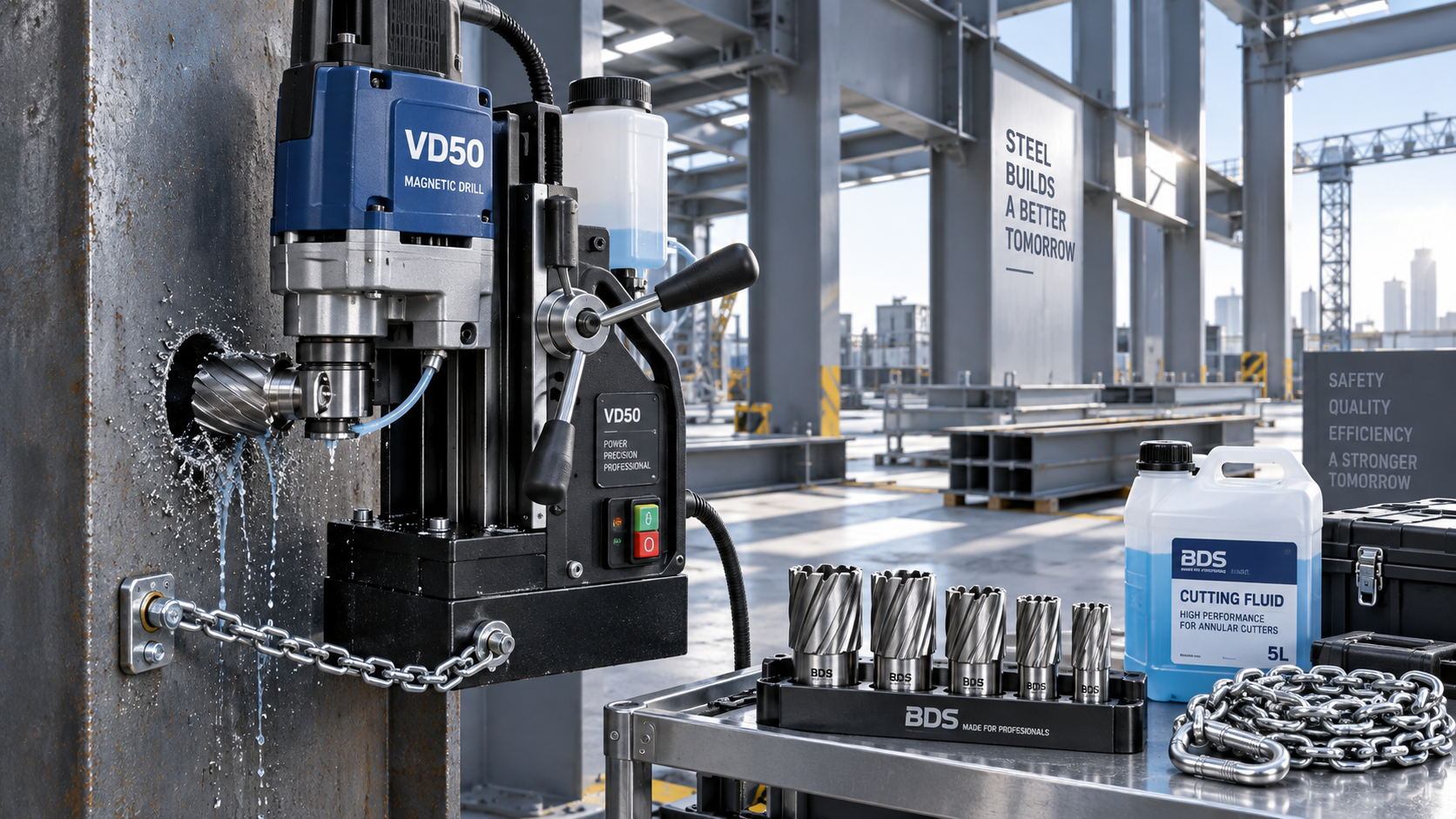
Mobile work also makes small consumables more important. Pilot pins, coolant bottles, spare power leads, safety chains, and deburring tools prevent avoidable interruptions. Their individual cost is modest, but the absence of one item can leave a crew unable to finish a simple task.
Magnetic holding capability affects both safety and productivity
The magnetic base is not just a safety feature. Its holding performance affects setup time, drilling stability, cutter wear, and the likelihood of rework. Rust, paint, scale, thin material, curved surfaces, and gaps between the magnet and steel can reduce effective holding. A quoted magnetic-force figure should therefore be considered alongside the actual surfaces and orientations the team encounters.
Before placing a VD50-class drill into a cost model, identify the percentage of work performed on clean, flat ferrous steel versus coated, thin, irregular, or non-magnetic material. Magnetic drilling may be highly efficient in the first case but may require preparation, clamping alternatives, or a different drilling method in the second. Treating all site steel as ideal magnetic-drill stock produces an optimistic estimate.
Vertical and overhead drilling require additional control. The drill must be secured with the appropriate retention method, and crews need enough access to position themselves safely without rushing the feed. These jobs may be profitable, but their labor allowance should not be based on horizontal bench drilling times.
Compare productivity at the crew level
A low-cost drill can appear economical when it is evaluated only by motor rating and maximum capacity. That comparison misses the cost of the person operating it and the people waiting for the connection or component to be completed.
Use realistic cycle times. Include the time to find a suitable drilling face, clean the contact area, secure the tool, drill, remove chips, inspect the hole, and move to the next point. When management compares alternatives, a short controlled site trial using the actual steel profile is more informative than a capacity claim alone.
Maintenance should be planned around field conditions
A magnetic drill works in an environment that exposes it to metallic chips, vibration, moisture, damaged leads, and inconsistent power supply. Routine checks should include the magnet contact face, cable and plug condition, switch operation, slide movement, fasteners, coolant delivery, and signs of abnormal motor noise or heat. Cleaning chips from the base and keeping the slide mechanism in proper condition protect drilling accuracy as well as the tool.
The maintenance budget should include planned inspection time and a clear process for removing a suspect tool from service. Waiting for a complete failure is rarely economical on mobile projects. It can damage cutters, create inaccurate holes, and force crews into last-minute rental or replacement decisions.
Match the drill capacity to the recurring job mix
Purchasing the largest available drill “just in case” can add weight and capital cost without helping daily work. Conversely, selecting a compact machine for work that repeatedly approaches its capacity can increase wear and slow production. The practical choice is the model that covers the normal workload with a sensible margin while preserving manageable handling for the crew.
For smaller industrial drilling and tapping tasks, a compact reference point is the VD13RE. Its stated configuration includes a 13 mm maximum drilling diameter, 1000 W rated power, 0-700 r/min no-load speed, 11,000 N magnetic force, and a 10 kg net weight. Those specifications can be relevant where portability and routine smaller holes matter, but they should not be used as a substitute for checking the actual hole diameter, steel condition, and access constraints of a VD50 requirement.
VEDON's broader equipment focus on CNC machine tools, intelligent manufacturing solutions, and precision cutting tools is relevant here because drill ownership is not isolated from cutter selection, support, and application fit. The procurement decision should still be driven by the work the team performs most often, not by a specification sheet viewed in isolation.
A practical pre-purchase cost check
Before approving a Magnetic drill VD50 purchase, ask the operating team for a representative list of upcoming work. Record hole sizes, material thicknesses, locations, required orientations, available power, and whether coating removal or surface preparation is common. Then obtain a consumables list and service-parts availability from each supplier being compared.
Build the estimate around an expected number of completed holes per shift, not an assumed drilling speed. Add labor for setup and relocation, allow for cutter replacement, and include a contingency plan for tool failure. The resulting figure will reveal whether a lower purchase price genuinely reduces project cost or simply transfers risk into consumables, downtime, and labor.
For mobile steelwork teams, the best purchase is usually the drill system that produces repeatable holes under normal site conditions, has a manageable operating routine, and can be kept working without disrupting the crew. That is the cost basis that protects both budget predictability and project margin.

Vedon
Typically replies within minutes
Any questions related to Home?

William / CEO / Brand Founder

Vinson / Sales Director

Elaine / Sales Manager

Jessica / Sales Manager