


VMC650 Selection Criteria for Precision Parts and Medium-Batch Output
A VMC650 is usually considered when a production team has outgrown manual machining or smaller vertical centers but does not need the footprint and cost of a larger machining platform. The pressure often appears during medium-batch work: parts are dimensionally acceptable on the first few pieces, then tool wear, repeated setups, fixture limitations, or insufficient chip evacuation begin to affect consistency. Procurement decisions made only on a headline spindle speed or travel figure can leave these production risks unresolved.
The right VMC650 should be selected from the actual part family, not from machine size alone. For precision parts and recurring medium-batch output, the strongest evaluation starts with five linked questions: can the machine hold the required tolerances throughout a shift, support the largest fixture and workpiece safely, remove material at the needed rate, change tools without interrupting flow, and remain serviceable when a production issue occurs? A machine that fits these conditions is generally a better investment than one with an attractive specification but weak alignment with the process.
Begin with the part mix, not the machine brochure
Before comparing VMC650 models, collect representative drawings from the work that will occupy the machine most often. Include not only the largest part, but also the parts with the tightest positional tolerances, deepest cavities, longest tools, and most demanding surface-finish requirements. A medium-batch environment rarely produces one identical component forever; the selected machine needs enough flexibility to handle the recurring range without frequent compromises.
Useful information to confirm with engineering and production includes:
- Finished workpiece dimensions, weight, and material grade.
- Fixture dimensions, clamping method, and any need for fourth-axis or rotary-fixture access.
- Required tolerances for holes, profiles, bores, and datum relationships.
- Typical tool diameters, maximum tool length, and expected cutter reach.
- Cycle-time constraints and expected batch frequency.
- Whether the work involves aluminum, carbon steel, stainless steel, cast iron, or mixed materials.
A VMC650 may have a worktable that appears sufficient for the part outline while still being too restricted once fixture plates, locating devices, clamps, and tool-clearance space are added. Purchasing should evaluate the complete setup envelope. It is also important to verify whether the spindle nose can reach all required machining faces without excessive tool extension, because long overhang can reduce rigidity and affect finish quality.
Travel capacity is only one part of usable machining space
The “650” designation is often associated with a nominal travel class, but buyers should not assume that all machines in this category offer the same usable range. X-, Y-, and Z-axis travel must be checked against the real fixture layout and the height of the tallest workpiece. Z-axis capacity becomes especially important when tall fixtures, vises, angle plates, or long drills are involved. A machine can physically accept a component yet still create an awkward setup with limited clearance for safe tool changes and inspection.
Ask for the table dimensions, maximum table load, T-slot arrangement, spindle-to-table distance, and spindle-center-to-column distance. These figures help determine whether heavy fixtures can be placed correctly and whether the machine can maintain stable cutting near the table edges. For parts that require multiple vises or pallet-style fixture plates, table load should include the total weight of the workholding hardware, not just the raw material.
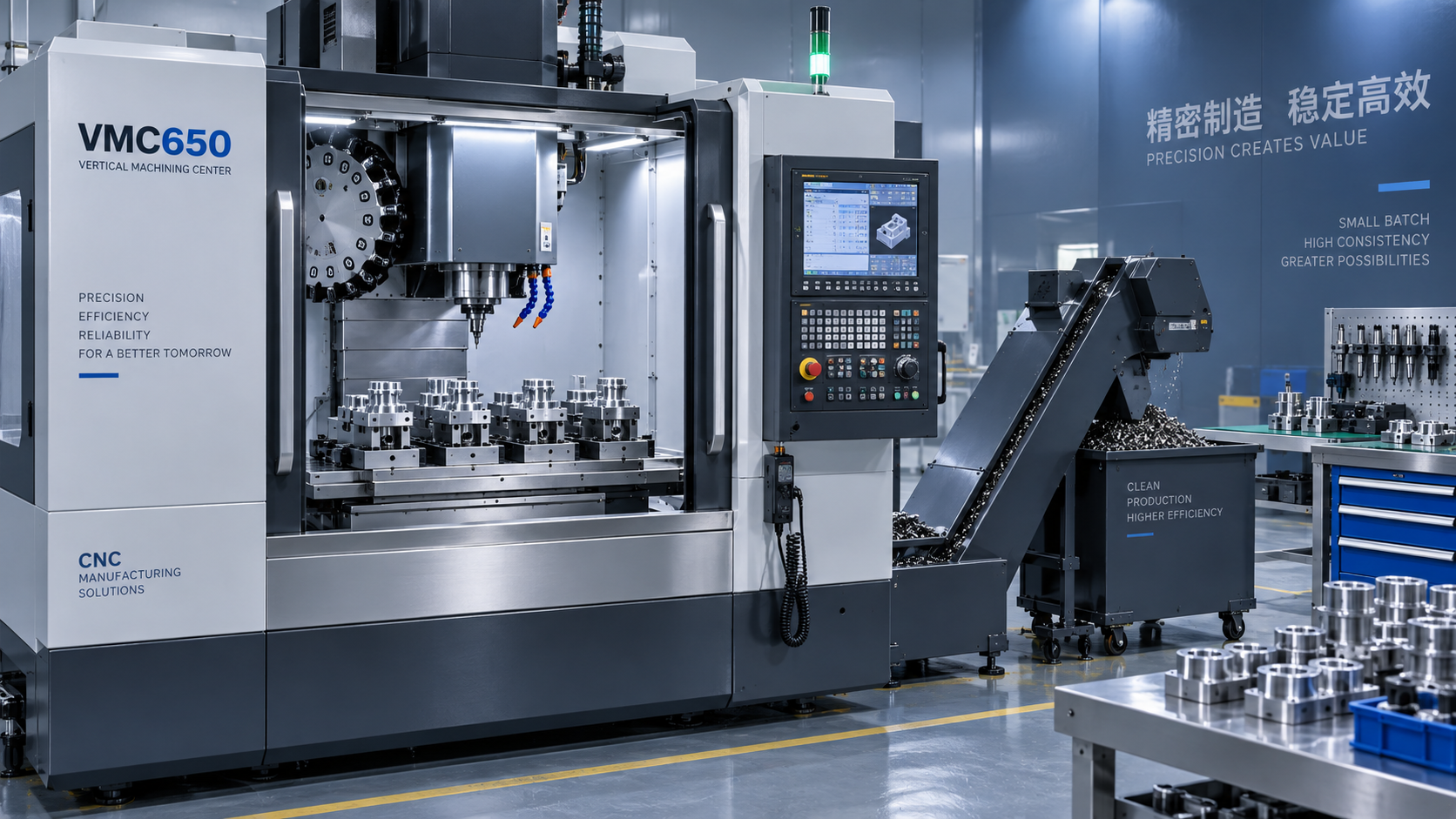
Procurement should also look beyond static capacity. A table rated for a certain load does not automatically mean that rapid movements, acceleration, and repeated direction changes will be equally suitable for every heavy setup. When batches involve dense steel fixtures or large castings, request clarification on the recommended working conditions rather than relying on maximum figures alone.
Accuracy must be evaluated as a production condition
For precision parts, positioning accuracy and repeatability should be considered separately. Positioning accuracy indicates how closely an axis reaches a commanded coordinate, while repeatability concerns its ability to return consistently to the same location. In medium-batch production, repeatability is often the more immediate concern because the machine will perform the same tool paths across many parts, sometimes after tool changes, operator intervention, and thermal variation.
Specification sheets are a starting point, not a full quality assessment. Ask how accuracy values are measured, whether they apply across the usable travel range, and what machine features help preserve stability during normal operation. Relevant construction details may include guideway type, ballscrew support arrangement, axis-drive design, lubrication method, and thermal management around the spindle and machine structure.
Precision also depends on the production system surrounding the machine. Stable workholding, correct toolholder selection, controlled tool runout, calibrated probing routines, and disciplined offset management all influence finished dimensions. A highly specified VMC650 will not compensate for a fixture that allows the part to move under cutting load. During evaluation, procurement teams should therefore ask which inspection or probing options are available and whether they match the factory’s established quality-control process.
Match spindle capability to the cutting workload
Spindle speed alone is not a reliable indicator of machining capability. Higher speed can be beneficial for small tools, aluminum, finishing operations, and certain high-speed toolpaths. However, steel roughing, larger face mills, deep drilling, or difficult materials often depend more heavily on usable torque, spindle power, rigidity, and consistent coolant delivery.
A practical review separates the expected work into cutting patterns. For example, a shop producing aluminum housings with many small holes may value speed, rapid acceleration, and efficient tool changes. A shop machining steel plates with tapped holes and milled pockets may place greater emphasis on low- to mid-speed torque and robust chip control. When both occur on the same machine, the spindle option should support the dominant workload without making the secondary work impractical.
Coolant and chip management deserve a direct review. Chips accumulating around fixtures can affect seating, obstruct probing, and create unnecessary operator intervention. For materials that produce long or packed chips, confirm the coolant arrangement, chip conveyor suitability, and accessibility for routine cleaning. These details influence actual throughput more than they may appear to during a quotation comparison.
Tool capacity affects batch flow
Medium-batch work often involves frequent part changes, but that does not mean tool capacity is unimportant. A limited magazine can force operators to replace tools between operations, increasing the chance of loading errors and offset mistakes. Count the tools required for a typical complete part cycle, including drills, spot drills, taps, roughing cutters, finishing cutters, chamfer tools, probes, and backup tools where appropriate.
Tool-to-tool change time matters when a cycle contains many operations, but reliability is more important than a marginally faster claim. Check the permitted tool diameter and length, maximum tool weight, adjacent-pocket restrictions, and the process for recovering from a tool-change interruption. These factors are particularly relevant when parts require long drills, large cutters, or mixed tool assemblies.
Automation should solve a real handling problem
Automation compatibility is worth evaluating when loading, unloading, deburring delays, or unattended running are creating a bottleneck. The required level may be simple: a probing package, a hydraulic fixture interface, a rotary table, or a workpiece loading provision. Fully automated loading is not always the correct first step for medium batches, especially when parts vary widely in shape and setup complexity.
The best approach is to identify the actual idle time. If the spindle waits mainly for an operator to indicate a new fixture, repeatable zero-point clamping may provide more value than complex loading equipment. If workpieces are similar and production volume is predictable, an automation-ready layout can be a sensible requirement. Confirm controller interfaces, safety provisions, floor-space needs, and access for manual operation before making automation a purchase condition.
Separate the CNC machining decision from auxiliary drilling needs
Some production areas also need portable drilling for fabrication, repair work, structural components, or pre-machining tasks that do not belong on a VMC. In those situations, a magnetic drill such as the VD60 may be relevant as separate supporting equipment. Its listed drilling capacities extend through different model options, with the VD60 configuration intended for larger drilling work. This type of tool should not be treated as a substitute for the positioning accuracy, programmed interpolation, enclosed cutting environment, or repeatable fixturing of a vertical machining center. Keeping these roles distinct prevents an incorrect comparison during sourcing.
Supplier support should be assessed before the order is placed
A VMC650 purchase includes commissioning, parameter setup, operator familiarization, maintenance planning, and access to spare parts. Problems with a production machine are rarely limited to a single component; they may involve tooling, program logic, servo settings, lubrication, workholding, or material variation. The supplier should be able to define the support route clearly rather than offering only general assurances.
Ask practical questions: What is included in installation? Which consumable and critical spare parts should be held locally? How are remote diagnostics handled? Is documentation available for electrical, lubrication, and routine maintenance procedures? Can the supplier clarify controller functions, optional accessories, and machine configuration before the final purchase order? Clear answers reduce the risk of discovering important limitations after delivery.
The final selection should be based on a documented comparison of real part requirements, fixture envelope, precision expectations, cutting duty, tool demand, and support capability. When those criteria are reviewed together, procurement can distinguish between a VMC650 that merely fits the budget and one that can support dependable medium-batch production without creating avoidable setup, quality, or maintenance problems.

Vedon
Typically replies within minutes
Any questions related to Home?

Elaine / Sales Director

Jessica / Sales Manager

Jaye / Sales Manager