Why Annular Cutter Selection Matters for Magnetic Drill VD50 Productivity
For project managers responsible for steel fabrication, maintenance, or site installation, annular cutter selection directly affects the productivity of a Magnetic drill VD50. The cutter is not a small purchasing detail; it is the part that determines how quickly a crew gets through a drilling schedule, how cleanly holes are produced, and how often work stops for replacement or rework.
On a busy structural steel job, delays rarely come from one dramatic failure. More often, they accumulate through slow drilling, burnt cutter teeth, oversized holes, difficult slug ejection, and repeated repositioning. Choosing a cutter that matches the material, hole diameter, and working conditions gives the drill a fair chance to perform at its intended capacity.
Why the cutter changes the real output of a Magnetic drill VD50
An annular cutter removes only the ring of material around the hole rather than turning the entire hole into chips, as a conventional twist drill does. This is why magnetic drilling is widely used for beams, plates, bridge components, machinery frames, and on-site repair work. Yet the efficiency advantage depends on the cutter’s cutting edge, flute design, and compatibility with the workpiece.
For a Magnetic drill VD50, a poorly selected cutter can create excessive cutting resistance. The motor works harder, feed becomes inconsistent, and the magnetic base may be exposed to vibration that is unnecessary and avoidable. A properly selected cutter, by contrast, should produce even chip formation, maintain a stable cutting sound, and leave a hole that needs little finishing before bolting or assembly.
From a project perspective, this affects more than drilling time. Predictable cutter performance improves labor planning, reduces the number of spare tools crews need to carry, and lowers the risk of discovering fit-up problems after steel members have already moved to the next operation.
Start with the material, not the diameter
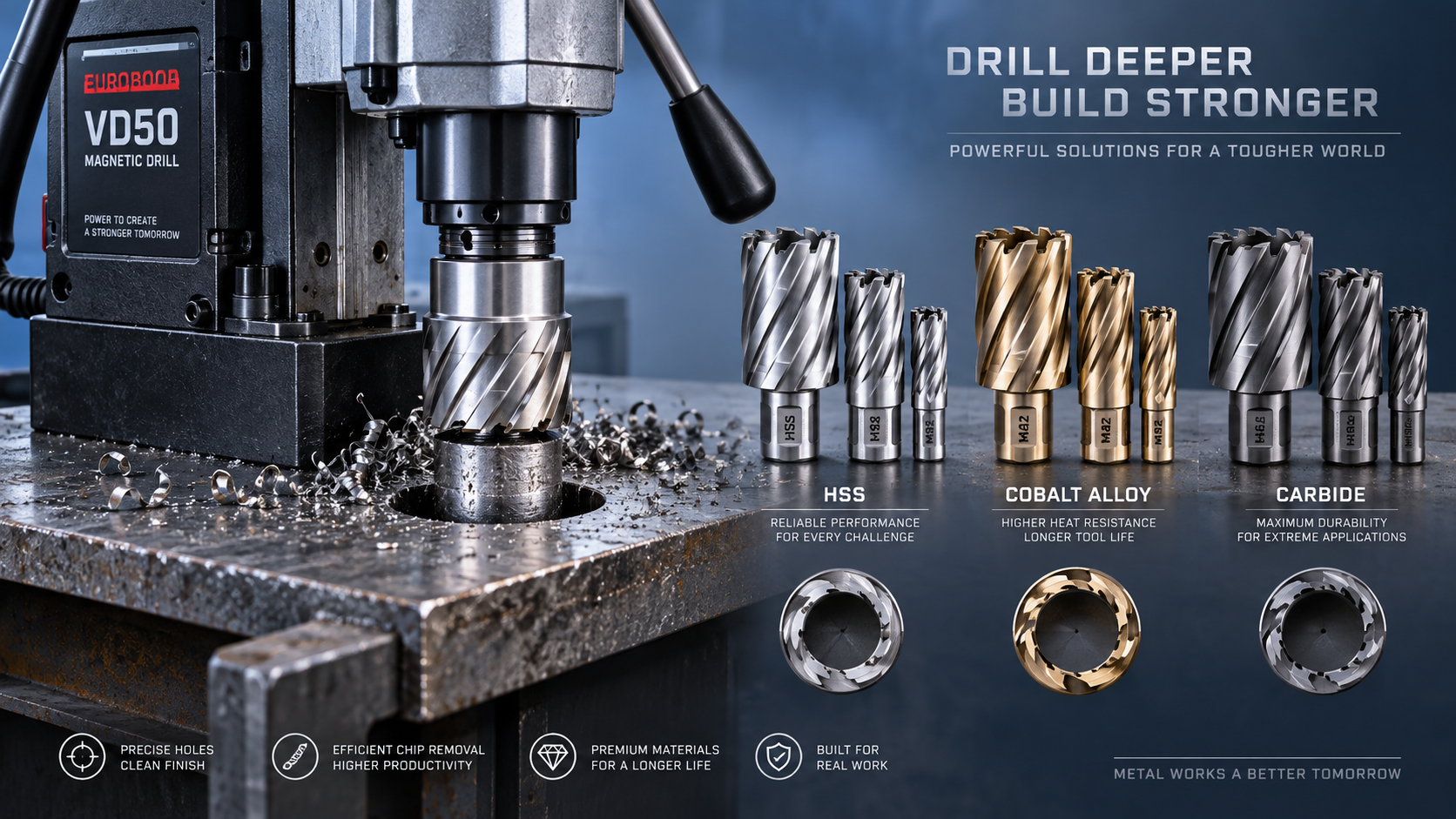
Diameter matters, but material is usually the first decision point. Standard high-speed steel (HSS) annular cutters are often suitable for general mild steel and routine fabrication. They offer a practical balance of cutting performance and cost when the material is clean, stable, and not excessively hard.
Harder steels, stainless steel, high-strength structural material, or workpieces with abrasive scale demand more attention. Cobalt-alloy HSS cutters generally retain edge hardness better under heat, making them a sensible choice where ordinary HSS cutters dull too quickly. For demanding production conditions or difficult materials, carbide-tipped annular cutters may offer longer usable life and improved resistance to wear. However, carbide is less tolerant of impact. A cutter that performs well in a rigid workshop setup can chip if it is used on an unstable site assembly with vibration or interrupted cuts.
Before approving a cutter order, ask a straightforward question: what is the actual steel at the drilling point? A beam may be carbon steel, but it may also have galvanized coating, paint buildup, mill scale, laminations, or a previously welded area. These details change heat generation and edge wear. Selecting solely by a catalog statement such as “for steel” is often too broad for a time-sensitive project.
Cutting geometry determines how the hole behaves
The number and shape of cutter teeth influence chip evacuation, cutting pressure, and finish quality. Larger diameters generally use more cutting teeth to distribute load, while flute geometry helps carry chips away from the cutting zone. When chips pack into the flutes, heat rises rapidly and the cutter can lose sharpness long before its expected service life.
Cut depth also deserves attention. A cutter should have enough cutting depth to pass through the material without forcing the operator into an awkward reset or relying on an unsuitable extension arrangement. At the same time, buying deep-cut cutters for every task is not always efficient. Longer cutters can be more expensive and may require greater care in feed control, particularly when drilling thinner stock where a short cutter would be more stable.
Hole tolerance is another practical issue. If holes are intended for close-fit pins, alignment bolts, or assembled mechanical components, cutter runout and pilot pin condition become important. Worn pilot pins can reduce centering accuracy and interfere with slug ejection. A cutter may still appear sharp, yet produce inconsistent results because the pilot system has been neglected.
A field-oriented selection checklist
Project teams do not need an overly complicated tool matrix, but they do need a repeatable way to avoid mismatches. The following checks are useful before cutters are issued to a crew:
- Confirm the workpiece material and thickness. Include coatings, scale, weld zones, and whether the surface is flat enough for secure magnetic mounting.
- Match shank type to the drill arbor. Cutter performance is irrelevant if the shank does not seat correctly or the pilot pin is incompatible.
- Select diameter for the finished requirement. Do not assume a larger hole will solve alignment issues; oversizing can compromise connection quality and create downstream approval questions.
- Choose cutting depth with the full setup in mind. Consider material thickness, access clearance, and whether chips can exit freely.
- Plan coolant use. Cutting fluid is especially valuable for larger holes, thicker sections, and stainless or high-alloy materials. It reduces friction and helps preserve the edge.
- Inspect the pilot pin and ejector action. A clean slug release prevents dangerous manual removal and keeps the drilling sequence moving.
Speed, feed, and magnetic holding force must work together
Even the right annular cutter will underperform when drilling parameters are wrong. Running too fast creates heat and accelerates wear; feeding too lightly can cause rubbing instead of cutting. Excessive force, meanwhile, can overload the cutting edge and produce rough holes. Operators should aim for steady, purposeful feed that creates consistent chips rather than dust or discolored fragments.
Magnetic holding force is part of this equation. The drill must be placed on a clean, sufficiently thick ferrous surface with no loose paint, scale, or debris beneath the magnetic base. If the workpiece is thin or irregular, the available holding force may be reduced. In those circumstances, cutter selection should favor controlled, low-vibration cutting rather than aggressive production rates.
For industrial metal drilling where portability and controlled power matter, the VDW50 provides a useful operating range. Its 1500W rated power, 0–600 r/min no-load speed, 12,000N magnetic adhesion, and maximum 50 mm core drilling capacity support a wide variety of fabrication and maintenance tasks. Those figures do not eliminate the need for correct cutter selection; they make correct selection more valuable by allowing the tool, cutter, and operator to work as one system.
Common choices that look economical but cost time later
A frequent mistake is standardizing on the cheapest cutter for every steel grade. This can appear efficient at procurement stage, but it often shifts cost to the site through slower drilling and higher consumption. Another common error is continuing to use a cutter after it has begun to rub, chatter, or leave a visibly poor hole edge. Operators may try to compensate with more pressure, which usually damages both the cutter and the schedule.
It is also risky to treat used cutters as interchangeable stock without labeling. Separating cutters by diameter, cutting depth, material grade, and wear condition helps crews avoid mounting an unsuitable tool when work is moving quickly. A simple inspection routine—checking teeth, flutes, shank condition, and pilot pin movement—can prevent an avoidable stoppage at height or in a restricted installation area.
Make cutter planning part of the drilling plan
The most productive projects treat annular cutters as planned consumables, not emergency replacements. Estimate the hole sizes and steel grades in advance, assign suitable cutter types to each work package, and keep a realistic reserve for difficult locations or unplanned modifications. This approach gives supervisors better control over both progress and quality.
For a Magnetic drill VD50, the right cutter is the link between available machine power and dependable field results. When material suitability, geometry, cooling, and operating discipline are considered together, drilling becomes less of an uncertain site activity and more of a controlled production step—exactly what a project schedule needs.

Vedon
Typically replies within minutes
Any questions related to Home?

William / CEO / Brand Founder

Vinson / Sales Director

Elaine / Sales Manager

Jessica / Sales Manager