


Gantry Machining Center ROI: Bringing Large-Part Machining In-House
A gantry machining center can justify its investment when a dependable workload generates enough savings to cover ownership and operating costs. A large outsourcing bill alone does not prove the case. The work must fit the machine, the factory must support it, and the production team must deliver acceptable parts at a realistic cost.
The strongest business case usually starts with recurring components that are expensive to transport, difficult to schedule externally, or critical to assembly. The decision becomes less attractive when demand is irregular, machining requirements vary widely, or the forecast assumes the machine will run continuously from installation.
Start with the work you can actually bring in-house
Review outsourced jobs by part family, drawing revision, material, annual quantity, machining cost, and delivery performance. Separate machining charges from raw material, heat treatment, coatings, and other services that would remain external. Only costs that disappear after the transfer belong in the savings calculation.
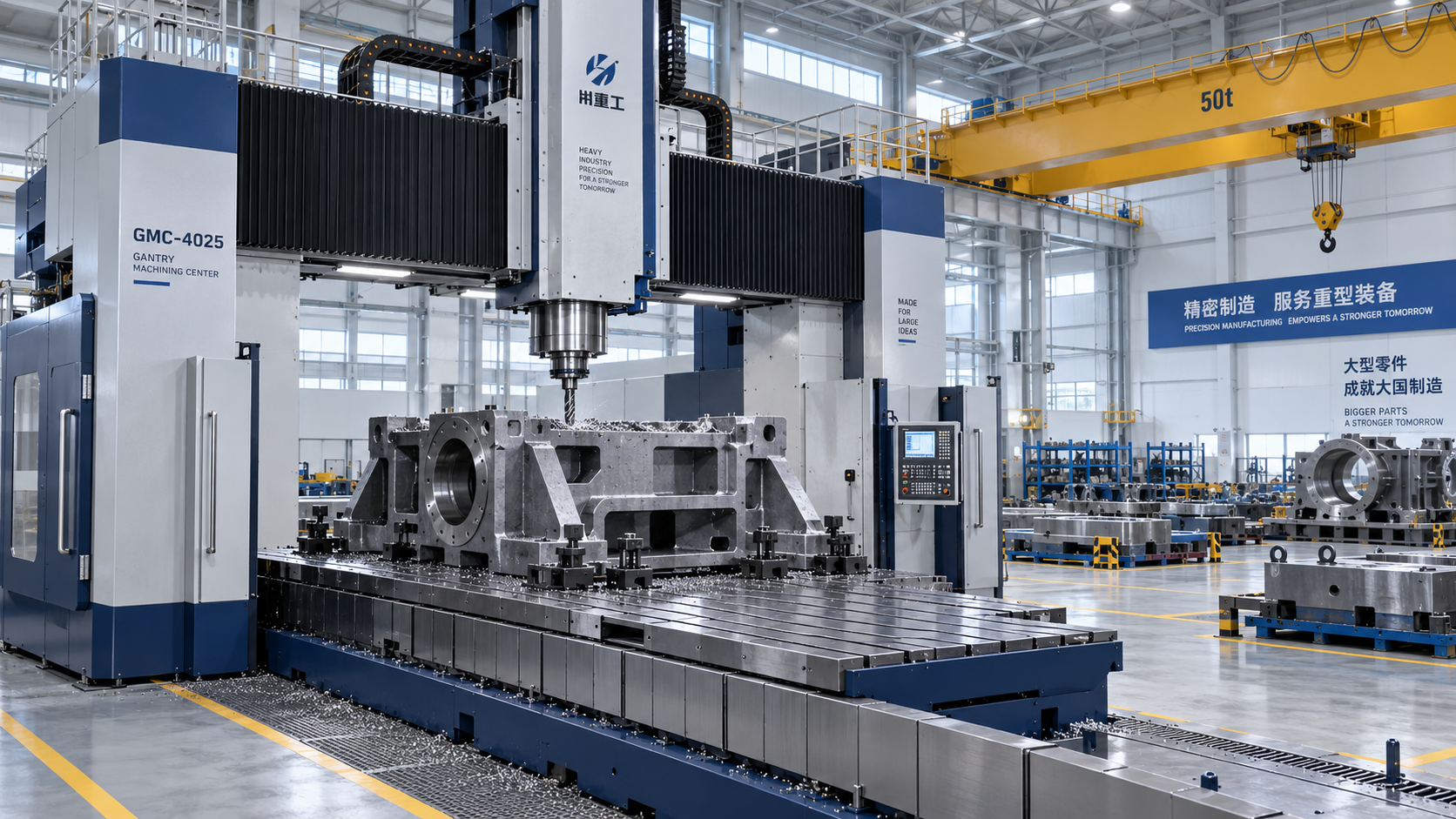
Then identify which operations suit a gantry machining center. Large bases, plates, frames, and housings may be candidates when they require milling, drilling, boring, or coordinated machining across widely spaced features. However, overall dimensions are only the first screening condition.
A component must fit with its fixtures, cutting tools, and loading clearances. Table load capacity must accommodate the workpiece and workholding arrangement, including load distribution. Access to side faces, deep cavities, or angled features may require additional heads or setups that change both the purchase price and cycle time.
Keep turning work in a separate investment calculation. For example, the TCK700 is a CNC turning machine with a 45-degree slant bed and a 12-station turret. It may be relevant to rotational components within a broader production plan, but its turning capacity does not establish suitability for large-frame milling. Matching each process to the correct machine prevents unrelated outsourcing expenditure from inflating the gantry investment case.
The installed cost extends beyond the quotation
Compare proposals against a common production requirement. A lower machine price can lose its advantage if essential tooling, probing, software, installation work, or application support appears later as additional expenditure.
Large-part handling deserves an early site review. A machine may fit on the floor while the longest component cannot pass through the loading route or rotate beneath the crane. Include space for staging, inspection, maintenance access, and chip removal. These requirements can affect the factory layout as much as the machine footprint.
Accuracy also has an infrastructure cost. Temperature changes, foundation behavior, workpiece support, and residual stress in the material can influence finished geometry. Buying a machine with suitable positioning specifications does not, by itself, guarantee that a large fabricated structure will remain flat after unclamping.
Calculate savings on equivalent finished parts
The useful comparison is the cost of producing the same accepted component through each route. Comparing a supplier’s finished-part price with internal cutting time leaves out much of the work required to make a usable part.
For the external route, include avoidable machining charges, freight, packaging, incoming inspection, and documented expediting or supplier-related rework costs. For the internal route, include setup and operating labor, programming, tools, energy, coolant, inspection, maintenance, and expected scrap or rework.
Keep shared costs consistent. If both routes use the same purchased casting, its cost normally cancels out of the comparison. However, a higher internal scrap rate would increase material consumption and must be included.
Annual net operating cash benefit = avoidable external costs − additional internal operating cash costs.
Simple payback = total initial cash investment ÷ annual net operating cash benefit.
Simple payback is a screening measure. It works best when annual benefits are reasonably stable. Where production ramps up gradually, calculate cumulative cash flow year by year to identify when the investment is recovered.
For a fuller ROI assessment, evaluate cash flows across the planned ownership period, including major maintenance, working capital recovery, and a reasonable residual value. Discounted cash flow helps account for the fact that savings received later have less value today. Keep financing treatment consistent so interest and the cost of capital are not counted twice.
Use cash costs for payback calculations. Depreciation matters for accounting and tax analysis, but it is not an additional operating cash payment. Likewise, an internal overhead allocation may help with product costing without representing cash that changes because of the purchase.
Utilization is where optimistic forecasts usually fail
Available shift hours do not equal productive capacity. Loading, alignment, fixture changes, tool setting, inspection, maintenance, and waiting for drawings or material all consume time. Long cutting cycles can still involve substantial preparation and operator attention.
Build capacity from the actual job mix. Estimate complete machine occupancy for each part family, including setup and any inspection that holds the machine. Apply the expected order quantities, then check whether the required hours fit the staffed schedule with room for disruption.
Do not use spindle hours and occupied machine hours interchangeably. If savings are calculated per cutting hour while capacity is measured by total occupancy, the model can overstate the workload the machine can absorb.
A useful break-even calculation is:
Required annual productive hours = annual fixed ownership cash costs ÷ net savings per productive hour before those fixed costs.
This relationship is useful only when the hourly savings reflect the expected job mix. Heavy roughing, precision finishing, and frequent short batches have different tooling, labor, and setup demands. A single average rate can conceal unprofitable work.
Prepare a base case and a downside case. Reduce transferable volume, extend setup times, and allow a slower startup. If the investment depends on unconfirmed orders or immediate second-shift staffing, those assumptions should be visible in the approval decision.
Delivery control has value when it changes an outcome
Bringing machining in-house can shorten transport loops and make urgent schedule changes easier. The financial value depends on what that control achieves: fewer paid expedites, less buffer inventory, avoided assembly stoppages, or additional orders that the business can fulfill.
Keep these benefits separate from direct machining savings. Inventory reduction is generally a working capital release; it should not be counted repeatedly as an annual saving. Additional sales contribute their incremental margin after associated costs, rather than their full revenue.
Internal production also concentrates risk. If one gantry becomes the only route for a critical component, a breakdown can interrupt several downstream operations. Service response, spare-parts availability, maintenance capability, and a qualified external backup affect the practical value of ownership.
Make the purchase conditional on a production demonstration
Before selecting a machine, provide suppliers with representative drawings, materials, tolerances, batch sizes, and inspection requirements. Ask for a process proposal covering fixturing, machining sequence, tool access, estimated occupancy, and staffing assumptions.
Acceptance criteria should include finished-part results and the conditions used to achieve them. A demonstration is most useful when its tooling, setup method, and inspection approach can be repeated in your factory. Include training, service responsibilities, and the handover process in the commercial agreement.
A phased transfer often offers a stronger starting point: bring a stable part family in-house, measure actual cost and output, and retain external capacity for peaks and specialized operations. Approve the investment when the downside case remains financially acceptable and the production plan explains who will make, inspect, and maintain the work from the first shift onward.

Vedon
Typically replies within minutes
Any questions related to Home?

Elaine / Sales Director

Jaye / Sales Manager

Jessica / Sales Manager