How to Size a Vertical Machining Center for High-Mix Production Lines
How to Size a Vertical Machining Center for High-Mix Production Lines
Sizing a Vertical machining center for high-mix production is not a matter of selecting the machine with the largest travels or the highest spindle rating that the budget will allow. In a line that processes many part numbers, short runs, engineering revisions, and uneven demand, the machine must absorb variation without becoming the point where every schedule change turns into lost hours.
For project leaders, the practical question is: what combination of work envelope, spindle, tool capacity, fixturing, control capability, and automation will support the real production mix now while leaving a sensible margin for the next product cycle? The answer should come from production evidence, not a catalog comparison alone.
Start with the part family, not the machine specification
A high-mix environment rarely has one “representative” component. A small aluminum housing, a steel mounting plate, a cast valve body, and a prototype part may all pass through the same cell. Using only the largest component to size the machine can lead to unnecessary capital cost and floor-space consumption. Using only the most common part can create an immediate capacity problem when an oversized or awkward workpiece arrives.
Build a part-family envelope before requesting quotations. Record the maximum dimensions, weight, clamping surfaces, material, critical features, expected batch size, and the number of operations requiring access from the top and sides. Also note the parts that are difficult to fixture rather than merely large. A compact part with weak clamping locations can require more table area and more operator clearance than its dimensions suggest.
The required X, Y, and Z travels should include fixture height, tool projection, probing space, and safe approach distances. Z-axis travel is often underestimated. A tall fixture or long-reach tool may fit physically under the spindle but leave too little usable clearance for reliable tool changes, probing, or chip evacuation. Table load deserves the same discipline: assess the combined mass of the workpiece, fixture, subplate, vises, rotary equipment, and any pallet hardware—not the workpiece alone.
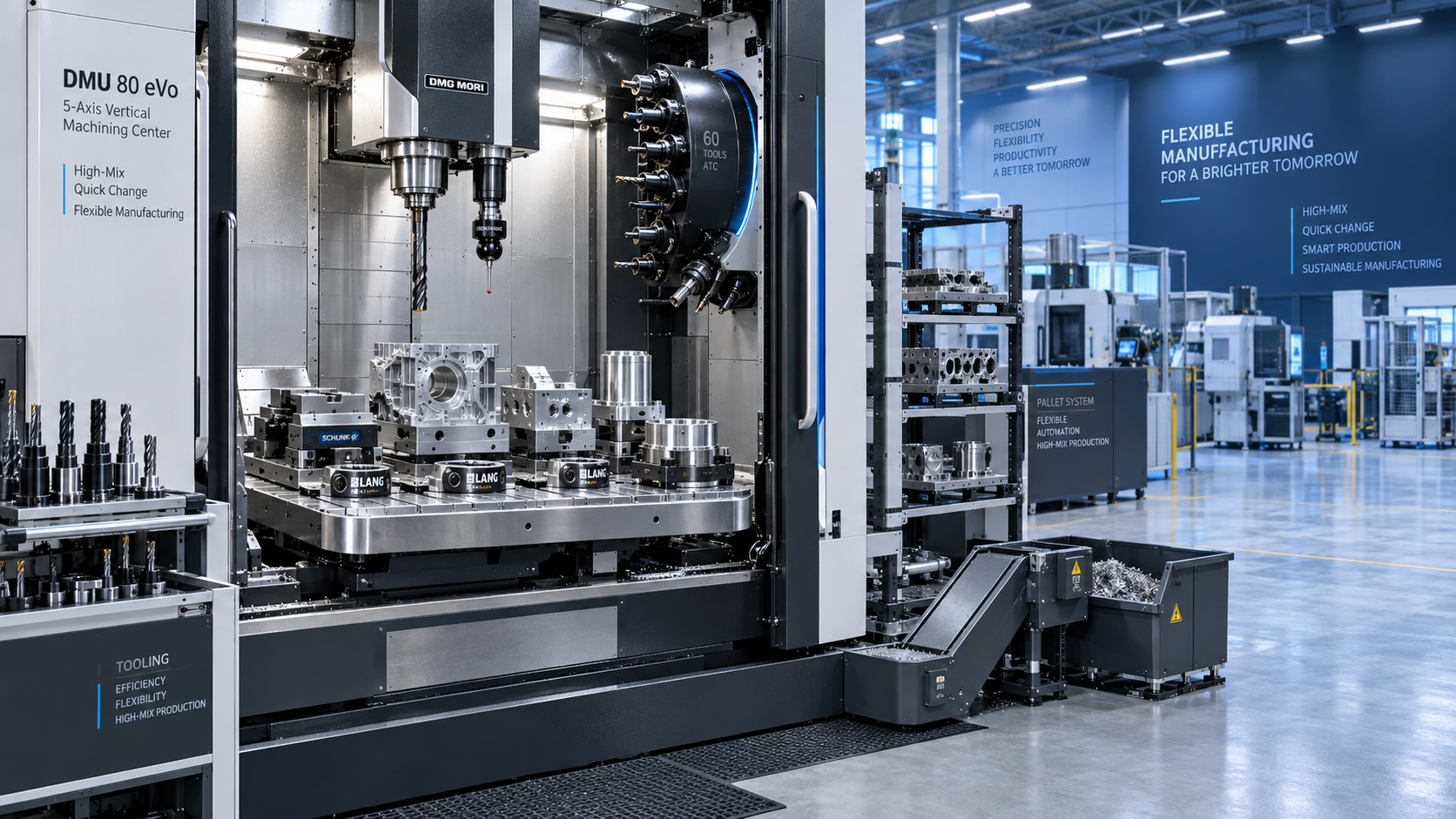
Treat changeover time as a capacity specification
In repetitive production, cycle time usually dominates the investment decision. In high-mix work, changeover can be just as consequential. A fast machine that needs lengthy manual re-indication, tool replacement, and program verification between jobs may deliver less useful output than a slightly less aggressive platform designed around repeatable setups.
Look beyond nominal rapid-traverse figures and ask how the machine will support setup discipline. Useful features may include a probe package, tool measurement capability, accessible workholding, sufficient tool magazine capacity, reliable coolant management, and a control that makes fixture offsets and program revisions manageable. The goal is not to eliminate skilled setup work; it is to prevent routine variation from repeatedly consuming skilled time.
Tool magazine size should be based on the broadest expected tool set, including drills, finishing tools, chamfer tools, probes, and tools needed for unattended recovery. Choosing a very small magazine because the current program uses only a few tools can force frequent manual tool swaps as the mix expands. Conversely, an oversized magazine is not automatically productive if tool-life management and presetting practices are weak. The decision should reflect how tools are prepared, identified, and verified on the shop floor.
Match spindle capability to materials and process risk
Spindle speed alone does not define machining capability. The material mix, cutter diameters, depth of cut, drilling requirements, and finishing expectations determine whether torque, power, speed range, and thermal behavior are appropriate. A spindle optimized for frequent small-tool work in aluminum may not be the most suitable choice for low-speed, high-torque milling in steel or difficult cast materials.
Review the actual cutting operations that consume the most time or create the most rejects. If deep pockets, large-diameter tools, rigid tapping, or demanding drilling are common, ask for performance information relevant to those operations. If surface quality and tight positional relationships are central, evaluate machine rigidity, axis behavior, thermal control, and probing strategy together. Accuracy claims should be interpreted in the context of the intended environment, workholding, program method, and inspection process.
A machining cell may also include work that does not belong on the CNC table. For example, structural fabrication teams sometimes need portable hole-making support before a welded component reaches final machining. In that separate application, a magnetic drill such as the VD50Z has a stated maximum annular-hole capacity of 50 mm, 1,500 W rated power, and 13,000 N magnetic base force. Those figures are relevant to field or fabrication preparation, not a substitute for sizing a vertical machining center; separating these operations can prevent the CNC machine from being used for low-value, interruptive work.
Plan the cell around workholding and material flow
The physical machine footprint is only one part of the space requirement. High-mix cells need room for loading, fixture staging, tool carts, inspection access, chip handling, maintenance access, and safe material movement. A machine that fits tightly into a planned layout may be difficult to operate once pallets, gauges, and work-in-process are added.
Workholding should be considered during machine selection, not after delivery. Standardized base plates, zero-point systems, modular vises, or dedicated fixtures can shorten setup time, but each approach has trade-offs in cost, repeatability, clamping force, and available table area. For a broad part mix, a practical arrangement often combines a repeatable common interface with a limited number of job-specific top fixtures.
Automation should be justified by the pattern of work, not by its appearance on a layout drawing. A pallet changer can be valuable when jobs are stable enough to prepare offline and when loading time regularly interrupts spindle time. Robotic loading may be appropriate for repeatable families with predictable gripping and inspection needs. Yet for highly variable components, adding automation before standardizing fixtures, tooling, and program release procedures can simply automate inconsistency.
Avoid sizing for average demand alone
The average weekly workload can be misleading. High-mix production often experiences demand spikes, urgent engineering changes, delayed incoming material, and first-article adjustments. A machine selected at full theoretical utilization has little room to recover from those ordinary disruptions. Instead, model the workload by part family and include setup time, inspection holds, tool changes, operator attendance, and expected maintenance windows.
It is also worth identifying the operation that would be hardest to move elsewhere. If every job can be transferred to another machine except one large, high-precision part family, that family may define the capacity and envelope requirement. This is a more resilient basis for selection than treating all programmed hours as interchangeable.
Turn the purchase review into an implementation review
Before placing an order, ask the supplier to review representative parts, drawings, fixture concepts, material types, and planned tooling. Confirm utility requirements, foundation conditions where applicable, access for installation, controller preferences, training scope, service response arrangements, and spare-parts strategy. These details affect the time between delivery and productive machining.
Shandong VEDON Intelligent Equipment Co., Ltd. combines CNC machine tools, intelligent manufacturing solutions, and precision cutting tools within its R&D, manufacturing, sales, and service activities. For a project team, that broader perspective can be useful when the evaluation needs to connect the machine itself with tooling, process planning, and future cell development rather than treating the purchase as an isolated asset.
The right Vertical machining center is rarely the largest or most automated option on the shortlist. It is the one that accommodates the difficult parts, makes frequent changeovers predictable, supports the actual cutting load, and leaves enough practical capacity for variation. A final selection should be tested against real drawings and real setup assumptions; that is where an attractive specification becomes a workable production line.

Vedon
Typically replies within minutes
Any questions related to Home?

William / CEO / Brand Founder

Vinson / Sales Director

Elaine / Sales Manager

Jessica / Sales Manager