


When Is a Vertical Milling Machine More Cost-Effective Than CNC Machining?
A vertical milling machine is more cost-effective than CNC machining when the work does not generate enough repeatable, high-value production to recover CNC programming, setup, capital, and support costs. This is most common in low-volume jobs, prototypes, repair work, simple prismatic parts, and operations where an experienced machinist can make adjustments faster at the machine than a programmer can revise a process.
The comparison needs careful framing. A CNC vertical machining center is itself a milling machine, so the practical purchasing question is usually whether a conventional or manually operated vertical mill should handle a given workload instead of moving that work to CNC equipment. CNC generally wins when volume, geometry, repeatability, and unattended cycle time matter. A manual vertical mill can win when responsiveness and low process overhead matter more.
Start with the total cost of producing the part
Machine purchase price is only one part of the decision. For a simple component, the total cost includes drawing review, workholding, CAM programming or manual planning, setup, first-part inspection, machining time, finishing, and the cost of correcting an error. A CNC machine may cut the part faster, but its advantage can disappear when those fixed preparation activities are spread across only one, five, or ten parts.
Consider a maintenance department that needs a replacement bracket with several drilled holes, a milled slot, and a faced surface. On a conventional vertical milling machine, a skilled operator may locate the work, make the features, inspect it, and adjust dimensions during the same shift. Putting that single part through CNC can require model preparation, program creation, proving out, tool selection, fixture design, and machine scheduling. The CNC process may still be justified for a tightly toleranced part, but it is not automatically the lower-cost route.
A useful procurement question is: how many parts will be made before the design changes, the order ends, or the machine setup is removed? The lower the likely quantity, the more important setup cost becomes. This is especially relevant for contract shops with frequent job changes, internal toolrooms, plant maintenance teams, and manufacturers supporting legacy equipment.
When manual control has an economic advantage
A Vertical Milling Machine is often the better financial choice when the machinist needs to make frequent judgment calls that cannot be defined efficiently in advance. Castings with inconsistent stock, repaired weldments, worn replacement components, and parts without complete digital models may require measuring and adapting as machining proceeds. Manual handwheel control, quick repositioning, and direct visual feedback can reduce the time spent formalizing an imperfect job into a CNC-ready process.
It can also be economical for straightforward work such as:
- Facing, slotting, drilling, deburring, and edge-breaking on a small number of parts.
- Producing fixtures, jigs, soft jaws, and inspection aids for an in-house production line.
- Modifying an existing component where dimensions must be established from the physical part.
- Training and toolroom work that requires flexible access to basic milling operations.
- Secondary operations that do not justify taking time on a fully booked CNC machine.
In these situations, a manual machine is not necessarily chosen because it is technically superior. It is chosen because it avoids converting a short, variable task into a formal automated process. That distinction matters: low equipment cost alone does not make a purchase economical; the machine must also fit the flow of work entering the shop.
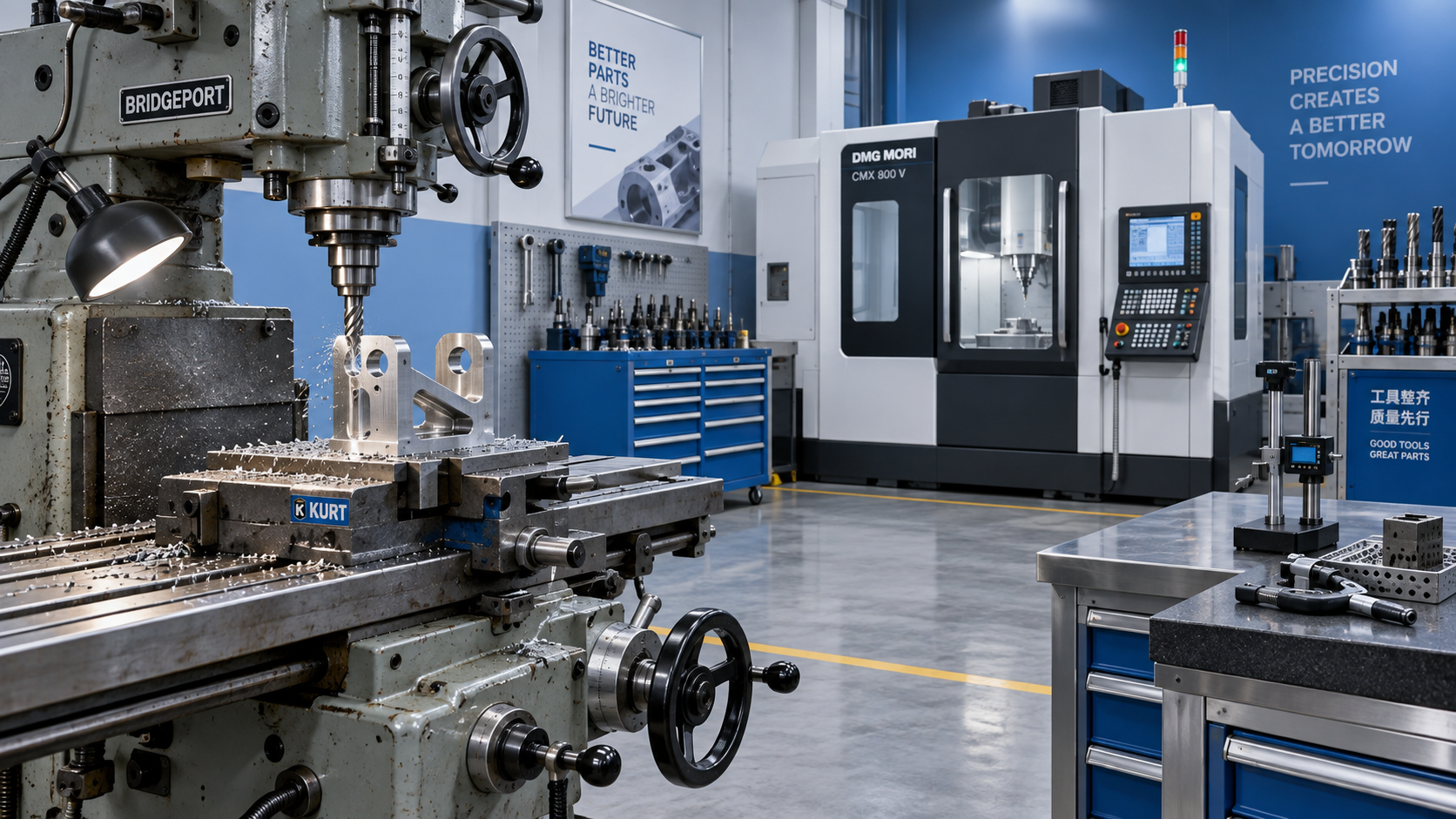
The break-even point is shaped by complexity, not volume alone
Low quantity is a strong signal, but it should not be treated as a universal rule. A one-off aerospace component with multiple angles, deep pockets, close positional tolerances, or difficult-to-reach features may require CNC capability despite being a single piece. Conversely, a run of several dozen flat plates with simple hole patterns may remain practical on a manual mill when tolerance requirements are moderate and the setup is stable.
The tolerance stack is particularly important. Manual milling may be fully appropriate for parts whose dimensions can be checked and adjusted feature by feature. It becomes less economical when inspection, scrap, or rework rises because several features must hold a precise relationship to one another. CNC equipment earns its cost by controlling that relationship repeatedly, not simply by moving faster.
Labor economics can reverse the obvious answer
It is easy to assume that manual work is cheaper because the machine is less expensive. That is only true when skilled labor is available and the task suits manual execution. A conventional mill depends heavily on operator capability: reading the job, selecting tools, establishing datums, controlling feed, and recognizing when material behavior is changing. If the shop must dedicate a highly skilled machinist to repetitive work for long periods, CNC may become cheaper even at modest quantities.
Conversely, CNC work also has labor costs that are sometimes overlooked. Programming, setup, proving out, tool management, fixture preparation, and quality documentation may involve personnel beyond the machine operator. For a changing mix of short jobs, those support activities can consume more time than the actual cutting cycle.
Decision-makers should therefore compare labor by process, not by hourly machine rate alone. Calculate the expected hours for planning, setup, machining, inspection, and correction under each route. Include the cost of delayed work if a shared CNC machine is already committed to production. A lower nominal CNC cycle time has limited value when the part waits several days for an open machine.
Do not force all drilling work onto the milling department
The cost decision can also involve a third option: use a specialized portable or magnetic drilling tool for work that does not require milling-machine rigidity or positioning. Structural steel, large fabrications, shipbuilding assemblies, oil and gas equipment, and field modifications often involve holes that are costly to bring to a stationary machine. In those cases, moving the tool to the workpiece may reduce handling, crane use, and production interruption.
For example, the VD13E is a compact magnetic drilling option with a 13 mm maximum drilling diameter, 120 mm travel, and a magnetic holding force specified at 11000 N. Those specifications are relevant when evaluating hole-making on ferrous structures, where portability and access matter. It should not be treated as a substitute for a milling machine when the job requires precision milling, controlled datums across multiple faces, or complex geometry. It is a way to avoid using a more expensive machine for a simpler drilling task.
Costs that should remain visible in the purchase decision
A manual vertical mill can be a sound investment, but only when its limits are acknowledged before purchase. The machine will need appropriate tooling, measuring equipment, workholding, preventive maintenance, and operators capable of producing the required quality. Buyers should also examine spindle condition, table travel, backlash, head alignment, available power, lifting and installation needs, and the practical size and weight of the parts to be handled.
CNC investment brings a different set of obligations: software, programming capability, tooling standards, fixture capacity, service support, backup procedures, and a plan for machine utilization. Buying CNC capacity for occasional complex work can create an expensive underused asset. Relying only on manual equipment while demand shifts toward repeat orders can create the opposite problem: labor bottlenecks and inconsistent lead times.
The most defensible approach is to classify the last several months of work by quantity, feature complexity, tolerance, setup frequency, and repeat likelihood. Jobs that are short, variable, and simple point toward a vertical mill or specialized drilling equipment. Jobs that repeat, demand controlled geometry, or consume too much skilled manual time point toward CNC. The most cost-effective choice is the one that matches the work mix expected after the purchase, rather than the machine that appears cheapest on the quotation.

Vedon
Typically replies within minutes
Any questions related to Home?

Elaine / Sales Director

Jessica / Sales Manager

Jaye / Sales Manager