Is the Magnetic Drill VD50 Suitable for Structural Steel Hole Drilling?
The Magnetic Drill VD50 can be a suitable choice for structural steel hole drilling when the job involves accurately positioned holes on ferrous steel members, particularly during fabrication, erection, repair, or modification work. Its value is not simply that it drills faster than a hand-held drill. A magnetic drill holds itself to the workpiece, keeping the cutter more stable and reducing the effort needed to produce repeatable bolt holes.
That said, suitability depends less on the nameplate and more on the actual steel section, hole specification, work location, access conditions, and safety controls. A VD50-type magnetic drill is generally a practical site tool for beams, columns, plates, channels, and other structural components with a clean, sufficiently thick magnetic surface. It is not automatically the right answer for every steel-drilling task.
Where a Magnetic Drill VD50 Fits Structural Steel Work
Structural steel projects often require holes after members have been delivered or positioned: connection changes, missed holes, added brackets, handrail supports, stiffeners, equipment supports, and field corrections are common examples. Moving a large member back to a workshop just to drill a limited number of holes can disrupt sequencing. A portable magnetic drill addresses this problem by bringing controlled drilling to the steel member.
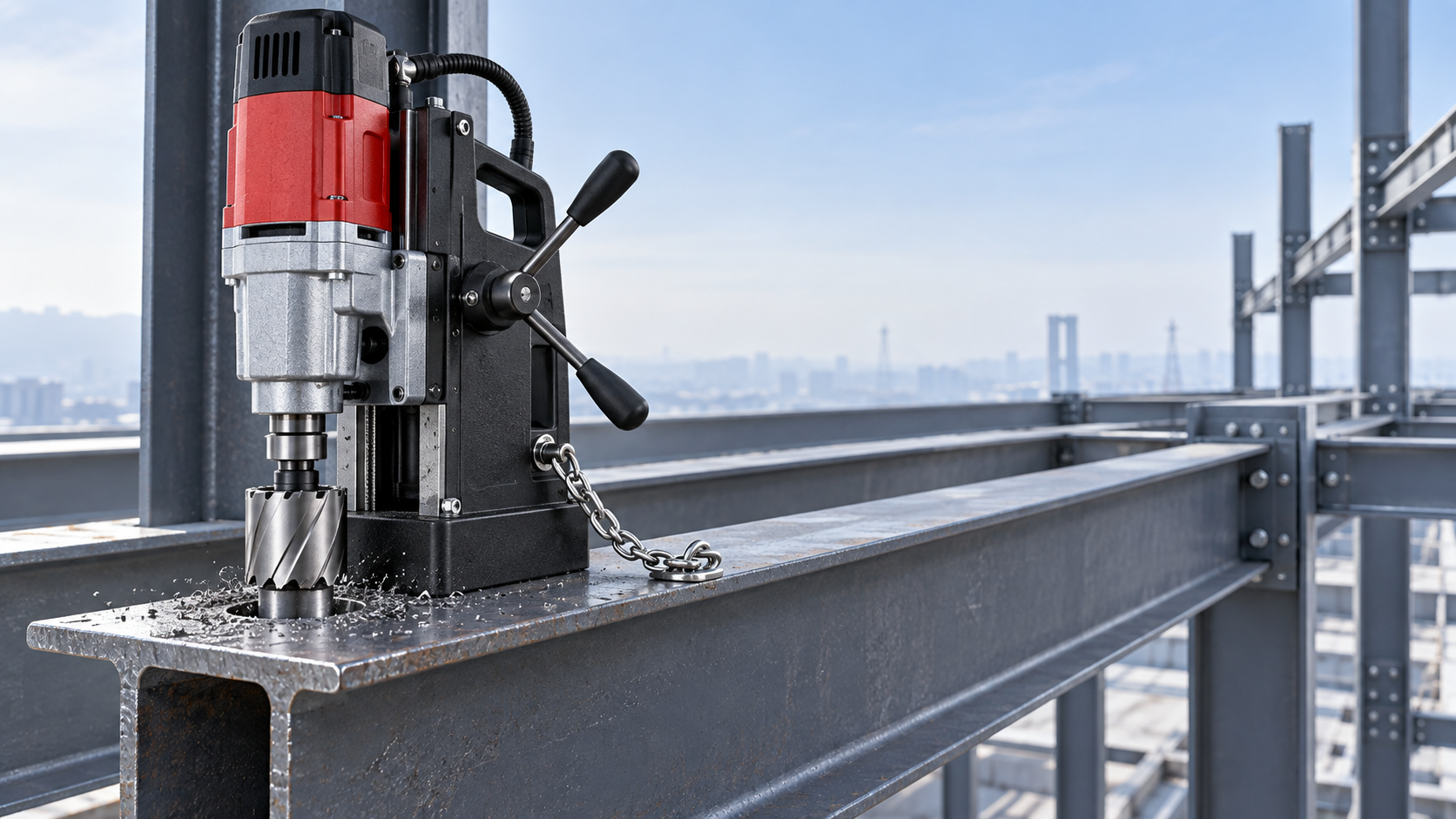
The Magnetic Drill VD50 is most appropriate when the drilling surface is flat enough for the magnet to seat fully and the material is magnetic. On a properly prepared steel plate or beam flange, magnetic adhesion stabilizes the machine while the cutter enters and exits the material. This helps the operator maintain hole location and reduce cutter wandering, especially compared with starting a larger hole using a conventional portable drill.
For projects with repeated connection holes, the practical benefit is consistency. A stable drill is easier to align from layout marks or a template, and annular cutters remove only the material around the hole rather than turning the entire hole into chips. This can make larger-diameter holes more manageable in structural steel.
The Conditions That Decide Whether It Is a Good Choice
Before assigning a magnetic drill to the work package, review the drilling conditions as a group. Focusing only on the desired hole diameter is a common purchasing and planning mistake.
A magnetic drill is not a substitute for checking the connection drawing. The hole center, bolt clearance, edge distance, member access, and whether the change affects the connection design should be resolved before cutting begins. Fast drilling does not correct an incorrectly located hole.
Magnetic Holding Is the Primary Safety and Quality Check
Magnetic adhesion is the foundation of the process. The drill base should sit on bare, reasonably smooth ferrous steel with no weld spatter, loose mill scale, thick paint, chips, or uneven buildup underneath it. Cleaning a small seating area takes little time and can prevent poor alignment, vibration, cutter damage, and movement during the cut.
Do not assume that a large steel member always provides a secure magnetic base. A narrow flange may not offer enough flat area for the full magnet. A tapered, curved, corroded, or heavily coated surface can also reduce contact. Material composition matters as well: magnetic drills are intended for ferrous materials and cannot rely on their magnet when used on stainless grades with low magnetic response, aluminum, or other non-ferrous materials.
For vertical and overhead work, a safety chain or strap is not optional. It provides secondary retention if power is interrupted or holding conditions change. The drill should be supported before placement, and the operator should remain clear of the potential drop path. These controls matter as much to schedule protection as to personnel safety: a dropped drill can damage the workpiece, access equipment, or nearby completed work.
Accuracy Depends on Setup, Not the Drill Alone
A Magnetic Drill VD50 can produce clean, usable structural holes, but field accuracy comes from layout and setup discipline. Mark the hole center clearly, verify the reference dimensions from a stable datum, and use the cutter pilot pin or centering method appropriate to the tooling. Check that the drill body and feed handles have enough clearance before energizing the magnet; a drill that is correctly centered but impossible to feed safely must be repositioned.
Annular cutters are usually the preferred tooling for larger holes because they cut an annulus instead of removing the full core. Their performance depends on using an undamaged cutter, correct pilot pin, steady feed pressure, and appropriate lubrication. Excessive force can chip the cutter or cause binding. Too little feed can generate excess heat and shorten tool life. The goal is a controlled cut with visible chip formation, not maximum lever pressure.
After breakthrough, remove the slug carefully and inspect the hole. Burrs, misalignment, or an elongated hole may signal poor seating, cutter wear, excessive vibration, or an unsuitable surface. Treat the first few holes in a new work condition as a process check, rather than assuming every location will behave the same way.
When a Magnetic Drill Is Not the Best Method
There are clear cases where the portable solution should give way to another process. If the member is non-magnetic, too thin, severely curved, inaccessible, or cannot provide a stable base, a magnetic drill should not be forced into service. A clamped drilling arrangement, purpose-built fixture, or other approved method may be required.
It is also a poor fit when a large number of holes must meet closely controlled positional requirements across a repeatable part. That work is generally better completed before assembly on a CNC machining center. For fabricated plates, brackets, and precision connection components, equipment such as the VMC855 provides a more controlled shop-based option, with a rigid worktable, programmed positioning, and repeatable axis movement. Its role is different from a portable magnetic drill: it supports planned precision machining, while a magnetic drill supports flexible field or fabrication-floor work.
This distinction helps avoid a costly decision error. Do not buy a magnetic drill to solve a production-volume or tight-tolerance machining problem, and do not delay a small site modification by treating it like a CNC workshop job.
A Practical Pre-Deployment Check
Before committing the VD50 to a structural steel package, confirm these points with the supervisor and operator:
- The material is ferrous and provides a flat, clean area for full magnetic contact.
- The hole diameter, material thickness, and required cutter depth match the planned tooling.
- The hole locations have been checked against the approved connection details and accessible reference points.
- The drill can be positioned and fed without interference from web plates, welds, adjacent steel, or access equipment.
- A safety chain or strap is available for non-horizontal work, along with suitable power management and chip control.
- The expected hole volume justifies portable drilling rather than shop machining before installation.
For localized structural steel drilling on suitable ferrous surfaces, the Magnetic Drill VD50 is a sensible, efficient tool category. Its best results come from treating magnetic contact, hole layout, cutter selection, and work orientation as part of one drilling plan. When those conditions are in place, it can reduce site rework time without compromising the discipline required for structural connections.

Vedon
Typically replies within minutes
Any questions related to Home?

William / CEO / Brand Founder

Vinson / Sales Director

Elaine / Sales Manager

Jessica / Sales Manager