Magnetic Drill VD50: What to Check Before Buying for Site Fabrication
Buying a magnetic drill for site fabrication is rarely a simple “capacity versus price” decision. A tool that looks suitable on paper can become a costly weak point when it is asked to work on weathered steel, elevated structures, tight maintenance areas, or long shifts without convenient access to workshop support.
For procurement teams evaluating a Magnetic drill VD50, the practical question is not only whether it can cut a 50 mm hole. The better question is whether its magnetic base, motor, feed travel, cutter system, safety provisions, and serviceability match the steelwork conditions your crews face every day. A considered purchase can reduce rework, avoid tool downtime, and give operators more confidence in demanding field applications.
Start with the actual fabrication environment
Before comparing specifications, define where the drill will spend most of its time. A magnetic drilling machine used for bridge repair or structural erection faces different demands from one used beside a fabrication bench. Surface condition matters: painted plate, scale, rust, thin material, curved workpieces, and overhead positions all affect how a magnetic base performs.
Ask project managers and operators a few direct questions: What steel thickness is normally drilled? Are holes mostly vertical, horizontal, or overhead? Is mains power consistently available? Will the crew drill new holes repeatedly, or enlarge and correct existing holes during maintenance? These answers narrow the buying decision far more effectively than a catalogue comparison alone.
A magnetic drill is designed to hold onto ferrous material. It should not be treated as a universal drilling solution for non-magnetic metals, very thin sheet, or surfaces where stable contact cannot be established. Where job conditions are uncertain, buyers should also budget for suitable safety chains, power-extension arrangements, cutter stock, and surface-preparation practices rather than purchasing the drill as an isolated item.
Magnetic holding force is a working-safety issue
Holding force is one of the first figures to inspect, but it needs to be interpreted in context. The quoted rating is typically measured under controlled conditions on clean, flat, sufficiently thick steel. In the field, paint, rust, weld spatter, heat, unevenness, or a narrow flange can reduce effective contact between the base and the workpiece.
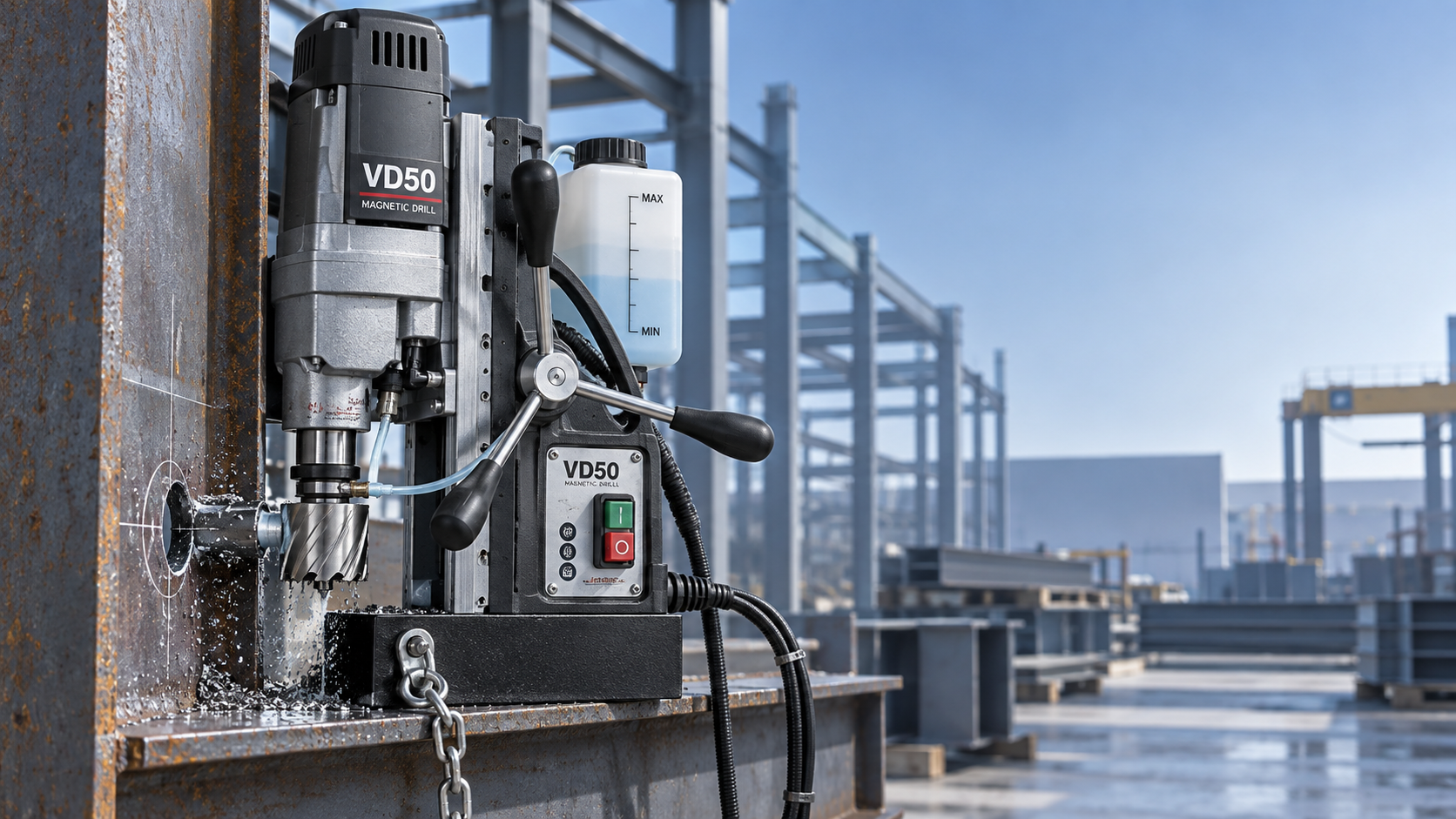
For a drill in the VD50 class, a strong magnetic base gives the operator a more stable platform while the annular cutter enters and exits the steel. The VD50Z is specified with a 13,000 N magnetic base force, a useful reference point for procurement teams assessing equipment intended for common structural steel and maintenance work.
Do not rely on the force number alone. Confirm the base footprint, the manufacturer’s guidance on minimum material thickness, and whether the drill includes a practical safety-chain attachment arrangement. For overhead or vertical work, a correctly fitted safety chain is not optional; it is a basic safeguard should power be interrupted or the magnetic contact be compromised.
Match motor output and speed to the holes you really buy cutters for
A frequent purchasing mistake is to select a drill around its maximum diameter and overlook how it will behave through a full day of ordinary holes. Cutter diameter, steel grade, cutting depth, coolant access, and feed technique all influence the load on the motor. A machine that is adequate for occasional large holes may still be frustrating if it lacks the torque and thermal resilience for repeated work.
The stated 1,500 W motor and 600 r/min no-load speed of the VD50Z place it within a practical range for annular cutting applications up to its 50 mm maximum hollow-hole diameter. That said, purchasers should verify the recommended cutter diameter and material range with the supplier, especially if the job involves hard structural grades, thick plate, or frequent use of larger cutters.
Speed should be viewed as part of a cutting system, not an isolated selling point. Excessive speed can shorten cutter life and generate unnecessary heat; insufficient speed can make production feel slow. Consistent feed control, appropriate cutting fluid, and compatible annular cutters usually have as much influence on hole quality as the machine rating itself.
Check travel before approving the purchase order
Travel distance is easy to overlook until an operator needs to drill through a thicker assembly, use a longer cutter, or position the machine around a protruding detail. The available feed travel must accommodate the cutter, pilot pin, workpiece thickness, and a comfortable approach to the surface.
For the Magnetic drill VD50 category, buyers should compare both standard stroke and adjustment options. The VD50Z lists a 120 mm travel distance and 220 mm adjustable travel. This can be relevant when drilling varying section depths or when the site team needs greater setup flexibility. Still, it is wise to check the practical clearance above the drill, because a compact steel frame may limit the usable travel even when the drill itself offers ample adjustment.
Also review the spindle and cutter mounting arrangement. Procurement should ensure that locally stocked annular cutters, pilot pins, and coolant accessories are compatible. A low initial machine price can quickly lose its appeal if replacement cutters are difficult to source or operators must use adapters that add runout and inconvenience.
Portability is more than the machine weight
Site teams value a magnetic drill that can move quickly from one connection point to another. But “portable” does not only mean light. It also means manageable handles, a sensible center of gravity, durable cable routing, and dimensions that fit into restricted work zones without sacrificing stability.
At a listed net weight of 11.5 kg and dimensions of 100 × 270 × 350 mm, the VD50Z is compact enough to merit consideration for mobile fabrication teams. Yet buyers should think about the complete carrying load: drill, case, cutters, coolant, chain, power lead, and personal protective equipment. If crews regularly climb ladders, work from lifts, or carry tools across large sites, storage and transport arrangements deserve attention during evaluation.
Safety checks that should not be left to the operator
Good operators make a difference, but procurement decisions should not assume perfect conditions or perfect habits. Review the machine’s operating controls, emergency-stop access, cable protection, and the separation between magnet activation and motor operation. Controls should be understandable when gloves are worn and when the tool is positioned at an awkward angle.
Electrical compatibility is another basic check. A machine rated for 220 V, 50/60 Hz may suit many site supplies, but purchasing teams should confirm local voltage requirements, plug configuration, generator quality, and extension-cable practices. Unstable power can affect both drilling performance and magnetic holding. Where generators are used, discuss the acceptable power supply conditions with the supplier before deployment.
Training needs should be built into the total purchase plan. Operators need clear procedures for cleaning the steel contact area, securing the safety chain, selecting cutter speed and coolant, clearing swarf safely, and never drilling on an inadequately supported workpiece. These simple disciplines protect both the tool and the people working around it.
Compare total cost, not just the purchase price
For buyers under cost pressure, the lowest quoted magnetic drill can be tempting. However, the relevant cost is the cost per productive hole over the tool’s working life. Include cutter consumption, downtime, spare-part availability, warranty terms, service response, and the practical cost of getting a failed unit back into operation.
Ask suppliers what wear parts are normally available, how technical issues are diagnosed, and whether they can provide application guidance for cutter selection. Shandong VEDON Intelligent Equipment combines equipment manufacturing with a focus on precision cutting tools and intelligent manufacturing solutions, which can be valuable when a buyer wants to discuss the drill and cutting consumables as one working process rather than unrelated purchases.
Request documentation that clearly states the included accessories and exclusions. A quotation should make it easy to see whether a safety chain, coolant system, carrying case, pilot pins, and cutter accessories are supplied, optional, or sourced separately. This prevents last-minute additions that distort the apparent cost comparison.
A practical approval checklist for site fabrication
- Confirm the required annular cutter diameter, material grade, and typical drilling depth.
- Check magnetic holding force alongside base contact area and minimum steel-thickness guidance.
- Review motor power, operating speed, and expected duty demands for repeated field drilling.
- Verify feed travel, adjustable stroke, overhead clearance, and cutter mounting compatibility.
- Assess complete transport weight, handling points, and fit within real jobsite access routes.
- Confirm voltage, frequency, plug, generator, and extension-cable compatibility.
- Include safety-chain use, operator training, cutter supply, warranty, and service support in the evaluation.
The right Magnetic drill VD50 should feel like a dependable field tool rather than a specification compromise. When the machine is matched to steel conditions, hole sizes, access limits, and support expectations, procurement teams can make a decision that protects productivity long after the initial purchase order has been closed.

Vedon
Typically replies within minutes
Any questions related to Home?

William / CEO / Brand Founder

Vinson / Sales Director

Elaine / Sales Manager

Jessica / Sales Manager