Manual or Powered Feed: A Practical Vertical Milling Machine Comparison
The feed system on a Vertical Milling Machine should be selected from the work pattern, not from the machine’s purchase price alone. Manual feed is often the better fit for low-volume repair work, prototypes, and one-off components where the operator must constantly react to changing features. Powered feed becomes the stronger choice when the shop repeatedly machines long faces, slots, shoulders, or similar parts and needs stable results across shifts.
For a procurement decision, the central question is simple: is the machine mainly supporting skilled, variable work, or repeatable production work? The answer affects more than cycle time. It influences surface consistency, operator fatigue, training needs, maintenance planning, and whether the equipment can support a more standardized manufacturing process later.
What changes when the feed is powered?
On a manual-feed mill, the operator turns the handwheel and controls table movement directly. This gives immediate tactile feedback. An experienced machinist can feel an interrupted cut, notice changing resistance, slow down near a shoulder, or make a careful approach to a finished edge. That control is valuable when each job is different.
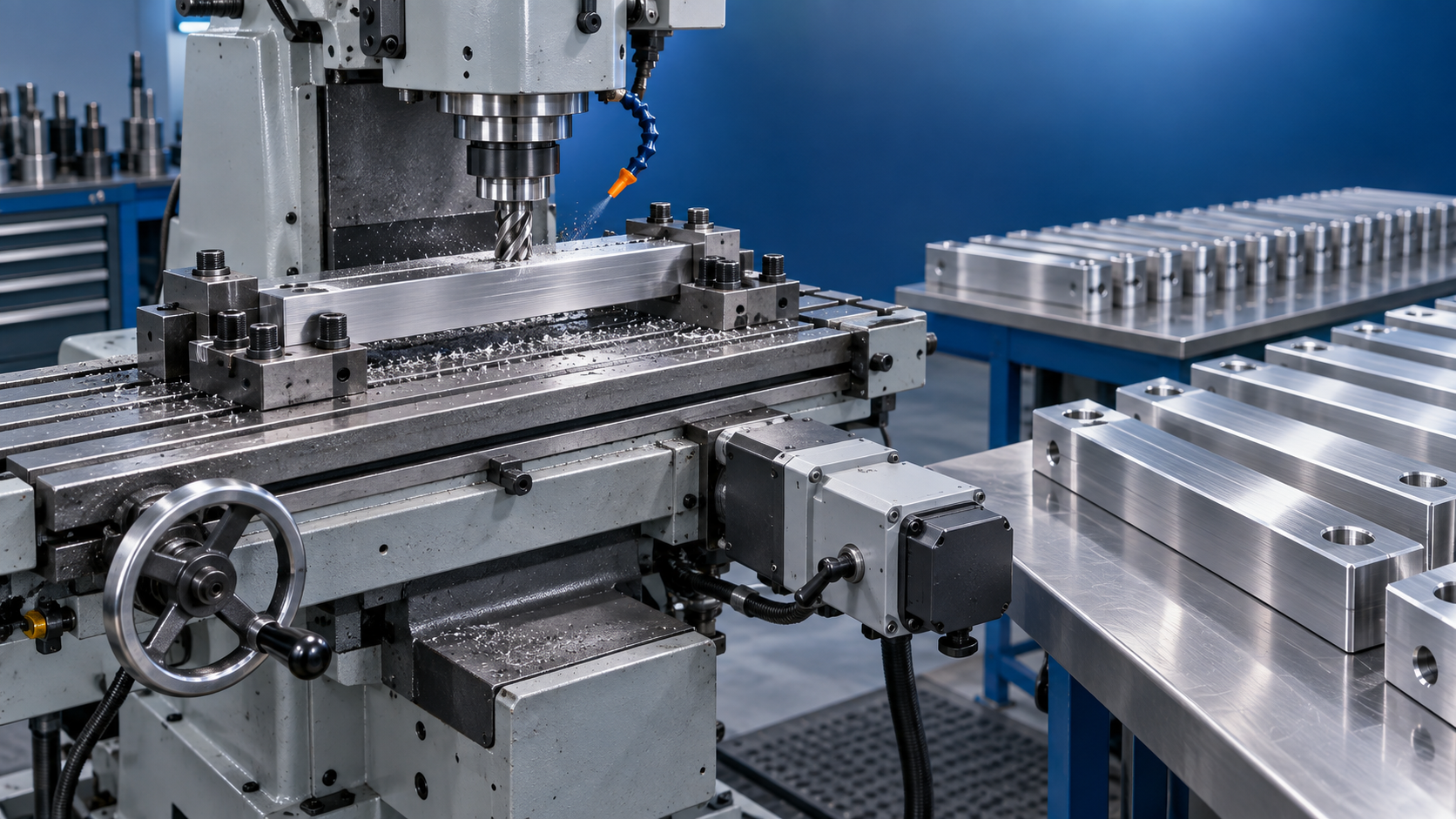
A powered-feed arrangement uses a drive unit to move an axis at a selected feed rate. In conventional vertical milling, this is commonly fitted to the table’s longitudinal movement, though other axes may also be powered depending on the configuration. The practical benefit is not merely that the table moves without hand-cranking. It is that the cutter receives a more consistent advance per unit of time.
Consistent feed is particularly helpful during longer finishing passes. If hand pressure changes during a cut, the feed rate changes too. That can show up as uneven surface appearance, variable cutting load, or inconsistent results from one operator to another. A powered feed does not correct poor workholding, dull tooling, or an unsuitable spindle speed, but it removes one major source of variation.
When manual feed is the more sensible purchase
Manual feed should not be treated as an entry-level compromise. It is often the more productive option where flexibility matters more than repeatability. Toolrooms, maintenance departments, vocational training environments, and small job shops commonly face parts with uncertain dimensions, mixed materials, awkward setups, and frequent stops for checking. In these situations, the operator may need to reverse direction, pause, pick up an edge, or make a very short controlled move several times within one job.
A manual table also keeps the machine simpler. There are fewer electrical or mechanical components associated with the feed system, and the operator can concentrate on setting up and cutting rather than configuring a feed drive. This can be appropriate when the expected workload does not justify the added capital cost or when the machine will spend much of its time drilling, indicating, boring, or performing short localized milling operations.
The limitation appears when manual movement becomes part of a repeated production cycle. Long passes are tiring, and feed consistency becomes difficult to hold over an entire shift. The issue is not whether a skilled machinist can produce a good part by hand. It is whether the process remains equally reliable when the part count rises, operators rotate, or deadlines compress.
Where powered feed earns its cost
Powered feed is usually justified by the nature of the cut, not by the size of the shop. It is a strong fit when work includes repeated face milling, long slotting operations, side milling, or finishing passes on multiple similar workpieces. A steady feed helps create a more repeatable machining process and reduces the physical effort required from the operator.
It also improves how labor is used. During an appropriate powered pass, the operator can watch coolant flow, chip evacuation, workholding stability, cutter behavior, and the approaching end of travel instead of continuously turning a handwheel. That does not make the operation unattended. It gives the operator more capacity to supervise the process.
There are boundaries. Powered feed is not automatically appropriate for every short cut or delicate approach. Operators still need to understand when to disengage it, how to avoid driving the table into a stop, and how the selected feed rate relates to cutter diameter, material, depth of cut, and tool condition. Buying a feed-equipped machine without planning for these operating practices can leave the capability underused.
Do not compare the feed system in isolation
The feed decision has to match the rest of the Vertical Milling Machine specification. A powered table is of limited value if the machine lacks the rigidity, spindle performance, travel, or workholding capacity needed for the intended cuts. Conversely, a rigid and capable mill may be over-specified if its normal workload consists of occasional repairs and short, hand-guided operations.
Before requesting quotations, prepare a small representative-part review. Include the material, largest and smallest workpiece, typical milling length, number of similar parts per batch, tolerance-sensitive features, tooling used, and expected yearly workload. Procurement teams should ask production personnel to identify which operations consume hand-cranking time rather than relying on a general statement that “the machine is busy.”
Also confirm the feed configuration itself. A quotation should make clear which axis is powered, the usable feed range, how direction is changed, whether rapid traverse is included, how travel limits are protected, and how the system is serviced. “Power feed” is not a complete specification by itself.
A useful rule for mixed work
Many buyers face a mixed workload: urgent repair jobs during part of the week and recurring production components during the rest. In that case, a mill that retains manual handwheel control while adding powered feed on the most-used axis is often the practical middle ground. The operator keeps the freedom to make short, sensitive movements by hand, then engages the drive for longer repeatable cuts.
This option is especially relevant when a business is moving gradually toward more standardized production but does not yet need full CNC control. Shandong VEDON Intelligent Equipment Co., Ltd. supplies CNC machine tools, precision cutting tools, and intelligent manufacturing solutions; that broader equipment perspective matters because the manual-versus-powered choice should fit a realistic process-development path, rather than being treated as a separate accessory decision.
Not every metalworking task belongs on a milling table. For drilling or tapping directly on large ferrous structures where moving the workpiece to a machine is inefficient, a magnetic drilling solution can be more appropriate. For example, the VD332 is designed for magnetic drilling, with a stated 32 mm maximum drilling diameter, 25 mm tapping capacity, 220 mm travel, and a 15000 N magnetic base. It addresses a different operation from milling, but it illustrates an important procurement principle: choose equipment around the actual access, clamping, and process constraints of the job.
Make the decision from the cost of variation
Choose manual feed when the work is irregular, short-cycle, and dependent on frequent operator adjustment. Choose powered feed when the same table movements recur often enough that a stable feed rate improves part consistency, reduces fatigue, and supports predictable throughput.
The common purchasing mistake is to view powered feed as a simple productivity upgrade or manual feed as the cheaper default. Neither is reliable. The better choice is the one that matches the operation where variation costs the most: operator time, finish quality, scrap risk, or delivery capacity. Define those costs using representative parts before comparing machine quotations, and the correct configuration usually becomes clear.

Vedon
Typically replies within minutes
Any questions related to Home?

William / CEO / Brand Founder

Elaine / Sales Manager

Jessica / Sales Manager