Safe Setup Practices for Overhead Drilling with a Magnetic Drill VD50
Safe Setup Practices for Overhead Drilling with a Magnetic Drill VD50
Overhead drilling is one of those operations where a small setup error can become a serious incident. The operator is working beneath the machine, metal chips fall toward the face and body, and the drill’s holding force is acting against gravity. For quality-control and safety managers, the question is not simply whether a hole can be made—it is whether the Magnetic drill VD50 can be mounted, powered, restrained, and operated in a way that keeps people safe while maintaining hole location and finish requirements.
A disciplined setup makes the difference. Before the cutter touches the workpiece, the magnetic base, steel surface, power supply, safety chain, cutting tool, work zone, and operator position should all be verified. This approach reduces the likelihood of drill release, poor hole quality, broken cutters, electrical faults, and dropped objects.
Why overhead drilling requires a different risk mindset
In a horizontal drilling position, a magnetic drill is generally supported by the workpiece and its own base. Overhead work reverses that relationship. Gravity continually pulls the machine away from the mounting surface, while drilling thrust, vibration, chip buildup, and cable drag may further challenge the magnetic attachment.
The magnet is essential, but it should never be treated as the only protective measure. A safe overhead setup uses layered controls: suitable base material, clean contact surfaces, an independent retention device, sound electrical protection, stable access equipment, and a clear procedure for stopping work when conditions change.
Quality teams have an additional concern. If the drill shifts even slightly, the hole may be out of position, oversized, angled, or damaged by cutter chatter. A failed setup is therefore both a safety event and a quality-control failure.
Start with the mounting surface—not the drill
Before bringing a Magnetic drill VD50 into position, inspect the workpiece where the magnetic base will sit. The surface must be ferromagnetic, sufficiently thick for reliable magnetic holding, and reasonably flat. Painted steel, rust scale, weld spatter, machining burrs, oil films, and loose debris can create a gap between the magnet and the steel. Even a thin gap can reduce effective holding performance.
Use a clean rag and, where appropriate, a non-damaging scraper or abrasive pad to prepare the contact area. The goal is not cosmetic cleaning; it is full, stable contact across the magnetic base. Inspect the underside of the drill base as well. Metal chips trapped below the magnet are especially hazardous because they can both weaken contact and allow the drill to rock under load.
Do not use a magnetic drill on material that is uncertain, thin, heavily curved, laminated, or structurally compromised unless the application has been assessed and an approved alternative mounting method is available. Stainless steel, aluminum, and other non-magnetic materials require specialized fixturing rather than reliance on the magnetic base.
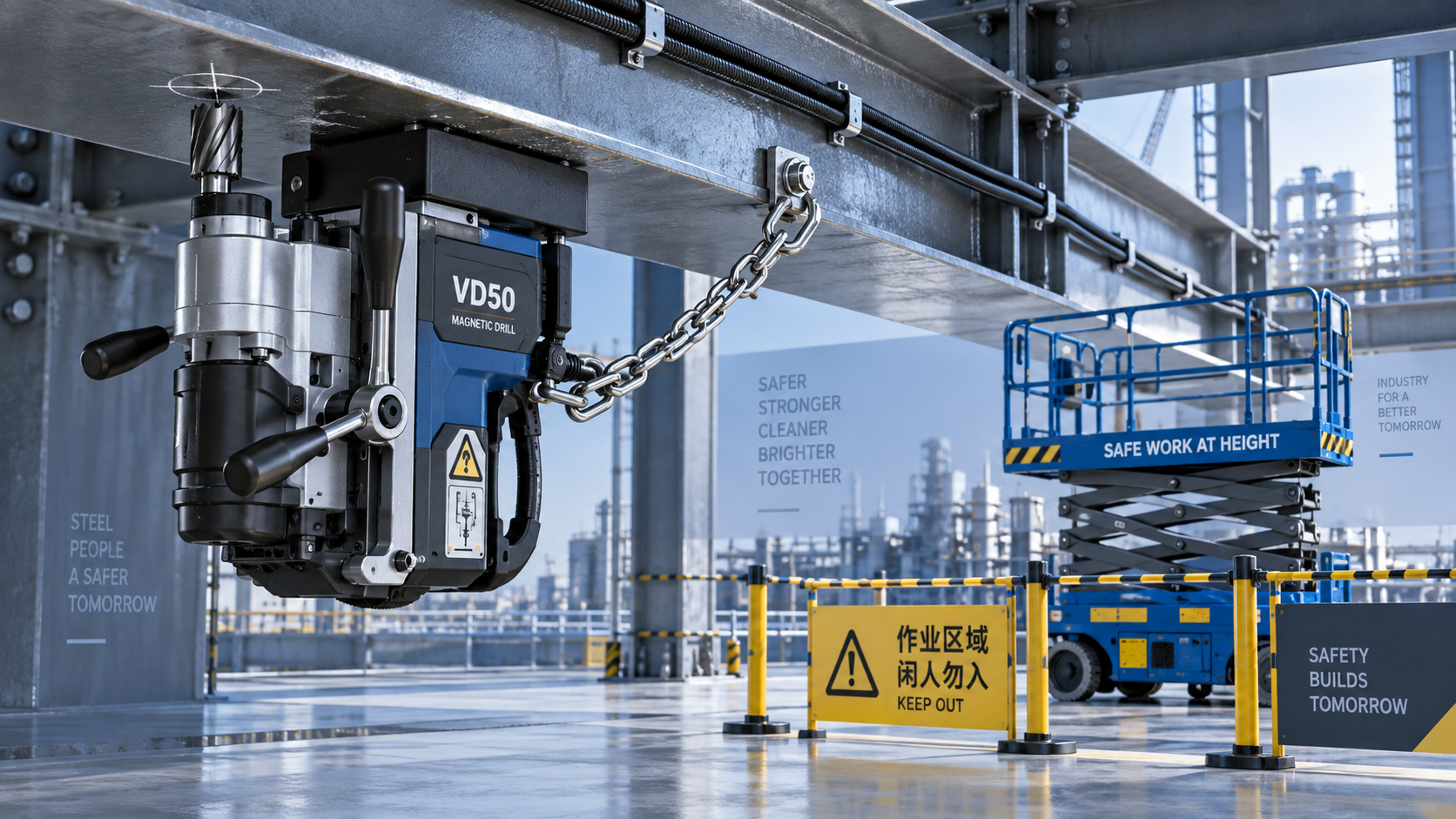
Verify retention before drilling begins
An independent safety chain, strap, or approved fall-arrest restraint is a core requirement for overhead magnetic drilling. It is not a substitute for magnet engagement; it is a secondary control should power fail, the base lose contact, or the workpiece surface prove unsuitable.
Attach the restraint to a structural point capable of supporting the drill’s weight and foreseeable dynamic loading. Keep the connection short enough to limit drop distance, but avoid routing it where it can interfere with feed handles, cables, or the cutter. A chain looped around a pipe, handrail, or temporary component may look convenient, yet convenience is not a load-rating decision.
Safety personnel should confirm that the restraint is fitted before the machine is raised into working position. A useful site practice is a simple “mount–magnet–restrain” callout: mount the drill on the prepared steel, energize and verify the magnet, then connect and check the independent restraint. The drilling motor should not be started until all three actions are complete.
Power checks matter as much as mechanical checks
Because magnetic holding depends on electrical power, the supply arrangement deserves close attention. Inspect the power cable for cuts, crushed insulation, exposed conductors, loose plugs, or improvised repairs. Keep cable routing clear of sharp edges, hot surfaces, moving equipment, and walkways. In overhead work, a hanging cable can also exert sideways pull on the drill, gradually disturbing alignment.
Use an appropriate protected electrical supply in accordance with site requirements. Where residual-current protection or ground-fault protection is specified, verify that it is present and functioning. Extension leads should be suitable for the environment and load; excessively long or undersized leads can contribute to voltage drop and unreliable performance.
Never assume that a running drill proves the setup is safe. The magnet must be engaged and holding before the motor is operated. If the equipment provides a magnet indicator or warning system, include it in the pre-use check. Any intermittent power condition, unusual sound, overheating, or unexpected movement is a reason to stop work immediately.
Control drill load to protect holding force and hole quality
Once the machine is mounted overhead, drilling technique becomes part of the safety system. Excessive feed pressure can cause cutter grabbing, vibration, or sudden torque reaction. Too little pressure can generate heat, work-harden the surface in some materials, and shorten cutter life. Operators should use steady, controlled feed rather than forcing the cutter through the material.
Select the correct annular cutter or twist drill for the hole diameter, material grade, and required finish. Confirm that the cutter is sharp, properly seated, and compatible with the arbor. A worn or chipped cutter increases thrust and vibration—the very forces that can challenge a magnetic base during overhead drilling.
Where cutting fluid is permitted, apply it carefully. Excess fluid must not be allowed to run onto the magnetic contact area, electrical components, or floor surfaces below. Chip evacuation also requires attention. Hot chips and slugs can fall without warning, so establish an exclusion zone beneath the work area and require suitable eye, face, head, and protective clothing.
Operator position and access equipment should be planned together
The safest drilling position is one in which the operator can control the feed without reaching, overextending, or standing directly below the cutter. Ladders are often a poor choice for sustained overhead drilling because they limit balance and make emergency withdrawal difficult. A properly selected platform, scaffold, or mobile elevated work platform may provide better footing, tool control, and space for a second person to observe the operation.
Workers should not place hands near the rotating cutter, attempt to catch a falling slug, or remove chips while the motor is running. Long hair, loose sleeves, gloves not suited to rotating machinery, jewelry, and unsecured tools all introduce avoidable hazards. Establish a clear stop signal, particularly when drilling is performed near lifting operations, vehicle movement, or shared access routes.
A practical pre-drill inspection for safety and quality teams
Rather than treating inspection as paperwork, use it to confirm the physical conditions that determine whether the operation is acceptable:
- Workpiece material is magnetic, sound, and suitable for the intended drill position.
- Magnetic base and mounting surface are clean, flat, and free from chips, paint, and oil.
- Hole position has been marked and checked against the drawing or fabrication reference.
- Correct cutter, pilot pin, arbor, and feed arrangement are installed and secure.
- Magnet engagement is verified before motor start.
- Independent safety chain or restraint is attached to an approved structural anchor.
- Power cable, plug, extension lead, and protective device have passed visual inspection.
- Personnel below the work have been excluded from the falling-chip and falling-slug zone.
- Access platform is stable, and the operator can maintain a balanced working posture.
When a fixed machine is the better control
Portable magnetic drilling is valuable when the workpiece is large, installed, or inaccessible to a conventional machine. Yet not every hole should be drilled overhead in the field. If the component can be safely removed or repositioned, a fixed machine may deliver stronger control over location, clamping, feed, and inspection.
For example, a versatile milling machine such as the X6436 can support drilling, boring, and milling work on components that can be brought to a controlled workstation. Its table capacity, multi-axis travel, and adjustable head arrangement may be relevant where repeatability and fixturing are more important than field portability. The choice should follow a risk assessment: use mobile equipment when the work demands it, and move the work to a fixed setup when that option reduces exposure.
Common mistakes worth challenging during audits
Several habits deserve immediate correction: drilling over paint without cleaning the contact area; relying on the magnet without a safety chain; using a damaged extension lead; applying excessive feed force; and allowing personnel to stand beneath the operation. Another common mistake is continuing after the drill begins to vibrate or creep. Movement is a warning, not a condition to “work through.” Stop, isolate power, support the drill if necessary, and reassess the mounting surface, cutter condition, and feed method.
Documenting these observations can improve future job planning. Repeated issues may reveal that workers need clearer work instructions, better access equipment, more suitable cutters, or a different drilling method altogether.
Safe overhead drilling is a controlled process
The Magnetic drill VD50 can be a practical tool for overhead steelwork, maintenance, fabrication, and installation tasks, but safe performance depends on the setup surrounding it. Clean magnetic contact, reliable power, independent fall prevention, controlled drilling force, and thoughtful work-area management create the conditions for both safer people and more consistent holes.
For safety managers and QC inspectors, the strongest intervention is often made before drilling starts: pause the job, inspect the setup, and require correction before risk becomes movement, damage, or injury.

Vedon
Typically replies within minutes
Any questions related to Home?

William / CEO / Brand Founder

Vinson / Sales Director

Elaine / Sales Manager

Jessica / Sales Manager