Universal Milling Machine vs Vertical Mill: Which Fits Low-Volume Parts?
For low-volume parts, a vertical mill is usually the stronger choice when work consists mainly of prismatic components, face milling, pockets, drilled patterns, and repeatable features reached from the top surface. A Universal milling machine earns its place when the part mix includes angular faces, shafts, helical features, long workpieces, or compound setups that would otherwise require repeated reclamping. The correct choice follows the geometry and setup path of the actual parts, not the broad label of “small-batch production.”
Low volume changes the cost equation. Cycle time still matters, but setup time, fixture preparation, proving out a first piece, tool changes, and the chance of rework often consume a larger share of total labor. A machine that removes one setup can be more valuable than a machine with a slightly faster cutting cycle. Conversely, paying for broad machine versatility creates little return when most parts only need straightforward vertical operations.
Where the Two Machine Types Separate
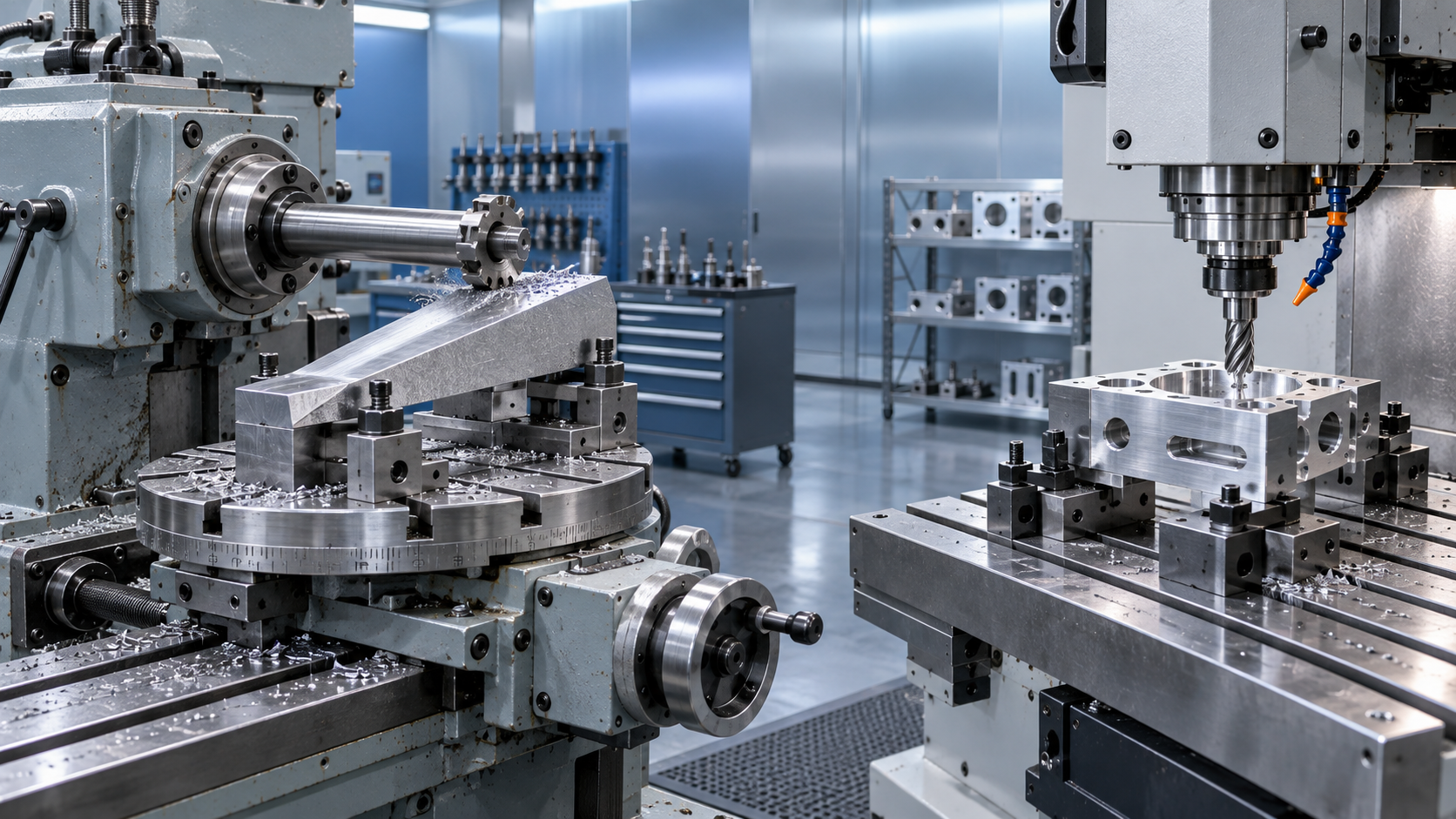
A vertical mill places the spindle above the worktable. This arrangement gives direct access to the top of a workpiece and makes it easy to see the cutter, fixture, and reference edges. It is well suited to facing, end milling, slotting, drilling, counterboring, tapping, and pocket machining. On a CNC vertical mill, common low-volume work can move efficiently from a drawing to a one-off fixture or vise setup.
A Universal milling machine is built around a more adaptable table and spindle arrangement, commonly combining horizontal milling capability with a swiveling table or angular work positioning. Its value is not simply that it has more motions. It changes the way an awkward part can be approached. A long keyway, an angled guide surface, a helical groove, or work requiring side-and-periphery cutting may be held more naturally than on a vertical machine.
Count Setups Before Comparing Spindle Specifications
A common mistake is to compare only motor power, spindle speed range, or table travel. Those values matter, but they do not explain whether the part can be machined in one clamping. Start by marking every machined surface on a representative drawing. Then identify the datum surfaces, cutter approach direction, required angular relationships, and points where the part must be turned.
If most features are on one face and tolerance references return to that face, a vertical mill often keeps the process simple. The work can be located against fixed vise jaws or a basic plate fixture, faced, drilled, and milled without disturbing its datum. That simplicity reduces the possibility of locating variation between operations.
When a component needs a side slot aligned to an angled surface, or when a feature runs along the length of a bar, the Universal milling machine can avoid a second fixture or an improvised angle plate setup. The savings are especially meaningful where each job has a different drawing and fixtures are not reused often. However, a swiveling table does not automatically solve every multi-axis problem. If contours require simultaneous multi-axis interpolation, a purpose-built CNC machining center or rotary-axis configuration should be assessed separately.
Accuracy Comes From the Process Chain
Neither machine type is inherently “more accurate” without defining the feature, material, cutting load, and setup. A rigid vertical mill with short tool projection can hold a flatness or pocket location requirement well when the part remains clamped. A Universal machine can preserve relationships between surfaces that would otherwise be established in separate orientations. In that situation, maintaining a single reference chain may matter more than the nominal positioning resolution shown in a brochure.
Tool overhang is frequently overlooked. Deep pockets and tall workpieces force a long end mill below the vertical spindle nose, increasing deflection and the risk of chatter. Horizontal arbor support on a Universal machine may offer a stiffer approach for certain side-milling operations. Yet the horizontal arrangement also demands sound arbor selection, cutter spacing, and support alignment. Poor support adjustment can introduce runout or leave the cutter prone to vibration.
Material affects this decision. Aluminum brackets with open pockets generally favor vertical machining because chip evacuation is manageable and tool access is direct. Steel components with long side faces may favor horizontal or Universal arrangements when peripheral milling uses a rigid cutter setup. Tough materials can expose weakness in either option: insufficient spindle torque at the selected speed, a flexible workholding method, or a machine foundation that does not resist intermittent cutting loads.
Speed Is Often Misread in Low-Volume Work
A vertical mill may complete an individual operation quickly, but a part with four orientations can still consume significant non-cutting time. Each turn involves deburring contact surfaces, indicating the new position, resetting work offsets, and confirming that clamps clear the toolpath. A Universal milling machine may shorten this sequence for parts that can be reoriented by the table rather than removed and remounted.
The reverse is also true. A Universal machine can be slower for a simple plate that needs only drilled holes, a circular pocket, and a perimeter profile. Bringing universal capability into that job can add alignment work with no corresponding reduction in operations. Low-volume work rewards direct setups, not maximum machine capability on paper.
Manual versus CNC control also changes the balance. On manual equipment, visibility, handwheel access, and ease of indicating often make the vertical configuration attractive for general repair parts and simple fabrication pieces. CNC vertical mills are particularly effective when programs are reused, tool offsets are managed consistently, and several similar components are made over time. A Universal machine is valuable where its mechanical flexibility removes otherwise difficult positioning tasks, but complex manual setups remain dependent on disciplined alignment and experienced machine handling.
Specify the Machine Around the Real Work Envelope
Table travel should be considered together with fixture size, clamp location, and cutter clearance. A part may fit physically on the table yet leave too little travel to reach its end features after a vise, rotary attachment, or support block is installed. Vertical clearance should include the workpiece, fixture, toolholder, cutter length, and a safe distance for tool changes. For horizontal operations, confirm arbor length, overarm support travel, and clearance around the workpiece at the required table angle.
Ask for spindle taper, available toolholders, clamping compatibility, coolant arrangement, and electrical requirements in the same review. An otherwise suitable machine becomes inefficient when the required collets, arbors, vises, or angle fixtures are not readily available. For low-volume jobs, common tooling matters because changing from one part family to another should not require a long search for a special holder.
Secondary holemaking should be separated from milling capacity. Large welded frames, installed structures, and plate assemblies may need portable magnetic drilling rather than relocation to a mill table. A compact magnetic drill such as VD23 is designed for this type of accessible ferrous surface work, with a 23 mm maximum drilling diameter and 225 mm travel. It does not replace a mill when hole position is controlled from multiple machined datums, but it can prevent a milling machine from being tied up for field-style drilling tasks.
Operating Cost Includes Changeover Friction
Machine purchase price is only one line in the decision. Estimate the recurring effort for setup, inspection, fixture adjustment, tool preparation, and cleanup across the expected part mix. A Universal milling machine may require more attention to accessories and alignment, while a vertical mill may require more fixtures when part orientation changes. The lower-cost option is the one that creates fewer avoidable hours and fewer opportunities to lose a datum.
Installation deserves similar attention. Verify floor loading, access for delivery, machine leveling, power supply, and space for handling stock. Long material processed horizontally needs room beyond the table travel. A vertical machine may require overhead access for heavy workpieces or tooling. Poor access does not merely slow loading; it encourages unsafe clamping shortcuts and makes repeatable setup harder.
For a low-volume mix dominated by plates, blocks, covers, brackets, and compact housings, select a vertical mill with adequate travel, a rigid spindle, practical tooling, and a workholding package matched to the part sizes. Select a Universal milling machine when varied work regularly introduces side cutting, angular relationships, long stock, or features that would otherwise force several re-clampings. The part drawing and its datum path should settle the decision long before the comparison reaches the purchase-price column.

Vedon
Typically replies within minutes
Any questions related to Home?

William / CEO / Brand Founder

Elaine / Sales Manager

Jessica / Sales Manager