VMC650 Quotation Comparison: Costs Beyond the Machine Purchase Price
A VMC650 quotation can look competitive while leaving out costs that will appear before the machine produces its first qualified part. The purchase price is only one line in the investment. A meaningful comparison must account for the machine’s actual configuration, shipping terms, site preparation, commissioning scope, tooling package, software, operator readiness, warranty boundaries, and the supplier’s ability to support the machine after delivery.
The central procurement question is not “Which VMC650 is cheapest?” but “Which quotation delivers the required machining capacity at the lowest controllable lifetime cost?” Two offers with a similar table size and travel range can differ substantially in spindle specification, control system, ball screw and guideway design, chip management, probing capability, electrical compliance, and service commitments. Those differences affect throughput, scrap exposure, downtime, and future upgrade costs.
Start by defining what the quoted VMC650 actually includes
“VMC650” generally indicates a vertical machining center in a common travel-class range, but it is not a complete technical specification. The designation alone does not establish spindle speed, spindle taper, motor power, tool magazine capacity, table load, positioning accuracy, repeatability, controller brand, or coolant arrangement. Comparing only the headline model and total price can therefore produce a false equivalence.
A quotation should identify the machine configuration in sufficient detail to make each offer technically comparable. At minimum, confirm:
- Axis travels, table dimensions, maximum table load, and clearance envelope;
- Spindle taper, speed range, continuous and peak power, and torque characteristics;
- Guideway type and size, ball screw arrangement, and lubrication system;
- Tool magazine type, tool count, maximum tool dimensions, and tool-change times;
- CNC control model, included software functions, language options, and interface availability;
- Coolant system, chip conveyor, enclosure arrangement, air supply requirements, and electrical cabinet specification;
- Accuracy and repeatability values, together with the stated inspection method and acceptance conditions.
A supplier may quote a base machine with a standard coolant pump and limited chip handling, while another includes a through-spindle coolant system, auger, oil skimmer, work light, and automatic lubrication. The first quote may be lower, but the required operating package may cost more once the omitted items are added. This is especially relevant for deep-hole drilling, production of aluminum parts with high chip volume, or unmanned cycles where chip evacuation directly affects process reliability.
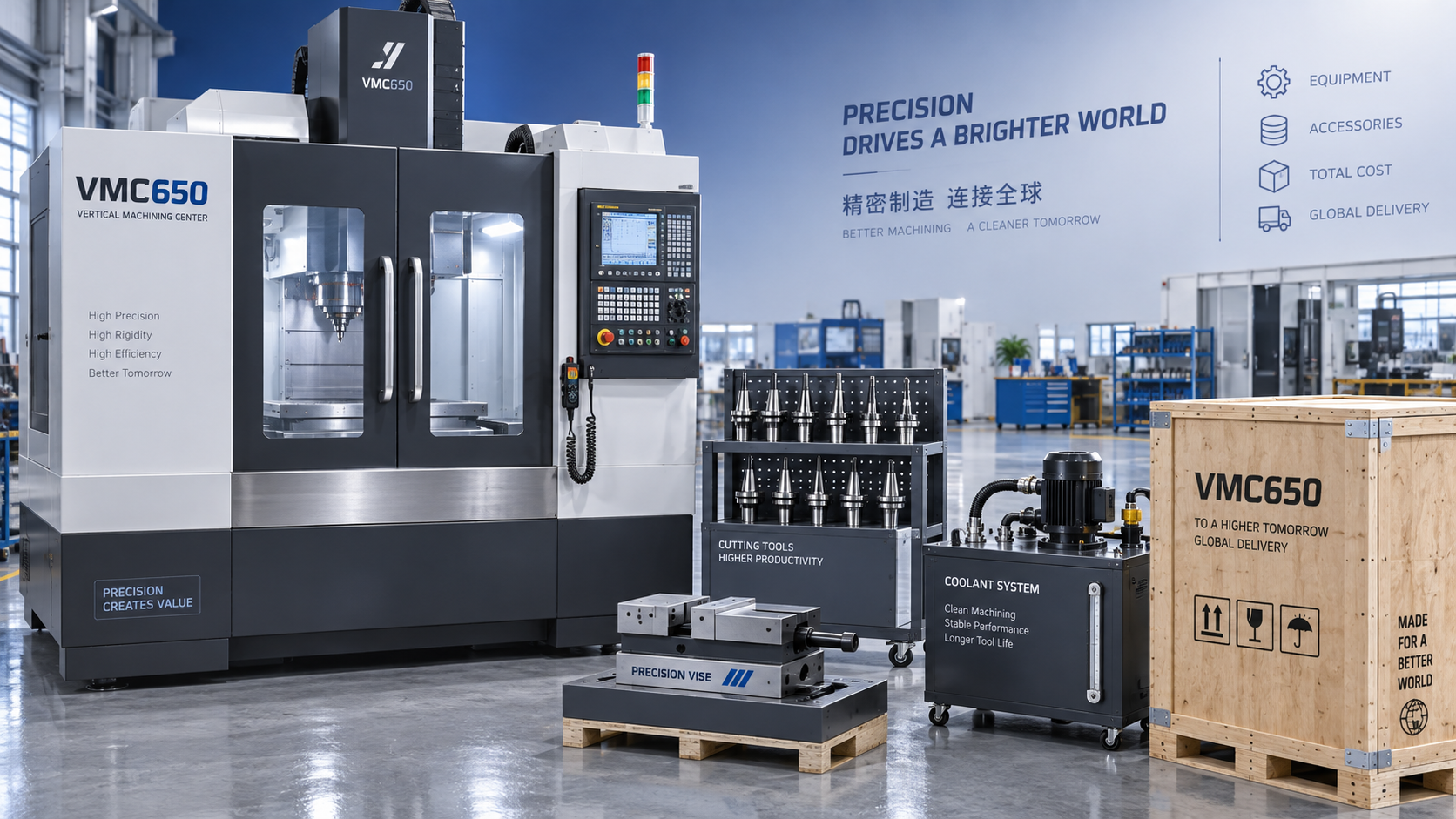
Freight is not just the ocean or road charge
International freight is often treated as a separate logistics matter, but machine dimensions, gross weight, packaging, and the agreed Incoterm can materially change the landed cost. A VMC650 commonly requires special handling because of its mass, center of gravity, and need for secure export packing. A low ex-works quotation does not reveal the full transport obligation transferred to the buyer.
Cost comparison should distinguish between factory collection, export customs clearance, inland transport, port handling, sea or rail freight, cargo insurance, destination charges, customs duties, import taxes, and delivery to the installation site. Local unloading is frequently underestimated. The machine may need a crane, forklift capacity beyond ordinary warehouse equipment, lifting plans, and a clear route from the unloading point to the foundation.
Packaging deserves attention as well. Confirm whether the price includes seaworthy packing, moisture protection, rust prevention for exposed metal surfaces, and separate packing for accessories. Damage claims become harder to resolve when the quotation and shipping documents do not clearly define packing responsibility and insurance coverage.
Installation costs begin before the machine arrives
A machining center needs more than floor space. The site must be checked for foundation strength, levelness, access clearance, power supply, grounding, compressed air, coolant handling, and chip disposal. If the machine is being placed in an existing production area, the disruption caused by moving equipment, modifying electrical lines, or changing workflow can have a real internal cost even when it does not appear on the supplier invoice.
Electrical compatibility is a common source of avoidable expense. Voltage, frequency, phase arrangement, protective devices, transformer requirements, and local electrical rules should be confirmed before order placement. A machine built for one power standard may require a transformer or electrical modification in another market. The same applies to documentation requirements: electrical diagrams, operation manuals, spare-parts lists, and declarations should be available in a usable form for the destination market and the buyer’s internal maintenance team.
The quotation should state whether installation includes mechanical leveling, initial alignment checks, machine startup, parameter verification, and test cutting. “Commissioning included” can mean anything from remote guidance to a multi-day on-site engineer visit. Clarify travel expenses, accommodation, interpreter needs, work-hour limits, and charges for delays caused by an unprepared site.
Tooling and workholding can exceed expectations
A VMC650 is not production-ready merely because the spindle turns and the axes move. Toolholders, pull studs, cutting tools, vises, clamps, fixture plates, zero-point systems, probing equipment, and measuring instruments may be outside the machine price. Their cost depends on the part family, material, tolerances, batch size, and cycle-time target.
For occasional job-shop work, a basic vise and a limited holder set may be sufficient. For repetitive production, the requirement can shift toward dedicated fixtures, multiple vises, hydraulic or pneumatic clamping, tool presetting, and in-process inspection. These additions affect not only capital expenditure but also setup time and operator dependency.
It is useful to separate “included accessories” from “necessary production equipment.” A bundled starter toolholder set may have value for initial acceptance testing, yet it may not match the preferred tool interface, gauge length discipline, balance grade, or tool inventory needed for regular work. Procurement should request an accessory list with quantities, brands where applicable, and technical descriptions rather than accepting broad wording such as “standard tools included.”
Training and process transfer should be priced realistically
The economic value of a VMC650 depends on the ability to program, set up, maintain, and troubleshoot it. Basic machine operation training does not necessarily cover CAM post-processor adjustment, fixture strategy, tool-offset management, alarm diagnosis, or process optimization. If the production plan depends on complex contours, multi-face workholding, tight positional tolerances, or unattended running, the training scope should reflect that reality.
Training can be delivered at the supplier’s factory, at the buyer’s site, remotely, or through a local agent. Each model has different cost and risk implications. Factory acceptance training can help the buyer verify the machine before shipment, while on-site training addresses actual material flow, fixtures, power conditions, and local operators. The quotation should identify the number of training days, trainees covered, course content, language, and whether travel expenses are included.
Where a facility is sourcing more than one type of CNC equipment, comparisons must remain application-specific. A turning center such as the TCK600DY, with a 45-degree slant bed, 12-station turret, and optional 1100 mm or 1600 mm Z-axis travel, has a different cost structure from a VMC650. Its tooling, workholding, installation footprint, programming approach, and process capability should not be used as a direct price benchmark for a vertical machining center. Combining dissimilar machine categories in a budget can conceal the real cost of each process route.
Warranty language matters more than warranty length alone
A longer warranty statement has limited value if exclusions are broad or service response is unclear. Buyers should check what is covered: machine structure, spindle, servo motors, drives, CNC control, electrical components, hydraulic or pneumatic items, and labor. Wear parts, damage caused by poor power quality, misuse, improper lubrication, and consumables are commonly treated differently from manufacturing defects.
Spindle support deserves particular attention because spindle replacement can involve both component cost and production interruption. Ask whether the supplier has diagnostic procedures, remote service capability, local engineers, stocked parts, and a defined route for urgent technical escalation. A supplier’s ability to provide drawings, parameters, alarm guidance, and replacement parts can be more valuable than a nominal discount at the time of purchase.
Spare-parts planning should be proportionate to the production risk. There is no need to buy every possible component in advance, but critical consumables and failure-sensitive items should be identified. Filters, lubrication consumables, belts, seals, sensors, and selected electrical components may be worth including in the initial package when import lead times are long. Obtain a recommended spare-parts list and verify part numbering, lead time, and availability commitment.
Energy and consumables are operating costs, not minor details
Electricity consumption depends on spindle load, axis motion, idle time, coolant pumps, chip conveyors, hydraulic systems, and auxiliary equipment. Rather than relying on a single nameplate power figure, estimate the likely operating pattern: hours per shift, typical spindle load, coolant use, compressed-air demand, and expected idle periods. This creates a more useful operating-cost forecast than treating rated motor power as actual consumption.
Coolant, cutting oil, filtration, way lubrication, compressed air, and chip disposal also influence recurring cost. Poor coolant management can shorten tool life, affect surface finish, create odor and hygiene issues, and increase cleaning downtime. For operations machining cast iron, aluminum, or materials that generate difficult chips, confirm that the selected filtration and chip-handling arrangement is suitable for the expected volume.
Build a comparable landed-cost and ownership-cost sheet
The most reliable method is to normalize every offer into the same commercial and technical basis. List the base machine, selected options, tooling, packing, freight, insurance, customs-related charges, unloading, site preparation, installation, training, warranty extensions, initial spares, and estimated operating consumables. Mark each item as included, excluded, provisional, or not applicable.
Then evaluate the remaining differences against the intended workload. A lower-cost VMC650 may be the rational choice for light-duty, intermittent work with simple fixtures. It becomes less attractive when the application requires higher metal-removal capability, stable tolerance over extended cycles, fast tool changes, reliable chip evacuation, or rapid recovery from service issues. Conversely, paying for advanced options that the part mix will never use increases capital cost without improving the return on the machine.
The strongest quotation is not necessarily the lowest initial number or the one with the longest option list. It is the offer with a clearly defined configuration, transparent landed-cost assumptions, realistic startup requirements, and support terms that match the production consequences of downtime. That level of comparison turns a VMC650 purchase from a price exercise into a controlled equipment investment.

Vedon
Typically replies within minutes
Any questions related to Home?

William / CEO / Brand Founder

Jaye / Sales Director