Where Universal Milling Machines Add Value in Repair and Tooling Shops
In a repair or tooling shop, the day rarely unfolds according to plan. A worn gearbox housing arrives unexpectedly, a production line needs a replacement bracket before the next shift, or a fixture must be modified after an engineering change. For project leaders, the challenge is not simply finding spindle time. It is keeping response time, accuracy, cost, and risk under control when the work itself keeps changing.
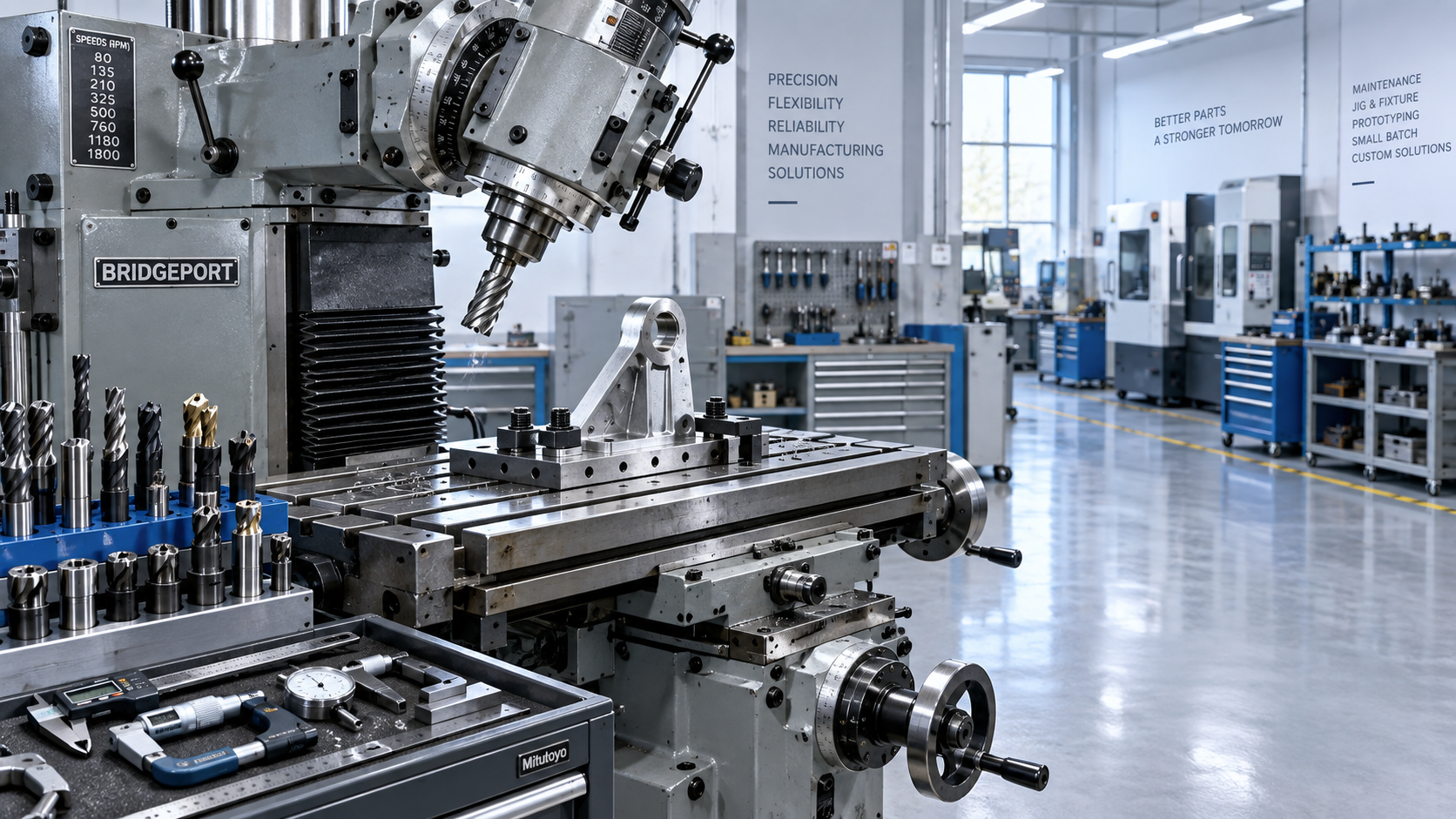
A universal milling machine earns its place in this environment because it can move from one-off restoration work to fixture machining, prototype adjustments, and low-volume component production without the lengthy setup logic associated with highly specialized equipment. Its value is not based on doing every job faster than every other machine. It comes from making a broad range of urgent, varied work practical to complete in-house.
Why repair and tooling work rewards flexibility
Production machining is often built around repeatability: stable drawings, known materials, planned tooling, and predictable quantities. Repair work is different. The part may be damaged, undocumented, warped, or only available during a short shutdown window. Tooling work brings another kind of variation, where fixture plates, locator blocks, soft jaws, gauge components, and mold-support parts often require changes after the first inspection.
In these circumstances, waiting for a dedicated process, external programming support, or a subcontractor quotation can be more expensive than the machining itself. A universal milling machine gives skilled machinists a direct way to face, slot, drill, bore, angle-machine, and profile components from multiple orientations. The machine’s adaptable table and head arrangements are particularly useful when the workpiece does not fit a simple “horizontal” or “vertical” machining assumption.
For a project manager, this means fewer work orders stalled by minor—but critical—machining tasks. It also creates a more reliable fallback capacity when a production asset needs attention immediately.
Where a universal milling machine adds the most practical value
Restoring damaged machine components
Repair shops frequently receive shafts, covers, brackets, base plates, bearing housings, and legacy parts with worn mounting faces or damaged holes. The goal is often restoration rather than full replacement: remove the damaged material, build up or sleeve an area where necessary, re-machine reference surfaces, and restore the original functional relationship between features.
A universal mill is well suited to this work because the operator can establish datums from the surviving geometry and approach difficult faces at controlled angles. A damaged keyway, elongated slot, distorted mounting face, or nonstandard drilling pattern may not justify a complex production setup, but it can still be repaired accurately with sound workholding and careful measurement.
Making fixtures when the design is still evolving
Tooling shops live with revisions. A locating pin may need to move by a fraction, a clamp clearance may prove insufficient, or an assembly team may request a faster loading sequence after trying the first fixture. The ability to bring a plate back to the machine, re-indicate it, and make a controlled modification is valuable far beyond the original machining time.
Universal milling machines are commonly used for fixture plates, angle blocks, clamping elements, inspection nests, drill jigs, and assembly aids. Their versatility helps teams avoid overcommitting to a dedicated process before the tooling concept has matured. This is especially important in pilot production, maintenance engineering, and product introduction projects, where a “finished” drawing may still need practical refinement on the shop floor.
Handling prototypes and replacement parts without unnecessary delay
When a component is needed in quantities of one to ten, setup efficiency means something different from cycle-time efficiency. The real question is: how quickly can the team turn an approved concept into a usable part with enough confidence to install or test it?
A universal mill supports that kind of response. It can machine flats, pockets, shoulders, drilled patterns, and angled details on a replacement part without requiring the shop to dedicate a larger automated cell to a short-run task. For project leaders managing shutdowns or development deadlines, this can reduce dependence on outside suppliers whose lead times may not match the urgency of the job.
Not every task should stay on a manual universal mill
Versatility should not be confused with a reason to machine everything the same way. A universal milling machine is a strong choice when parts are irregular, quantities are low, dimensions need to be developed during setup, or the job requires frequent operator judgment. However, repeat batches, complex three-dimensional profiles, tight positional relationships across multiple faces, and high documentation requirements may be better served by CNC equipment.
The most capable repair and tooling shops do not treat manual and CNC machines as competing assets. They assign work according to risk and value. A universal mill may be used to rapidly create a repair fixture, prepare a blank, machine an angled feature, or prove out a concept. A CNC vertical machining center can then take over where repeatability, programmed geometry, and unattended consistency matter more.
For example, the VMC1160 provides a 1100 mm × 600 mm × 600 mm travel envelope and a 1200 mm × 600 mm table with up to 800 kg loading capacity. For larger fixture plates, multi-feature repair components, or small batches that have moved beyond manual processing, its stated positioning accuracy of ±0.003 mm and repeatability of ±0.004 mm offer a useful CNC complement to the flexibility of a universal machine. Its 24-tool magazine also helps when a job includes several drilling, milling, boring, and finishing stages.
The hidden benefit: better control of project risk
Many equipment decisions focus only on machining capacity. Project leaders should also consider what happens when capacity is unavailable. A delayed repair can extend downtime. A fixture sent out for a small modification can interrupt a validation plan. A replacement part with an unclear drawing can move through several email cycles before anyone starts cutting metal.
Keeping broad milling capability in-house shortens the path between problem identification and corrective action. It allows engineers, maintenance personnel, and machinists to examine the part together, discuss datums and function, and make decisions based on the physical component rather than photographs alone. This close feedback loop is often what prevents a small issue from becoming a delayed project milestone.
There is also a quality advantage when the shop can inspect and adjust during the process. Rather than assuming that an old part matches a nominal drawing, the team can measure actual mating features, account for wear or prior repairs, and machine to the condition that will make the assembly work.
What to evaluate before assigning work to the machine
A universal milling machine delivers its best results when the job is selected thoughtfully. Before committing work, a project manager should ask a few practical questions:
- Can the part be held safely and repeatably? Irregular repair components may require custom clamps, angle plates, parallels, or soft supports. Workholding time should be included in the schedule.
- Which surfaces are reliable datums? On worn or repaired parts, the original datum may no longer be usable. Functional interfaces often provide a better reference than cosmetic surfaces.
- Is the geometry suited to manual control? Straight slots, planar faces, holes, and angled features are generally appropriate. Complex freeform surfaces or densely coordinated features may justify CNC processing.
- What tolerance actually matters? A repair does not always need drawing-level precision everywhere. Identify the dimensions that control fit, alignment, sealing, or motion, then focus inspection effort there.
- Will this become a recurring job? A one-time repair may belong on the universal mill. If the same part returns regularly, a CNC program, dedicated fixture, or redesigned replacement part may offer a better long-term answer.
Accuracy depends on process discipline, not machine type alone
It is easy to assume that flexible machinery automatically means compromised precision. In reality, repair and tooling accuracy is strongly shaped by setup discipline. Clean contact surfaces, correct vise or fixture alignment, tool condition, backlash awareness, probing or indicating practices, and in-process checks all influence the final result.
For critical work, establish a simple inspection plan before machining starts. Record the reference dimensions, verify the first machined feature before proceeding, and inspect mating relationships rather than isolated measurements alone. This is particularly important when repairing legacy equipment, where the real assembly condition may differ from the original documentation.
Shandong VEDON Intelligent Equipment combines CNC machine tools, intelligent manufacturing solutions, and precision cutting tools around the practical needs of modern workshops. For repair and tooling teams, the right equipment mix is less about choosing a single “best” machine and more about creating a dependable route from urgent problem to verified part.
A useful asset when schedules cannot wait
A universal milling machine adds value wherever adaptability matters more than repetition: restoring worn components, making or revising fixtures, supporting prototypes, and producing short-run parts that cannot wait for a long supply chain. Its contribution is measured in more than chips removed. It helps protect schedules, preserve maintenance autonomy, and give technical teams a practical way to respond when the next unexpected job arrives.
For project leaders, the decision is straightforward: use universal milling capability for the variable, hands-on work that benefits from immediate judgment, then bring in CNC capacity when accuracy demands, geometry, or repeat volume make programmed control the smarter route.

Vedon
Typically replies within minutes
Any questions related to Home?

William / CEO / Brand Founder

Elaine / Sales Manager

Jessica / Sales Manager